

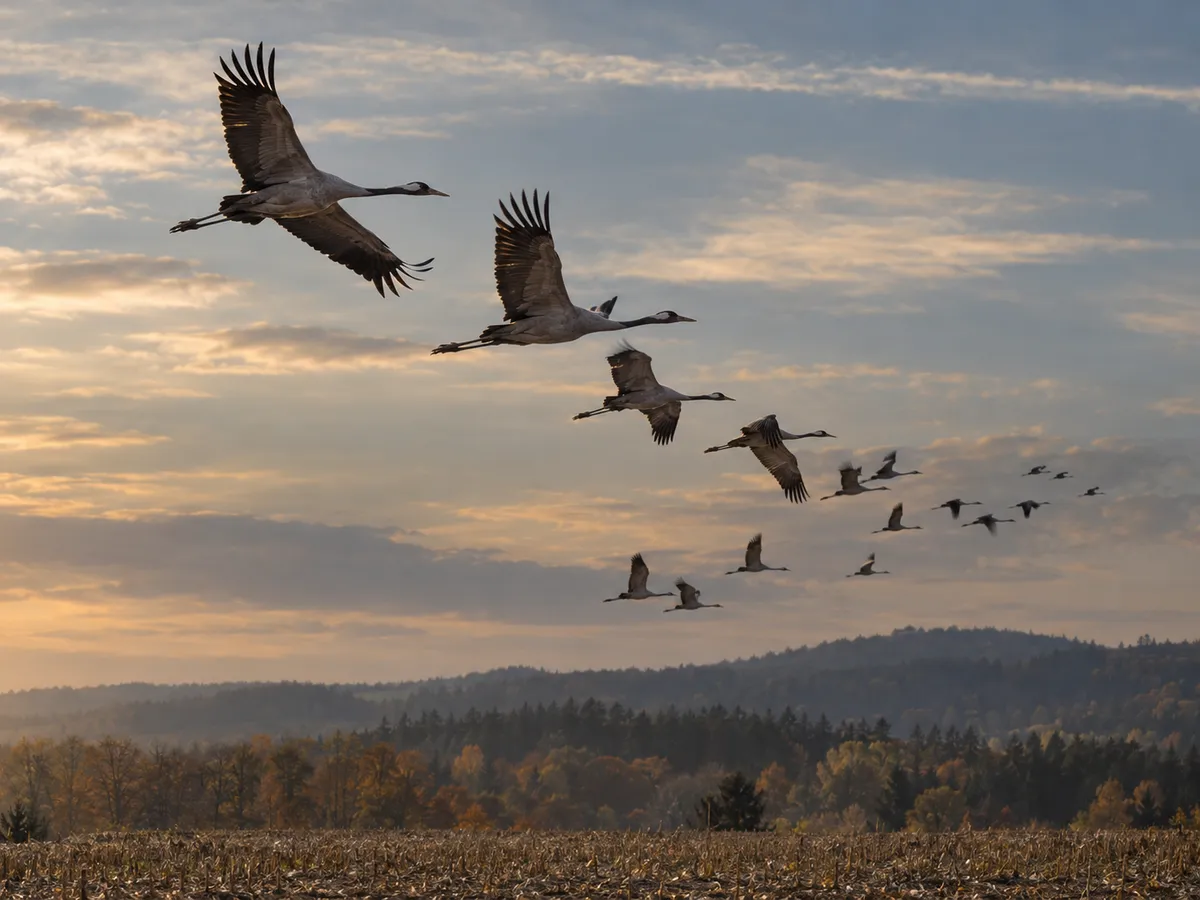
Look up over a pond or a field at this time of year and you may well catch a skein of migrating cranes or geese. The shape is probably more than decoration. According to the prevailing explanation, each bird flies diagonally behind its neighbour, where the air behind that bird's wingtip is rising, and so gets carried along a little almost for free.
01Mechanism
A near-free ride off a neighbour's wing
With every wingbeat, a spinning vortex trails backwards from the tip of each wing. Directly behind the bird the air in it sinks, while a little to the side, behind the wingtip, it rises. A bird that hits the rising part gains extra lift, much as a glider stays aloft in rising air.
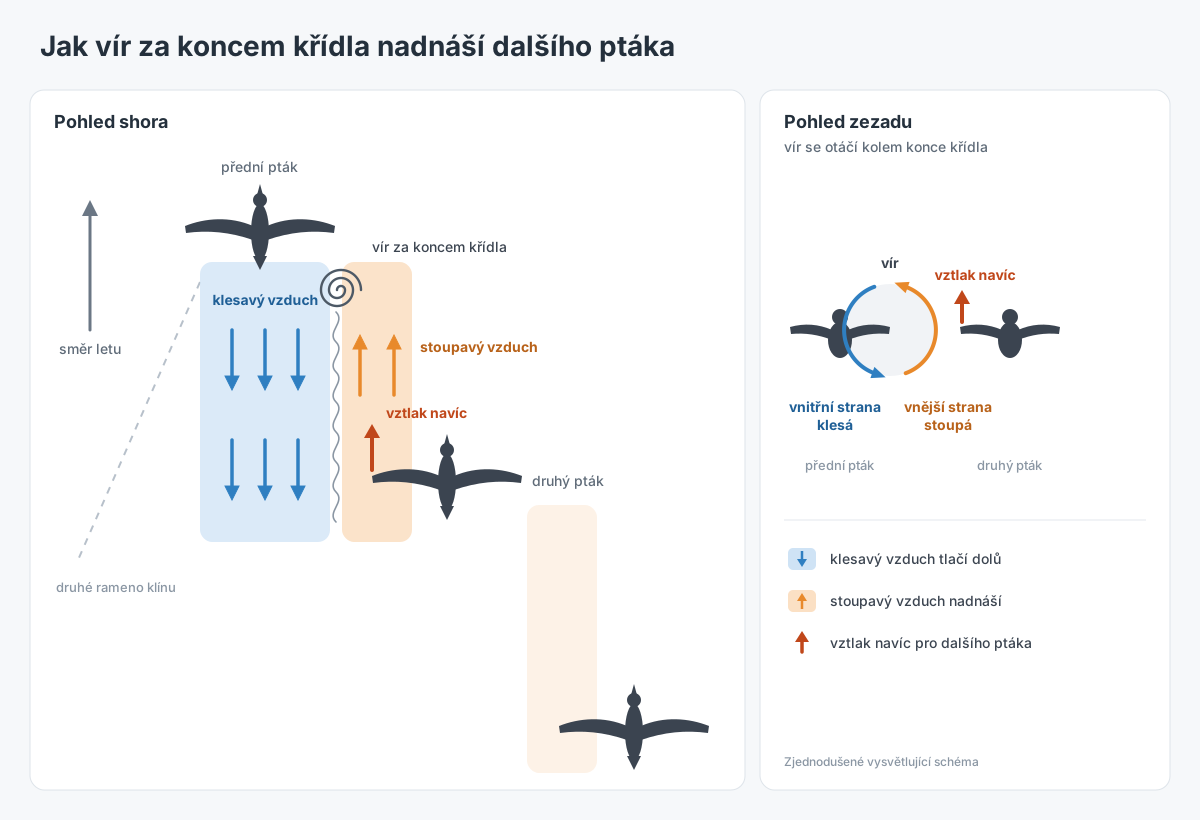
Flying in the sinking air directly behind a neighbour, by contrast, does birds no favours, as it would push them down and cost them more energy. So when each successive bird shifts a little to the side, a diagonal line forms, and with lines on both sides of the leading bird, a V takes shape.
How birds sense the rising air is not yet known. The flight feathers themselves may act as sensors, and theoretical calculations describe stabilising mechanisms that should allow a bird to find the favourable position easily and naturally.
02Precision
Why it works only on the diagonal, not directly behind
Aerodynamicists calculated as early as 1970 that a V formation could save energy. According to their model, the V shape is needed to share the reduction in drag evenly among the birds, and the leading bird does not necessarily have the hardest position.
Such calculations, however, traditionally assumed a fixed wing like an aeroplane's, whereas a bird flaps. Testing them on free-flying birds was also difficult, because data from an instrument can be recovered only from a bird that comes back.
The first experimental evidence came in 2014 from a group of northern bald ibises reared at Vienna Zoo, which conservationists had taught to fly behind an ultralight aircraft. For training flights, researchers fitted them with lightweight loggers that recorded body position and wing movements, and the birds returned with them.
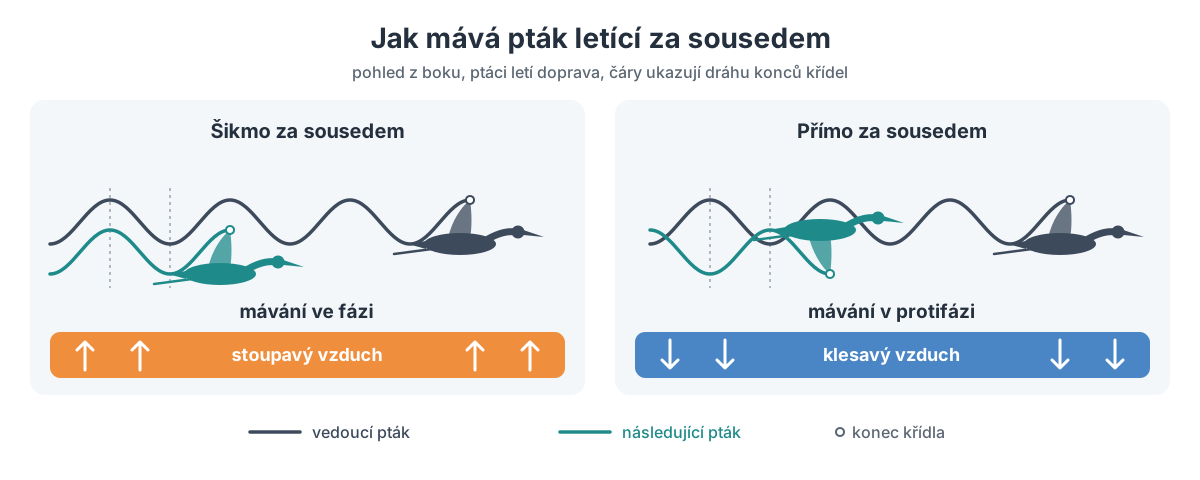
The recordings showed that the ibises in the V held positions that matched theoretical predictions. They also flapped in phase with the neighbour ahead, so they could catch the rising air from the vortex behind its wing throughout the entire wingbeat.
When a bird found itself directly behind another, it flapped out of phase instead. The authors cautiously suggest that this may have softened the adverse effect of the sinking air, but it is not a proven saving.
03Comparison
How it works elsewhere – ibises, pelicans and pigeons
The V is not a universal recipe and may be more of a special case. It is limited to fairly large birds in calm, steady flight, so conclusions about it cannot automatically be applied to other flocks.
| Bird | Flock shape | What was measured | What was found | Study |
|---|---|---|---|---|
| Northern bald ibis | Flock shape: V formation, group of 14 birds | What was measured: Body position and wing movements from lightweight loggers | What was found: The birds held positions matching theory and flapped in phase with their neighbour, while the data only hint at an energy saving | Study: Portugal et al., 2014 |
| Pelican | Flock shape: V formation | What was measured: Heart rate and wingbeat frequency | What was found: In the V, a lower heart rate and less frequent flapping than when flying alone at the same speed, with energy use only inferred from heart rate | Study: Weimerskirch et al., 2001 |
| Pigeon | Flock shape: Compact flock | What was measured: Wingbeat frequency in the flock | What was found: No aerodynamic advantage found, and in a tight flock they flapped more often | Study: Usherwood et al., 2011 |
| Goose | Flock shape: V formation | What was measured: Wingtip spacing, with the saving estimated from a model | What was found: The estimate differed from the model, mainly because geese constantly adjust their position | Study: Cutts and Speakman, 1994 |
Pigeons are a useful counter-example. In a tight flock they flapped more often, which suggests that flying in a group costs them a fair amount of effort, whether through the direct effect of air from their neighbours or through greater demands on stability and control.
04Saving
How much birds save – what we know and what we don't
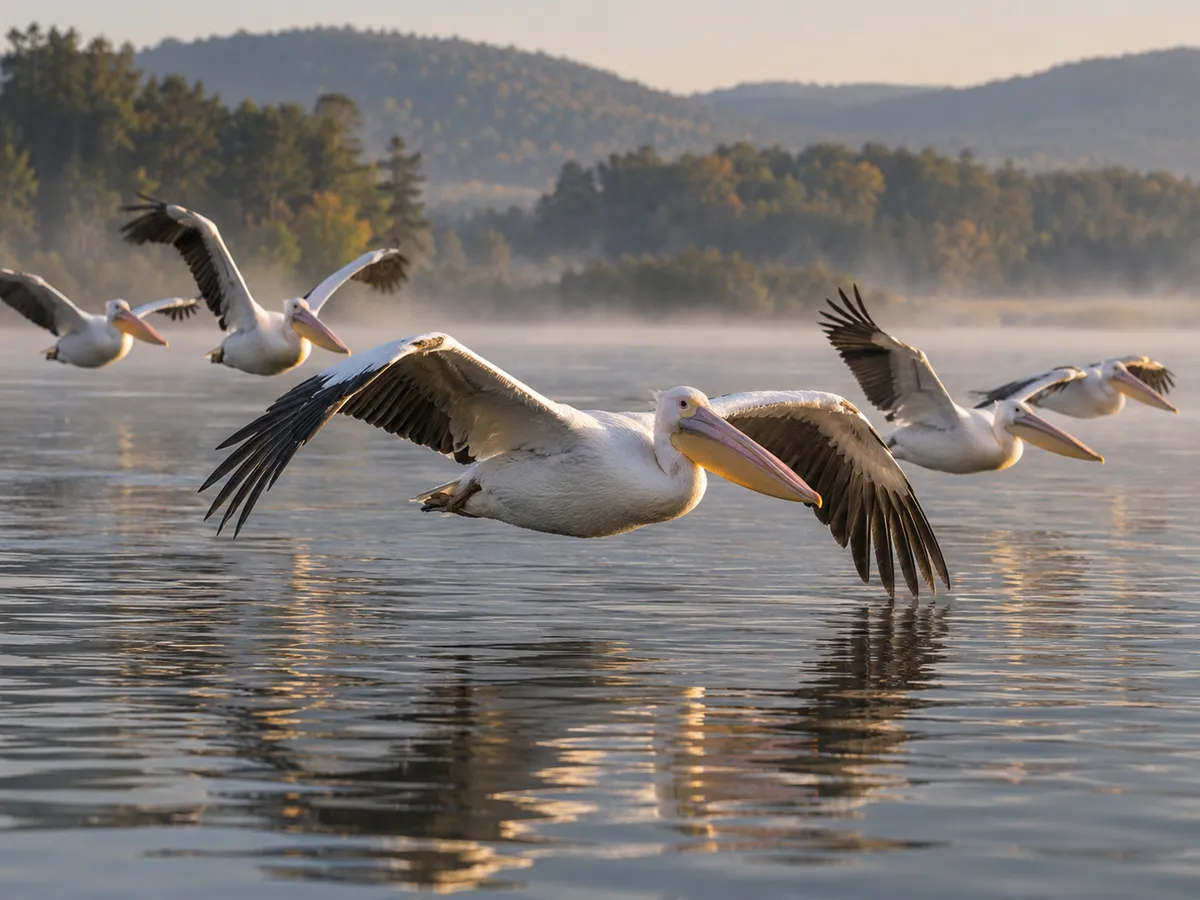
The first evidence of a saving came in 2001 from pelicans fitted with heart-rate monitors, which had a lower heart rate in the V and flapped less often than when flying alone. Even that, though, is an indirect measurement, as energy use is only inferred from heart rate. Moreover, wingbeat frequency reflects actual power output well only around the speed at which flight requires the least power.
In the ibises, energy use was not measured directly, and the position and flapping records only hint at a saving. In geese, the estimated saving differed from the model, mainly because geese constantly adjust their position and spend a good part of the flight away from the ideal spot.
Saving energy may not be the only reason, either. According to another hypothesis, the V is a shape in which many large birds can fly close together without being disturbed by the vortices of the bird in front, while still seeing one another clearly and holding the formation easily.
05Watching
Cranes and geese over the Czech Republic – where to see them and how to spot the V
Many of the geese you see over the Czech Republic are only passing through or wintering there. The greater white-fronted goose, for example, does not breed in the country at all, but it passes through regularly and smaller numbers also spend the winter.

| Area | What you will see |
|---|---|
| South Moravia, the Lednice area (around the village of Lednice near the Austrian border) | What you will see: Greater white-fronted geese on migration and through the winter, around 1500 birds |
| South Moravia, the middle reservoir of Nové Mlýny (a chain of three reservoirs on the river Dyje) | What you will see: Thousands of greater white-fronted geese every year |
| The areas around České Budějovice and Třeboň (a pond-rich region of South Bohemia) | What you will see: Gathering sites for bean, greylag and greater white-fronted geese |
| The rivers Labe (Elbe) and Morava | What you will see: Smaller flocks of bean geese passing through and resting |
How to tell who is flying in the V
- 01
Watch the neck and legs
A crane flies with its long neck stretched out and its legs trailing well beyond its tail. A goose has a shorter neck and its legs tucked into its feathers.
- 02
Listen to the calls
Cranes call with a loud, far-carrying trumpeting. Geese honk and chatter, often the whole flock at once.
- 03
Notice the shifting shape
The shape of the V keeps changing and the birds swap places within it. You will therefore hardly ever see a perfect, unchanging V.
- 04
Look for rusty heads
Pairs and whole families can be picked out in a flock of cranes. This year's young give themselves away with their brick-rusty heads.
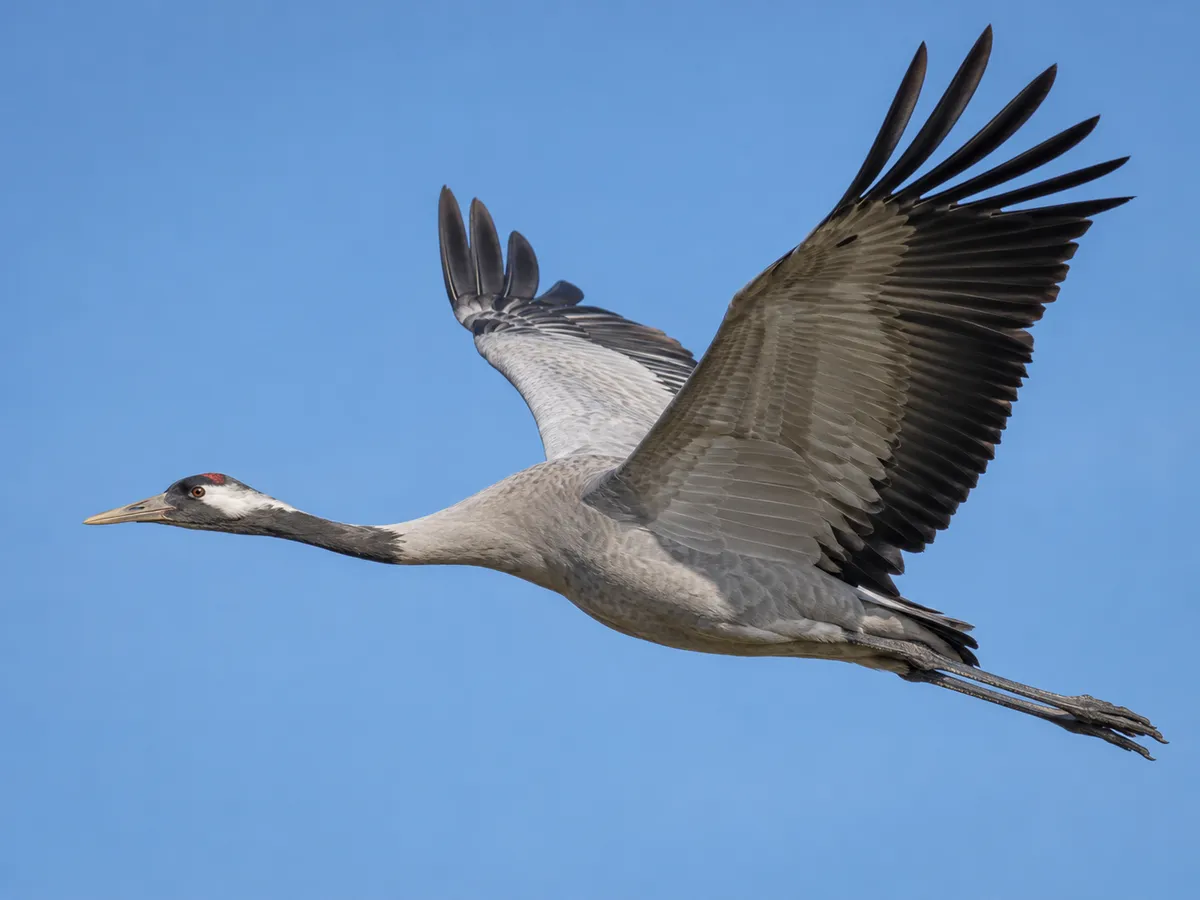
When you hear trumpeting or honking overhead, it is worth waiting a moment. The V regroups before your eyes as the birds seek a place diagonally behind a neighbour, where, by all accounts, they are helped along by the invisible vortex behind its wing.
Weather for watching migrationV formations are easiest to see under clear skies. Check the forecast for your area.Show forecastSources12 sources · specific figures come from the sources, the general explanation from expert knowledge
- AOPK ČR, Portál ISOPhusa běločelá (greater white-fronted goose) (in Czech)
- Živa 6/2016, J. Andreska, Z. Souček (in Czech)
- Portugal et al. 2014, Nature 505 (abstract)checked 13 October 2026
- Ingenia: Birds flying in a V formationchecked 13 October 2026
- Lissaman & Shollenberger 1970, Sciencechecked 13 October 2026
- SICB: The aerodynamics of flapping V formation flight (abstract)checked 13 October 2026
- V is for vortex (editorial comment in Nature (2014))checked 13 October 2026
- Wikipedia: V formationchecked 13 October 2026
- Usherwood et al. 2011, Nature 474 (abstract)checked 13 October 2026
- Trenchard & Perc: Energy saving mechanisms, collective behavior and the variation range hypothesis (arXiv)checked 13 October 2026
- Usherwood et al. 2011, Nature 474 (author manuscript on PMC)checked 13 October 2026
- AOPK ČR, Portál ISOPhusa polní (bean goose) (in Czech)