
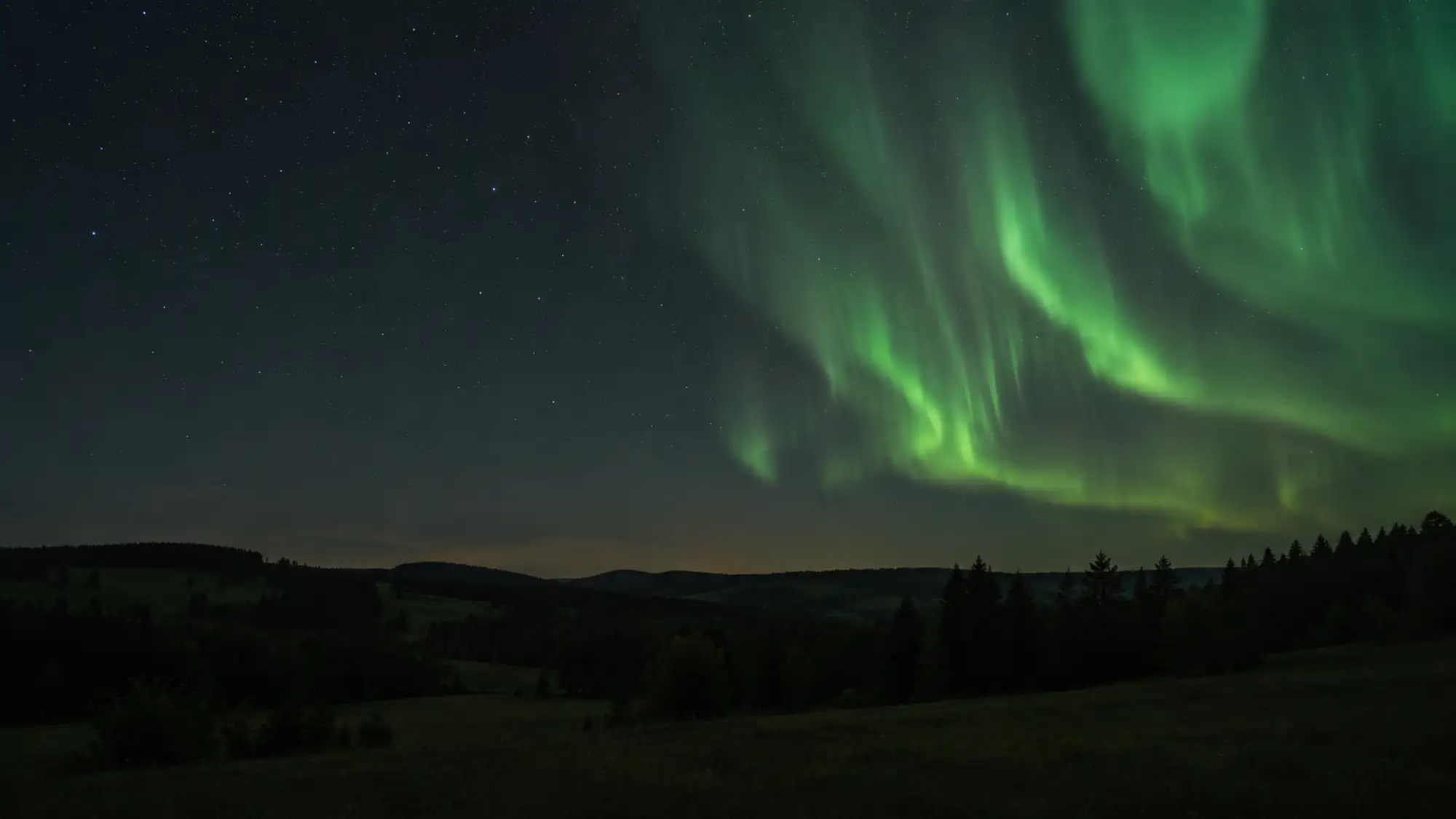
A green haze rising like a curtain above the northern horizon is neither reflected light nor an unusual cloud. It is the upper atmosphere itself glowing, struck by electrons accelerated in the space around the Earth. Over the Czech Republic the aurora appears only rarely, but it is not out of the question.
01What we see
Light from hundreds of kilometres up
The most common colour of the aurora is a pale green. It is emitted by atomic oxygen, meaning single oxygen atoms not bound into molecules, at a wavelength of 557.7 nanometres. The wavelength of light determines its colour. The green glow forms at altitudes of roughly 100 to 250 kilometres. Red auroras also come from oxygen but shine higher up, at around 200 to 500 kilometres. The whole show therefore plays out far above the clouds and aircraft, in a layer of the atmosphere where the air is incomparably thinner than at ground level.
The glow works much like a neon tube. An electron striking an atom hands over part of its energy, leaving the atom in an excited state. When the atom returns to its original state, it releases the surplus energy as light of a precisely defined colour. Different colours therefore arise when different atoms and molecules, chiefly oxygen and nitrogen, are excited into different states.
Altitude and colour are linked. Some excited states last a relatively long time before the light is emitted. In denser air the atom would collide with other particles in the meantime and pass its energy on to them, so it would never glow at all. That is why red, which depends on long-lived excited oxygen, appears in the thin upper layers, while green shines lower down.
02The energy source
Where the fast electrons come from
A common explanation holds that particles from the Sun rain straight down into the atmosphere. That is a simplification. The Sun constantly gives off the solar wind, a tenuous stream of electrically charged particles that also carries the Sun's magnetic field with it. It runs into the Earth's magnetic field, which forms a protective cavity around the planet known as the magnetosphere. Most of the electrons that light up the aurora are accelerated only inside the magnetosphere. They then rush into the atmosphere along magnetic field lines, the imaginary lines that trace the direction of the magnetic field. Iron filings scattered around a magnet form a similar pattern.
On an ordinary day these electrons carry only enough energy to produce a glow in the ultraviolet, which the eye cannot see. A visible aurora needs more energetic electrons. These arise, among other ways, through magnetic reconnection, when previously separate field lines of the magnetosphere and the solar wind link up and release energy.
Reconnection is more likely when the magnetic field of the solar wind points southward relative to the Earth. On the side facing the Sun the Earth's field points north, and oppositely directed field lines connect more easily. Because of the tilt of the Earth's axis, this favourable orientation occurs more often around the equinoxes, in March and September. A fast solar wind also helps, but its link to solar activity is complicated, and a highly active Sun does not by itself guarantee a fast wind.
The most spectacular displays come during geomagnetic storms, strong and sudden disturbances of the Earth's magnetic field. They are often triggered by coronal mass ejections, vast clouds of electrically charged gas, known as plasma, hurled out by the Sun. If such a cloud hits the Earth and carries a southward-pointing magnetic field, the magnetosphere is violently shaken and far more energetic electrons head into the atmosphere.
03Around the poles
Why the aurora lives near the poles and how it reaches us
The field lines of the Earth's magnetic field converge at the magnetic poles, and that is where they enter the atmosphere. Electrons travelling along them therefore light up the aurora mainly in a roughly oval band around the magnetic poles, called the auroral oval. In quiet conditions it lies far to the north, over northern Scandinavia, Canada or Alaska.
During a strong geomagnetic storm the oval expands towards the equator and the aurora appears over the middle latitudes too. The Czech Republic lies a long way from the oval, but at exceptional moments its southern edge comes close enough for the glow to be glimpsed low above the northern horizon.
04In the Czech Republic
Can the aurora be seen in the Czech Republic?
It can, but only rarely and during very strong geomagnetic storms. Do not expect rippling green curtains like those in photographs from Iceland. At Czech latitudes the aurora tends to show itself as a low, often faintly reddish light in the north. Only the upper part of the phenomenon rises above the horizon, and at that altitude red dominates. An inexperienced observer can easily mistake it for the glow of a distant town or late twilight.
Several conditions have to come together. It must be night, since the aurora cannot be seen in daylight, the sky must be clear of cloud, and the storm must be strong enough. The weeks around the equinoxes, when reconnection is more likely, may improve the odds. The strength of a storm is expressed by the Kp index, a numerical measure of how strongly the Earth's magnetic field is disturbed. Forecasts and current values are published by services that monitor activity on the Sun and around the Earth, the so-called space weather. For Czech latitudes the index has to reach high values, which usually happens only during the very strongest storms.
05Limits
What remains uncertain and what to watch out for
The biggest obstacle to forecasting is that the orientation of the magnetic field inside a cloud from the Sun can be reliably determined only once it passes the monitoring satellites between the Earth and the Sun, shortly before it arrives. The cloud may also turn up earlier or later than expected, and the field within it may rotate so that the storm brings nothing visible from the Czech Republic. Forecasts therefore express a probability rather than a certainty, and high expectations may not be met.
The aurora itself is harmless light hundreds of kilometres up and poses no threat to anyone on the ground. The strong geomagnetic storms that accompany it can affect satellites, satellite navigation and power grids, most of all at high latitudes. For the ordinary observer in the Czech Republic, the greatest risk is rather the disappointment of a cloudy sky.
Sources3 sources · specific figures come from the sources, the general explanation from expert knowledge
- NASA: Red and Green Aurora Australischecked 9 October 2026
- NOAA SWPC: Aurora tutorialchecked 9 October 2026
- Sky at Night Magazine: What causes the aurora?checked 9 October 2026