
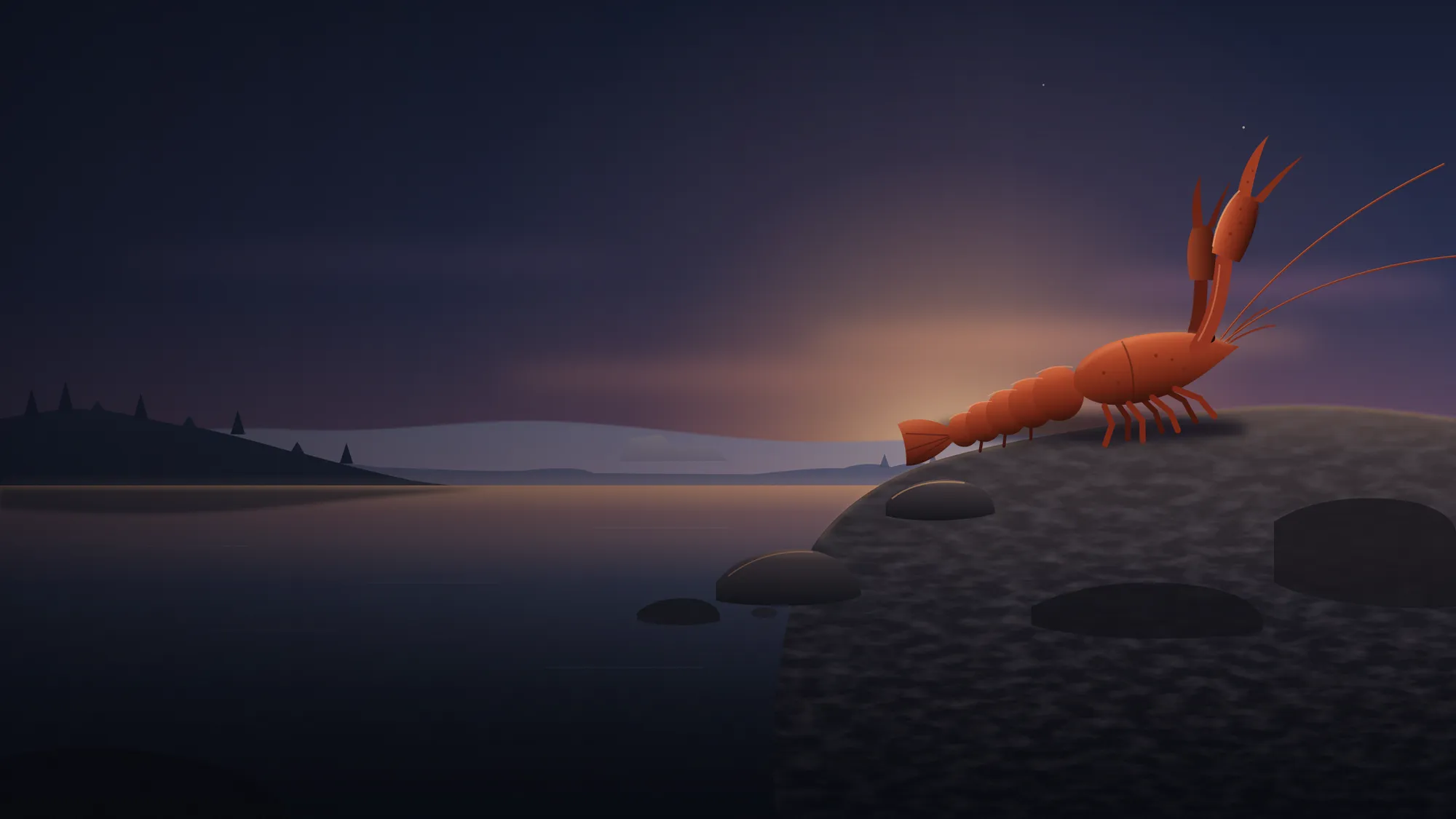
In early September, cyclists on a weekend ride spotted a crayfish and the remains of claws on a path by Lake Milada, and sent a photo to AOPK, the Nature Conservation Agency of the Czech Republic. The photo showed a red swamp crayfish, a species that nobody had yet recorded in Czech nature. Agency staff then caught several red swamp crayfish right in the lake.
01The find
A crayfish from the south-eastern USA ended up in a former pit
The red swamp crayfish comes from the south-eastern United States and northern Mexico, and grows up to 15 cm long. In September nobody yet knew how many crayfish live in Milada. Scientists planned a more detailed survey to find out.
02Over land
A crayfish that wanders over land
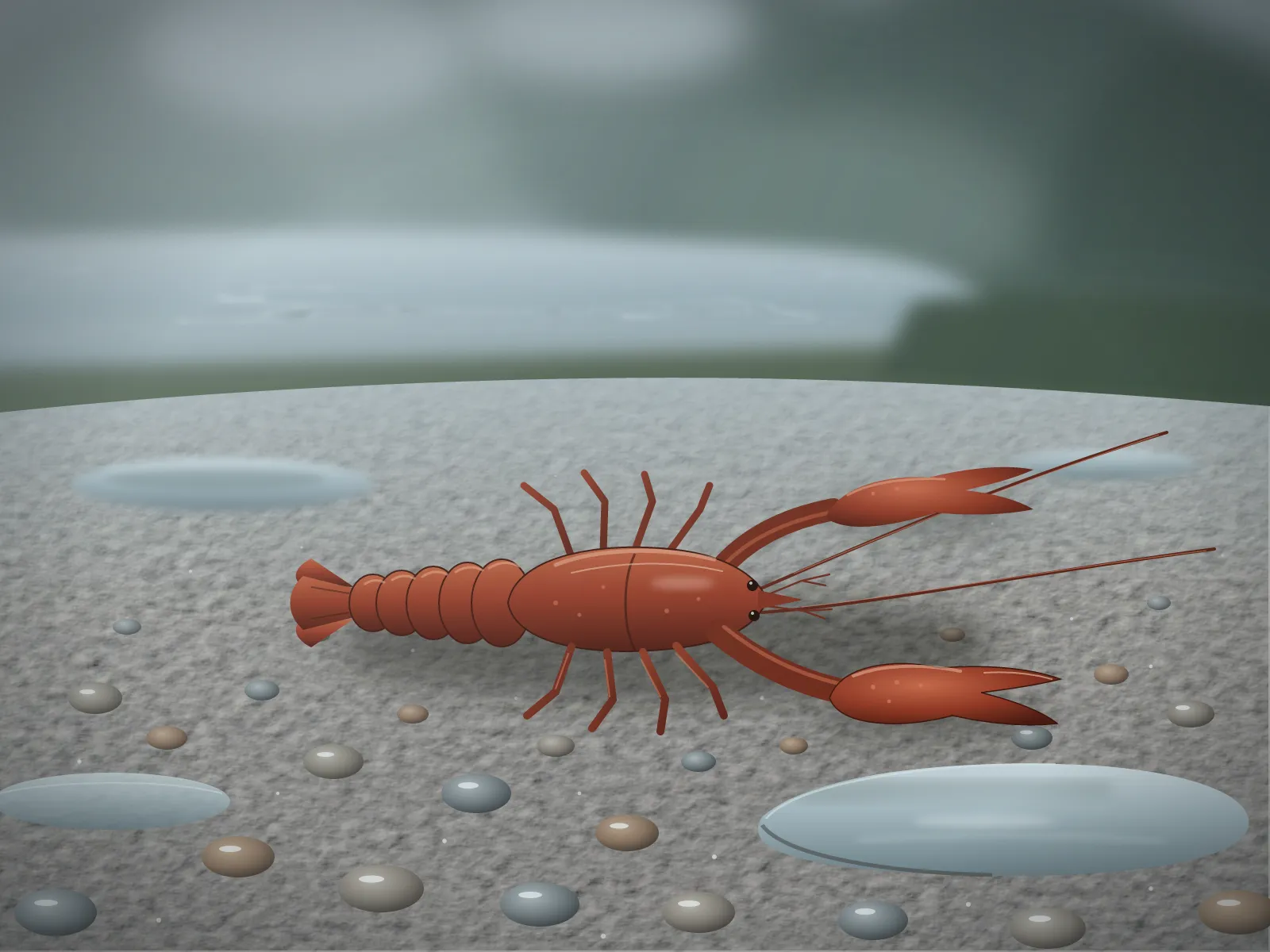
British scientists compared the red swamp crayfish with the signal crayfish in experimental tanks in a 2019 study, not in the wild. Both species climbed out of the water, and they did not differ significantly in their willingness to head onto land. The signal crayfish has lived in Czechia for a long time.
According to the study's authors, crayfish can reach nearby bodies of water overland, which has already helped invasive species spread. When water dries up, the red swamp crayfish also looks for food on the banks and on land, and according to the AOPK it thrives relatively well in dry conditions too. The crayfish from Milada was likewise spotted on a path, out of the water.

03Next door
Neighbours caught crayfish by the thousand, and Berlin even ate them
In Berlin the crayfish were noticed when they appeared on streets and paths near the Tiergarten park. According to a 2019 report by the German press agency dpa, they are most likely descendants of crayfish released from aquariums. In Slovakia, scientists recorded the red swamp crayfish for the first time at two natural sites, both fed by thermal springs. In both countries the crayfish were then caught in large numbers.
| Place | Year | What happened |
|---|---|---|
| Berlin, Tiergarten and Britzer Garten | 2018 | almost 39,000 crayfish caught and sold as food |
| Slovakia, two sites with thermal springs | 2023 | thousands of crayfish removed |
| Lake Milada, Czechia | 2026 | several crayfish caught, population size unknown in September |
04Origin and risks
Someone most likely released it into the lake
AOPK believes that an irresponsible keeper illegally released the crayfish into the lake. The red swamp crayfish used to be popular as an ornamental species in aquariums. Since 2016 it has been on the EU list of invasive species, which bans keeping it, trading it and releasing it.
According to AOPK, four invasive North American crayfish species are confirmed in Czechia, the red swamp crayfish plus the signal, spiny-cheek and marbled crayfish. According to the Czech News Agency (ČTK), the spiny-cheek crayfish also lives in Milada.
05Winter
In the lab, the red swamp crayfish survived winter
In 2015 scientists from the Faculty of Fisheries and Protection of Waters at the University of South Bohemia described an experiment in which red swamp crayfish were kept in a laboratory for 6.5 months at temperatures imitating the winter of still waters in the European temperate zone. Of 15 animals, 13 survived, and they coped with the coldest period at about 2.5 °C.
The authors conclude that the red swamp crayfish can tolerate the low winter temperatures of still waters in the temperate zone. It was, however, a laboratory experiment, not an observation made directly at Milada.
06What to do
Do not release the crayfish, and report any find
In September AOPK said that the most important thing now is to isolate the new population where possible and, above all, to prevent the red swamp crayfish from spreading further. The agency also welcomes reports if a crayfish appears at other places.
What to do if you see a crayfish
- 01
Do not release or move it
Do not release any crayfish into the wild or move it elsewhere, because releasing the red swamp crayfish is prohibited.
- 02
Take a photo and note the place
Photograph the crayfish and write down the exact place, for example coordinates, an address or a point on a map, and the date of the sighting.
- 03
Report it to AOPK
Send an email to invaznidruhy@aopk.gov.cz, or enter the find in the iNaturalist app, in BioLog or in Raci v ČR (Crayfish in Czechia, Android only).
- 04
Tell the local authority
An invasive species must also be reported to the locally competent nature conservation authority, that is the municipal office, the national park administration or the CHKO (protected landscape area) administration.
Sources7 sources · specific figures come from the sources, the general explanation from expert knowledge
- AOPK ČR (tisková zpráva 14. 9. 2026) (press release of 14 September 2026) (in Czech)
- Thomas a kol. 2019, Behavioural Processes 167 (Thomas et al. 2019)
- ČTK / České noviny 14. 9. 2026 (news report of 14 September 2026) (in Czech)
- Veselý, Buřič, Kouba 2015, Scientific Reports 5:16340 (Veselý, Buřič and Kouba 2015)
- Tagesspiegel / dpa 31. 3. 2019 (text of 31 March 2019)
- Lipták a kol. 2024, BioInvasions Records 13(3) (Lipták et al. 2024)
- AOPK ČR, Nález invazního druhu (report of an invasive species find) (in Czech)