
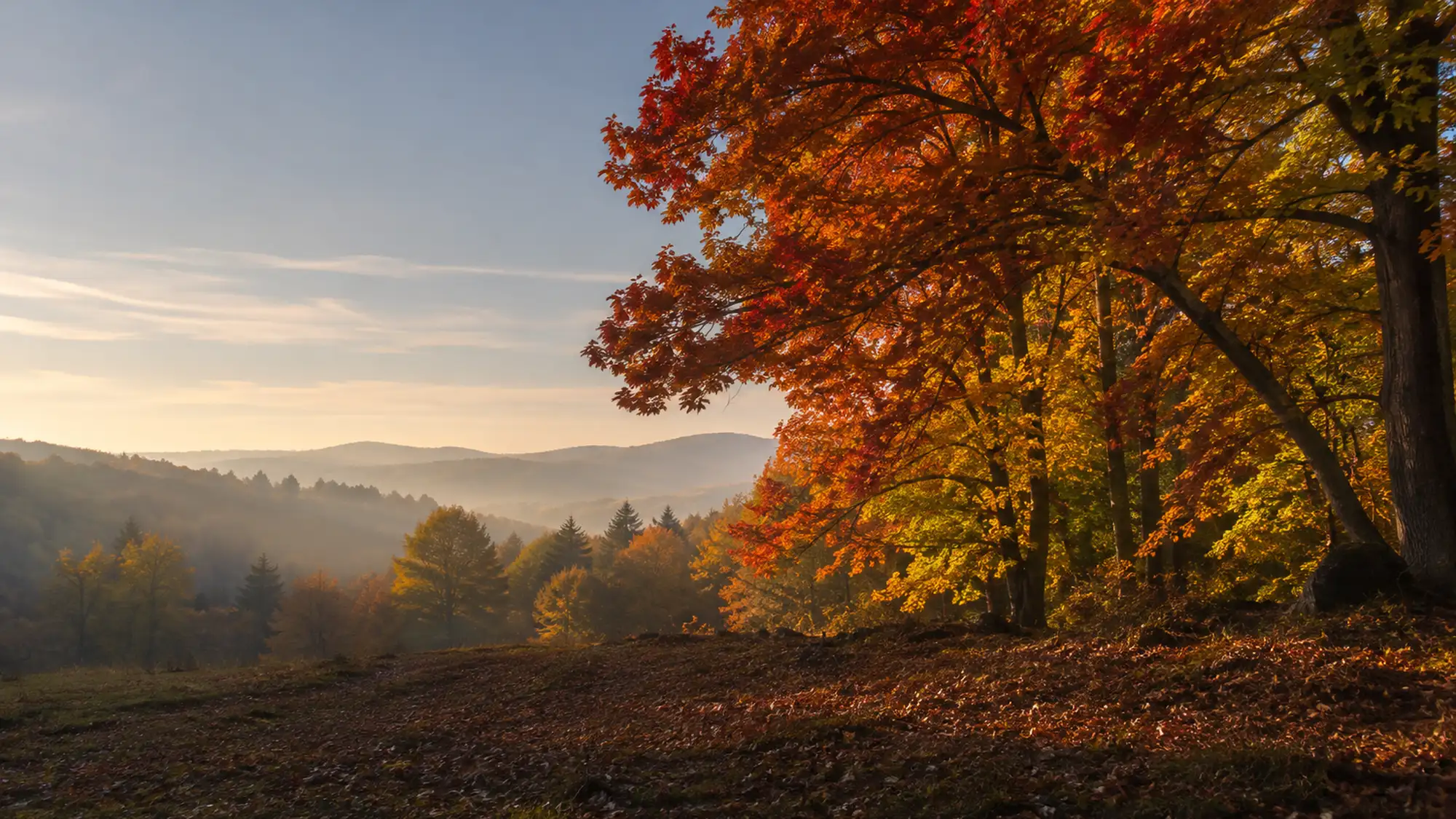
Green chlorophyll is not the only pigment in a leaf, merely the most abundant. When a tree starts breaking chlorophyll down in autumn, the yellows and oranges that were there all summer show through, and in some species red appears too, a colour the leaf has only just begun to make.
01Hidden colours
Yellow and orange were in the leaf all summer
In summer, leaf cells are packed with chlorophyll. It absorbs red and blue light and uses that energy for photosynthesis, the process of making sugars from water and carbon dioxide. Green light is reflected, which is why leaves look green to us. Chlorophyll sits in chloroplasts, tiny bodies inside the cells, and right alongside it are yellow and orange pigments called carotenoids. There are fewer of them, and the chlorophyll masks them like a thick coat of paint.
Light constantly damages chlorophyll, so the leaf has to keep replacing it throughout the summer. Once the tree stops replacing it in autumn and instead begins breaking it down, the green fades and the carotenoids remain. Yellow, in other words, is not created but uncovered. That is why trees that turn yellow, such as birch or lime, tend to show a gradual shift from green through pale green to yellow.
02Clearing out
Trees do not lose chlorophyll, they dismantle it on purpose
Autumn colour is not simply a matter of leaves drying out. The changes are linked to the tree withdrawing nutrients from its leaves and storing them over winter in its branches, trunk and roots. Chlorophyll is broken down through a series of chemical steps that are switched on specifically as the leaf ages.
This makes sense, because chloroplasts and their proteins hold a large share of the leaf's nitrogen, which is valuable to the tree. The broken-down chlorophyll is converted into colourless compounds that no longer hide the yellow and orange. Before the leaves fall, the tree recovers whatever it can, and the colour is a visible by-product of this clear-out.
03Red
Red is newly made, which makes it more fickle
Reds and purples tell a different story. They come from anthocyanins, pigments dissolved in the cell sap, which a mature green leaf does not usually contain. The tree begins producing them only in the ageing leaf, as chlorophyll declines. So some maples, cherries and dogwoods turn red, while birch and lime generally stay yellow.
Because this is new production, the intensity of red varies more than that of yellow. It is usually deeper after sunny days followed by cold but frost-free nights. The same tree can therefore be red on the sunny side of its crown while the shaded leaves inside stay merely yellow.
Why trees bother making red pigment at all has not been fully settled. The most commonly considered idea is that red shields the ageing leaf from excess light while the tree draws nutrients out of it. But this explanation is still being researched, not a closed question.
04Brown
Brown is a mix of pigments, or a dead leaf
Brown can arise from a mixture of leftover chlorophyll and red anthocyanins. In some species that do not make anthocyanins, it is partly due to a build-up of tannins, substances familiar from oak bark, for instance, which darken in the dying leaf.
Brown leaves can also have a simpler cause. If a leaf is hit by a hard frost, a long drought or a fungal disease, it may die before the colour change has taken place. Such a leaf then turns brown without any marked yellow or red phase.
| Colour | Pigment | Where it comes from |
|---|---|---|
| Green | Pigment: chlorophyll | Where it comes from: present in the leaf all summer, deliberately broken down by the tree in autumn |
| Yellow and orange | Pigment: carotenoids | Where it comes from: already in the leaf in summer, revealed as chlorophyll declines |
| Red and purple | Pigment: anthocyanins | Where it comes from: newly made in the ageing leaf |
| Brown | Pigment: leftover chlorophyll and anthocyanins, tannins | Where it comes from: pigments mixing or the leaf dying |
05When
What triggers the colour change and when to expect it in Czechia
A tree needs a reliable signal that winter is coming. Day length is the steadiest calendar, because it changes the same way every year, whereas temperature varies from one autumn to the next. In the aspen, the shortening of the day alone appears to trigger autumn senescence. In other species, however, both the onset and the duration of senescence are influenced by further factors, such as temperature.
Experiments are used to establish that these really are triggers, rather than things that merely happen to coincide in autumn. With seedlings in growth chambers, day length and temperature can be varied separately, which is impossible in nature, where the days shorten and cool at the same time. It is precisely such comparisons that show the factors carry different weight in different species.
In the Czech Republic, leaves usually begin to colour noticeably around the end of September, the colours tend to peak in October, and some species hold on to their leaves into November. In the mountains the colours generally appear earlier, in the warm lowlands later. The order of species tends to be similar from year to year, with birch yellowing early while oak and beech keep their leaves longer. The exact timing, though, shifts with the weather.
06Limits
Where the simple explanation stops working
Because temperature as well as day length matters for many species, autumn does not look the same every year. A warm autumn can delay the colour change, while drought can bring it forward in some trees and dull the colours. The same species can thus be vivid one year and rather brown the next.
This whole explanation also applies only to landscapes with a distinct cold season. Where there is no cold season, leaves do not change colour to the same rhythm, and many tropical trees shed their leaves during the dry season instead. And the exact chain of signals that leads from shorter, cooler days to the halt in chlorophyll production has still not been fully described.
The whole answer therefore fits into a few sentences. Yellow was in the leaf all along, red is newly made, and brown is either a mix of pigments or a dead leaf. When it happens depends mainly on shortening days and cold, with each species responding a little differently.
Sources3 sources · specific figures come from the sources, the general explanation from expert knowledge
- Ougham, Thomas, Morris 2005, Current Topics in Developmental Biologychecked 13 October 2026
- Lee et al. 2003, Ecological Research (Harvard Forest)checked 13 October 2026
- Mattila et al. 2018, AoB Plantschecked 13 October 2026