
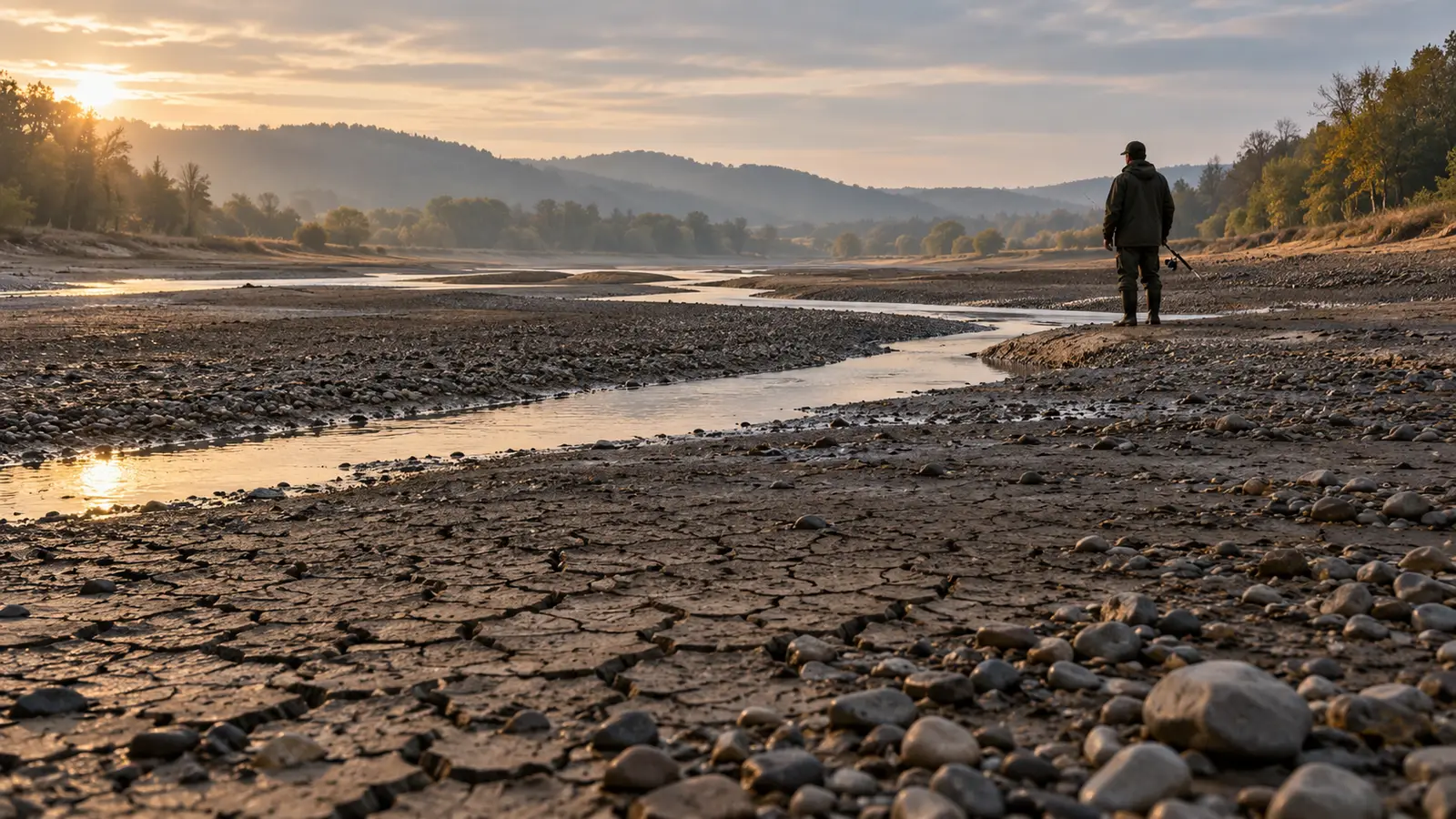
In numbers
164profiles
Measuring profiles on rivers at the level of the historical minimum, the same as or lower than in the droughts of 2015, 2018 and 1947
146mm
Average precipitation deficit against the normal from the start of the year to mid-August
70%
Share of monitored groundwater with strong or extreme drought in mid-August
1.3%
Share of the usual volume left in the storage space of the Husinec reservoir on 6 October
The comparison with 1947 applies to 164 measuring profiles on rivers. According to a report by the ČHMÚ (the Czech Hydrometeorological Institute) of 14 August, water in them fell to the level of the historical minimum, that is, as low as during the droughts of 2015, 2018 and 1947, or even lower. This does not mean the whole country is equally dry, but at that point over two thirds of the monitored profiles were below the drought limit, and in mid-October rivers remained mostly well below average.
01Terms
Drought has four faces, and each arrives at a different time
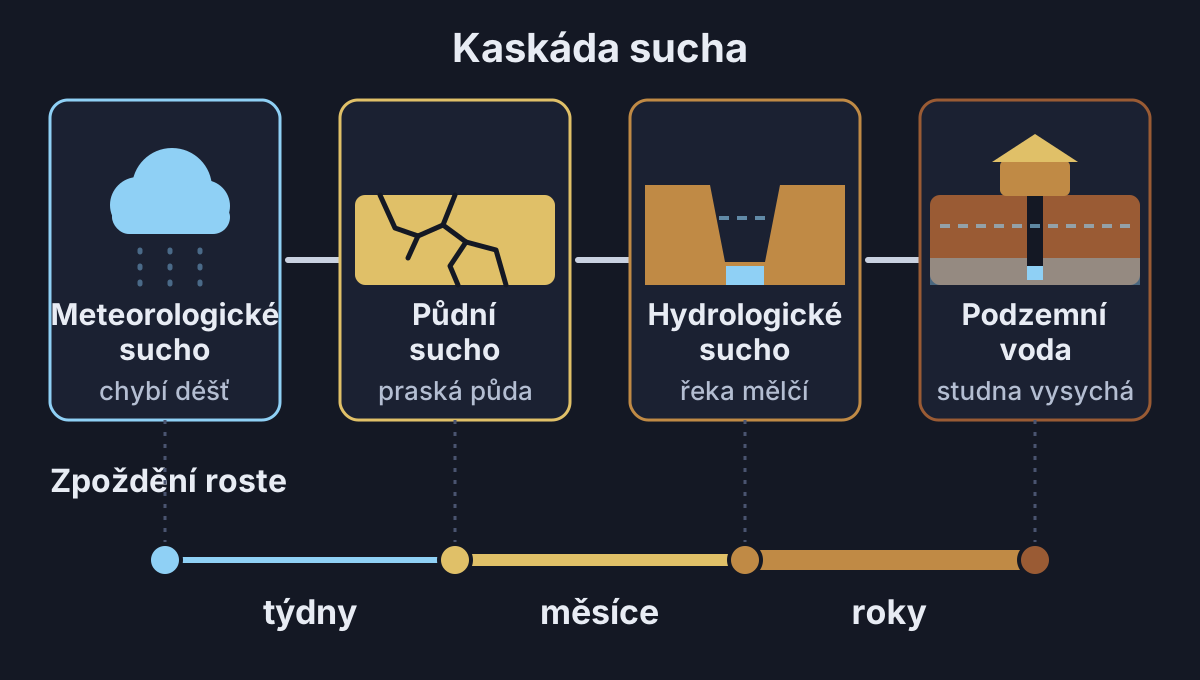
Ask anyone about drought and they picture something different. Meteorologists mean missing rain, farmers dried-out soil, hydrologists falling rivers, reservoirs and groundwater. Finally come the impacts on people who lack water at home, in the field or in the well.
These four forms follow one another with a delay. First the rain stops, within weeks the soil dries out, then rivers fall, and groundwater reacts only after months, sometimes years. That is why, after heavy rain, the soil can turn damp while rivers and wells keep falling for a long time.
The ČHMÚ issues warnings for three types of drought, namely drought in surface water, drought in groundwater, and hydrological drought, which affects both at once. On the ČHMÚ map, the colour orange marks municipalities with extended powers (the larger administrative districts) that are affected by hydrological drought.
| Term | What it means |
|---|---|
| Meteorological drought | What it means: Rain is missing for a long time, so less precipitation falls than is usual for the place. |
| Soil drought | What it means: Plants do not get enough water from the soil because the moisture in the root layer has run out. |
| Hydrological drought | What it means: Rivers, reservoirs and groundwater fall. The ČHMÚ issues a warning for it when there is drought in both surface water and groundwater at once. |
| Drought limit at a profile | What it means: The flow level at or below which the ČHMÚ reports drought at a measuring profile. It is denoted Q355d, that is, the flow that a river normally exceeds on 355 days a year. |
| Drought in groundwater | What it means: The level in a borehole or the yield of a spring falls below the level that the ČHMÚ takes as the drought threshold. It monitors shallow boreholes, deep boreholes and springs. |
| Water level and flow | What it means: Water level is the height of the river surface, flow is the amount of water that passes through the profile per second. |
| Shallow and deep groundwater | What it means: Shallow wells and springs react to rain and drought faster than deep boreholes, which reach into layers that refill more slowly. |
02Numbers
The sky was stingier with rain than at any time since 1961
According to preliminary ČHMÚ data, only 289 mm of precipitation fell on Czechia from 1 January to 10 August, that is 66% of the 1991–2020 normal, the least since 1961. The total is almost identical to the exceptionally dry year 2015. According to preliminary data, spring was even the driest, with only 89 mm falling in three months.
Infographic
Precipitation from January to 10 August
The heat dealt another blow, because repeated heatwaves since June, according to the ČHMÚ, markedly increased how much water can evaporate from the landscape and from water surfaces. For example, on 31 July the mean daily temperature in Prague-Ruzyně came out at 28.1 °C and in Brno-Tuřany at 30.8 °C, according to ČHMÚ data. By mid-August the amount of water in the soil had fallen below 10% of usable water capacity across most of the territory.
03Curiosities
If you see me, weep. What drought brings up from the riverbed
In Děčín, on the left bank of the Labe river under the Tyršův most (Tyrš Bridge), lies a rock in the riverbed known as the hunger stone (hladový kámen). It emerges when water levels are low, and people carved years and inscriptions into it that bear witness to dry years. The oldest legible inscription dates from 1616.
The best-known inscription reads, in German, ‘Wenn du mich siehst, dann weine’, and in Czech ‘Když mě uvidíš, plač’ (‘If you see me, weep’). A younger Czech inscription, according to the city portal, does the opposite and comforts a girl, telling her not to cry or lament, because when it is dry the fields will be sprinkled.
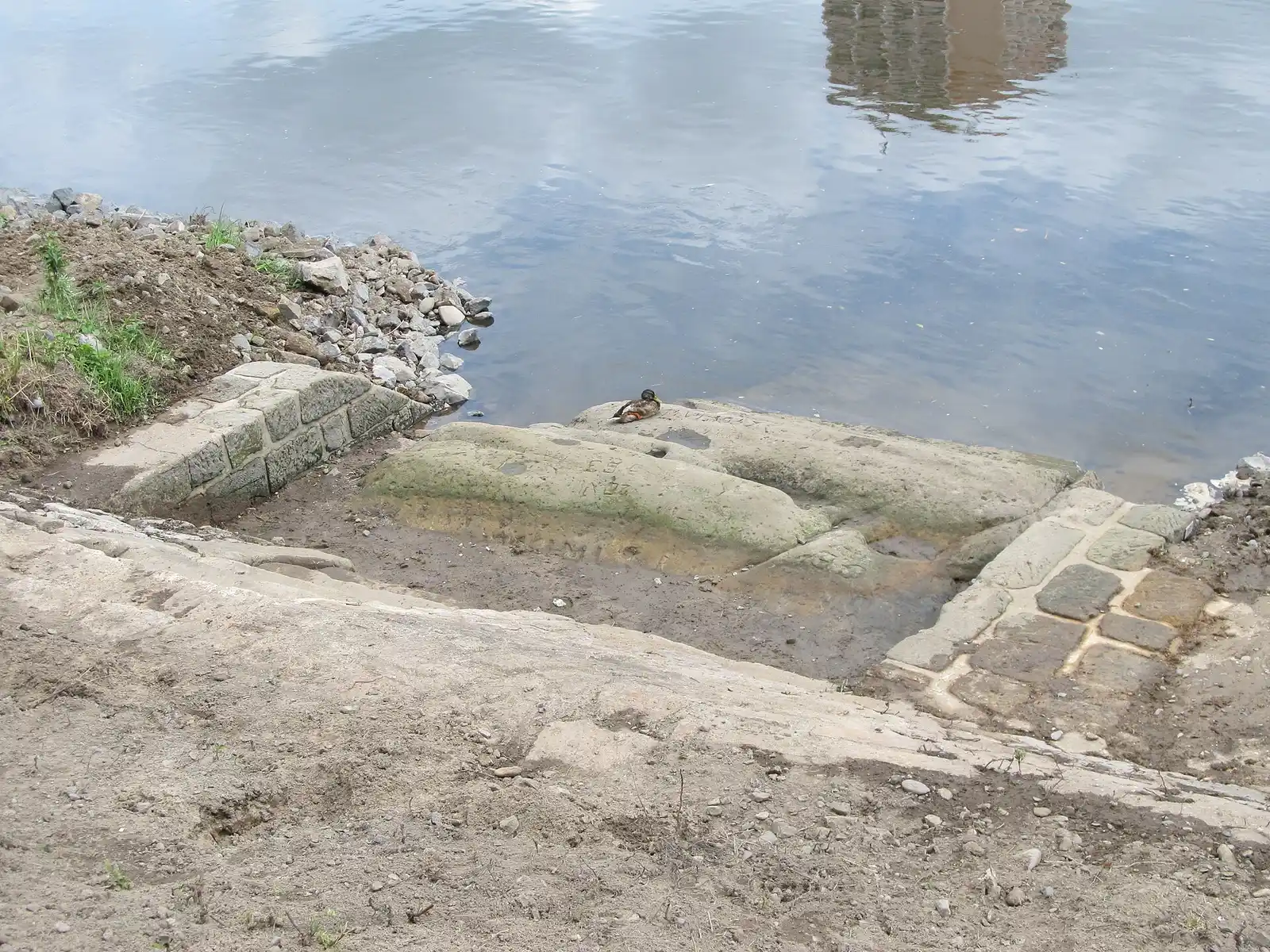

According to the city, the stone is visible on average 126 days in a normal hydrological year. After the dams were built on the Vltava river, it appeared much more often after 1926 than before. Because of the extreme drought of recent years, another hunger stone was discovered at Těchlovice.
Dams running out of water
The Husinec reservoir in the Prachaticko area almost dried up, the first Czech dam to do so. On 6 October only 30 thousand cubic metres of water remained in its storage space, that is 1.3% of the usual volume, and the level was seven metres lower than usual. The director of the plant that manages the reservoir said that nothing like it had happened during his time there.
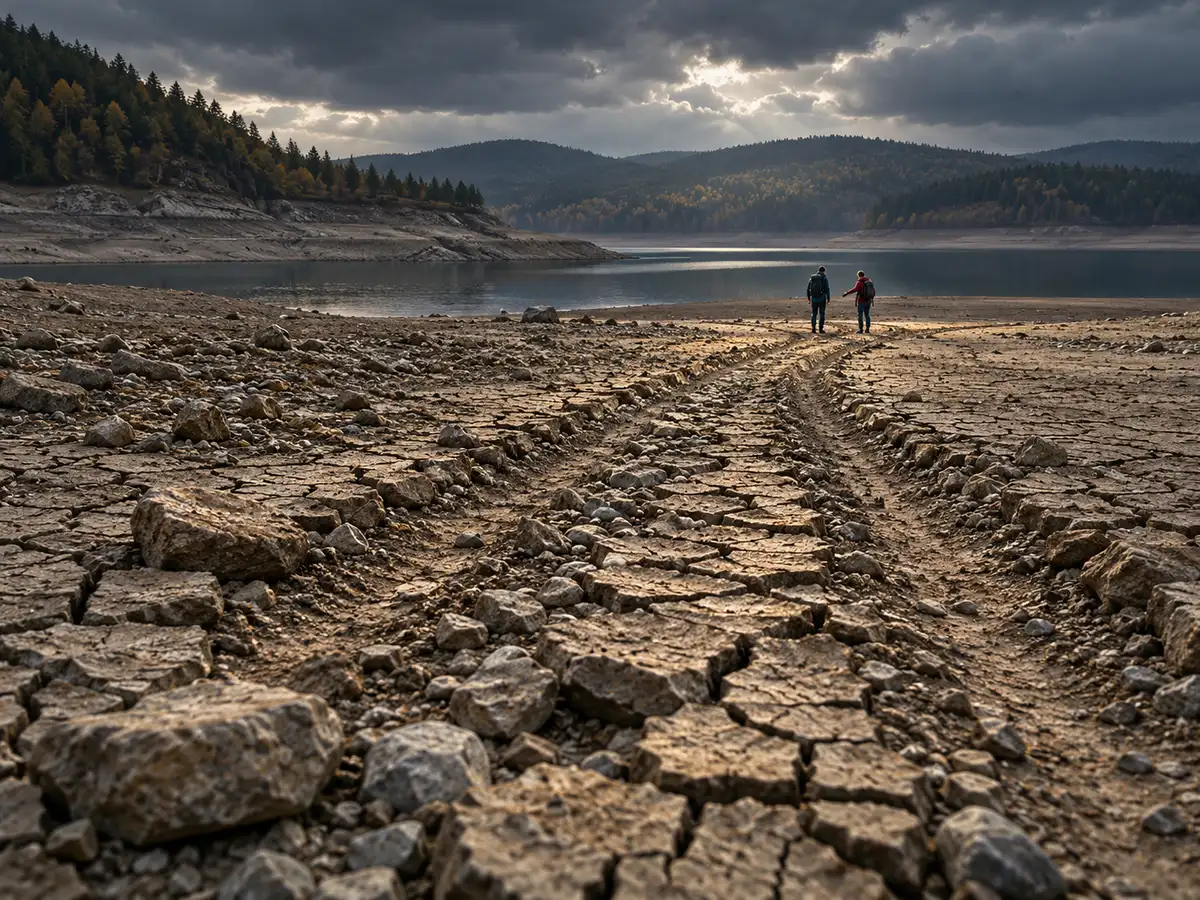
At the beginning of September, Povodí Vltavy (the Vltava river basin authority) announced that it would, for the first time in history, use the storage space of the Slapy dam to top up water in rivers. On 4 September the level of Orlík was 15 metres lower than usual and the two reservoirs together held 47% of the usual volume. Without topping up from them, the flow of the Vltava in Prague would then have been only around ten to 15 cubic metres per second.
| Reservoir | Fill level or drop in level | Figure as of |
|---|---|---|
| Husinec | Fill level or drop in level: 1.3% of usual volume, level 7 m lower | Figure as of: 6 October 2026 |
| Želivka | Fill level or drop in level: 80% full | Figure as of: 8 October 2026 |
| Lipno 1 and Římov | Fill level or drop in level: roughly half of volume | Figure as of: early October 2026 |
| Orlík and Slapy together | Fill level or drop in level: 47% of usual volume, Orlík level 15 m lower | Figure as of: 4 September 2026 |
Drinking water from water-supply reservoirs is doing better for now. Petr Kubala, managing director of Povodí Vltavy, said on 8 October that all reservoirs supplying drinking water are sufficiently full and that restrictions on supplies are not a threat.
04Underground
Water vanishes where we cannot see, and wells feel it first
Groundwater reacts to drought and to rain with a lag of months. According to hydrologists, a single shower or a week of rain does not raise the level, because water accumulates over months and years. Depletion, however, can come very quickly.
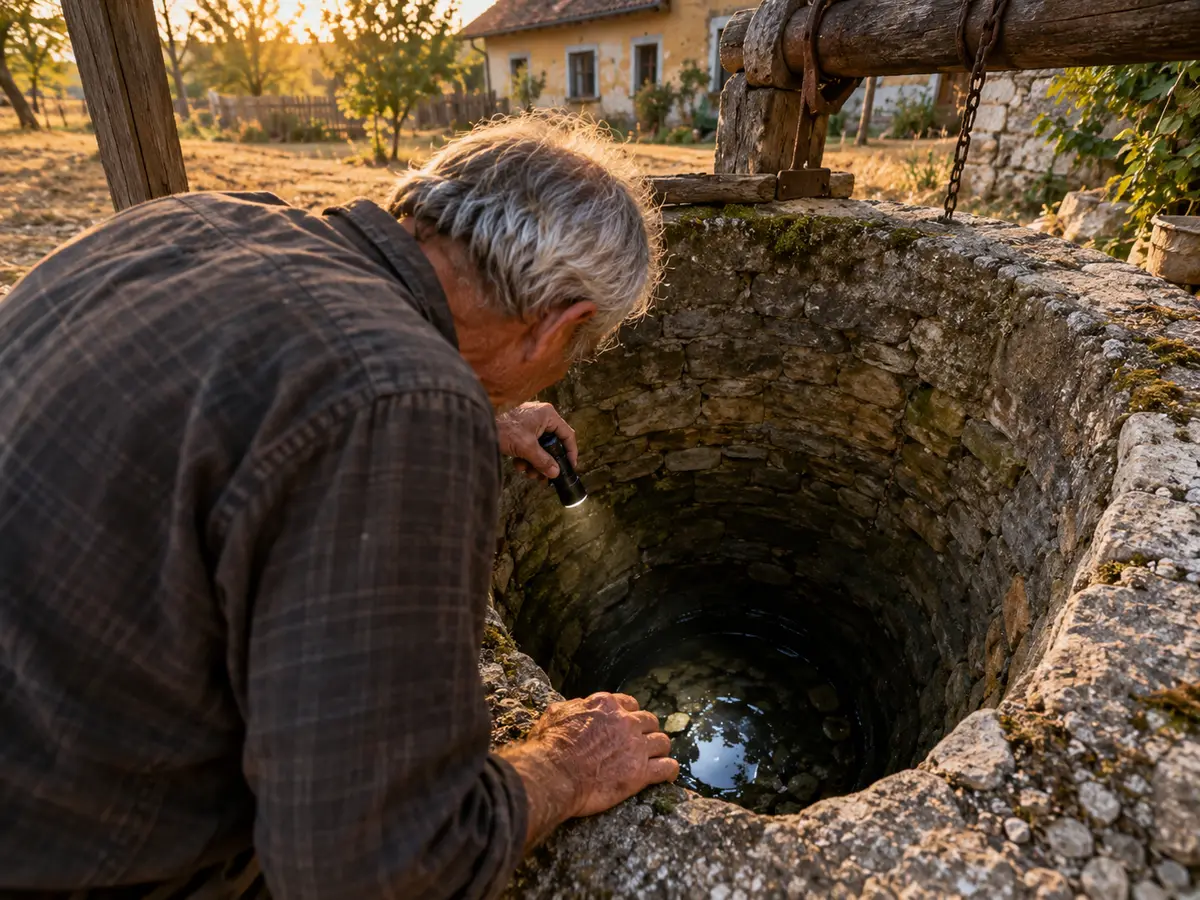
Shallow dug wells and springs are fed from layers just below the surface, and so they react to missing rain sooner than deep boreholes. According to the preliminary ČHMÚ assessment for September, shallow groundwater and spring yield were exceptionally below normal, the worst for September since 1981. Deep boreholes are not safe either, as their level was again exceptionally below normal.
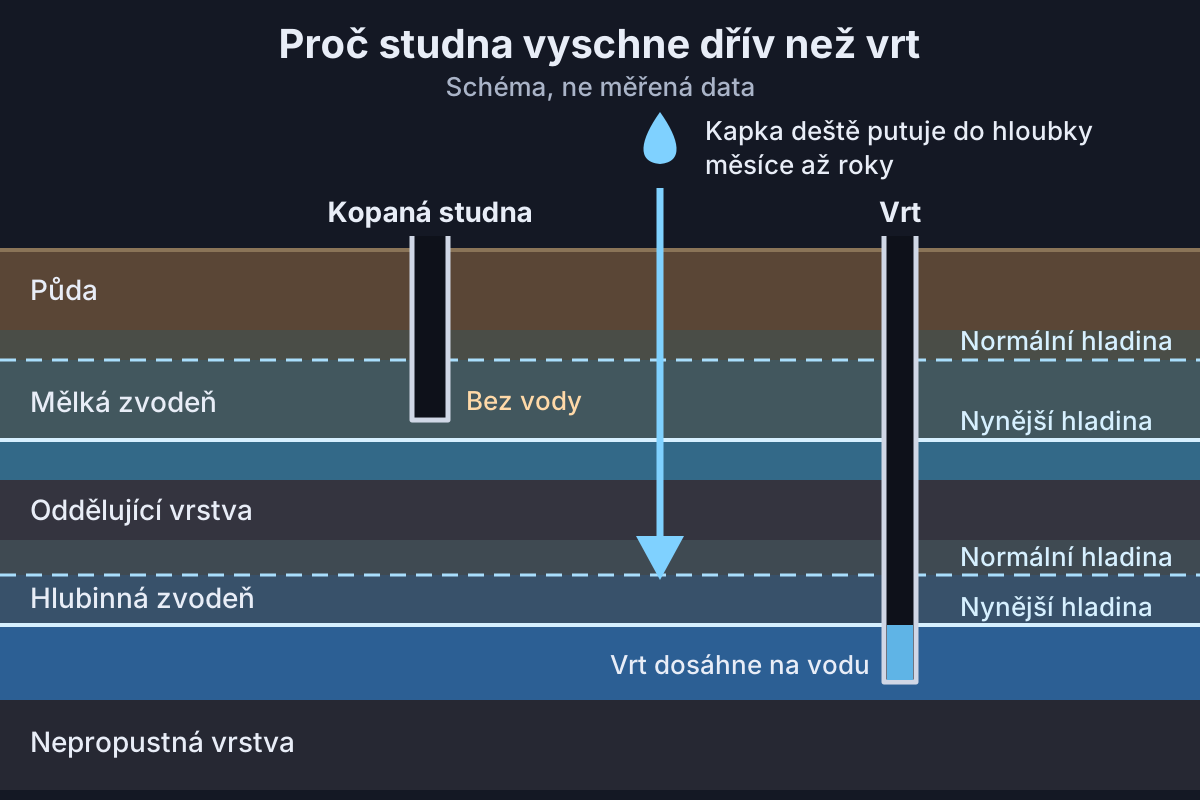
In mid-August, according to the ČHMÚ, 70% of monitored groundwater showed strong or extreme drought, and in mid-October levels remained exceptionally below average. In its outlook of 15 October, the ČHMÚ expects them to stay steady or fall slightly.
When a well weakens
- 01
Measure how much water is left
Find out how deep the water level is and how fast it falls during pumping, so that you know whether it is a fluctuation or a lasting decline.
- 02
Pump little and often
Limit watering and large withdrawals, and let the well refill between pumping sessions before you draw it down to the bottom.
- 03
Protect the pump
Do not let the pump run dry at a very low level, otherwise it will be damaged quickly and silt will get into the house.
- 04
Seek advice before deepening
Deepening a well or drilling a new borehole may require permission from the water authority, and a hydrologist warns that deepening alone will not help in the future.
- 05
Look for another source
According to a hydrologist, municipalities with threatened local sources should negotiate in good time with water companies about connecting to a group water supply.
05Forest and fields
Forest, field and garden are thirsty. Who feels it first
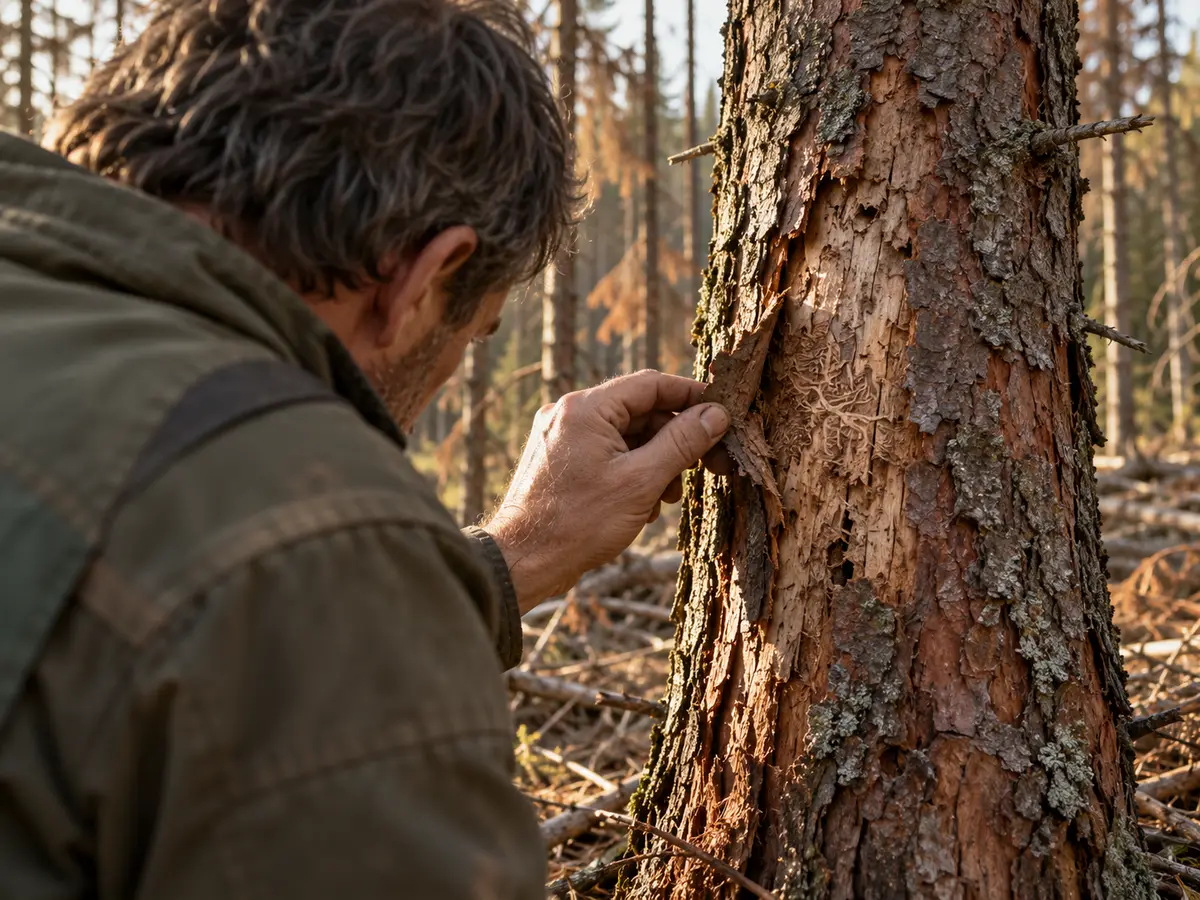
Drought weakens trees, and a weakened tree defends itself less well against the bark beetle. In September Lesy ČR (Forests of the Czech Republic, the state forestry company) said that this year's drought had noticeably weakened forests, and it is preparing an extraordinary survey of their condition. The biggest bark beetle calamity so far broke out in 2018, and at its peak in 2020 the company harvested more than 14 million cubic metres of wood, almost double the usual volume.
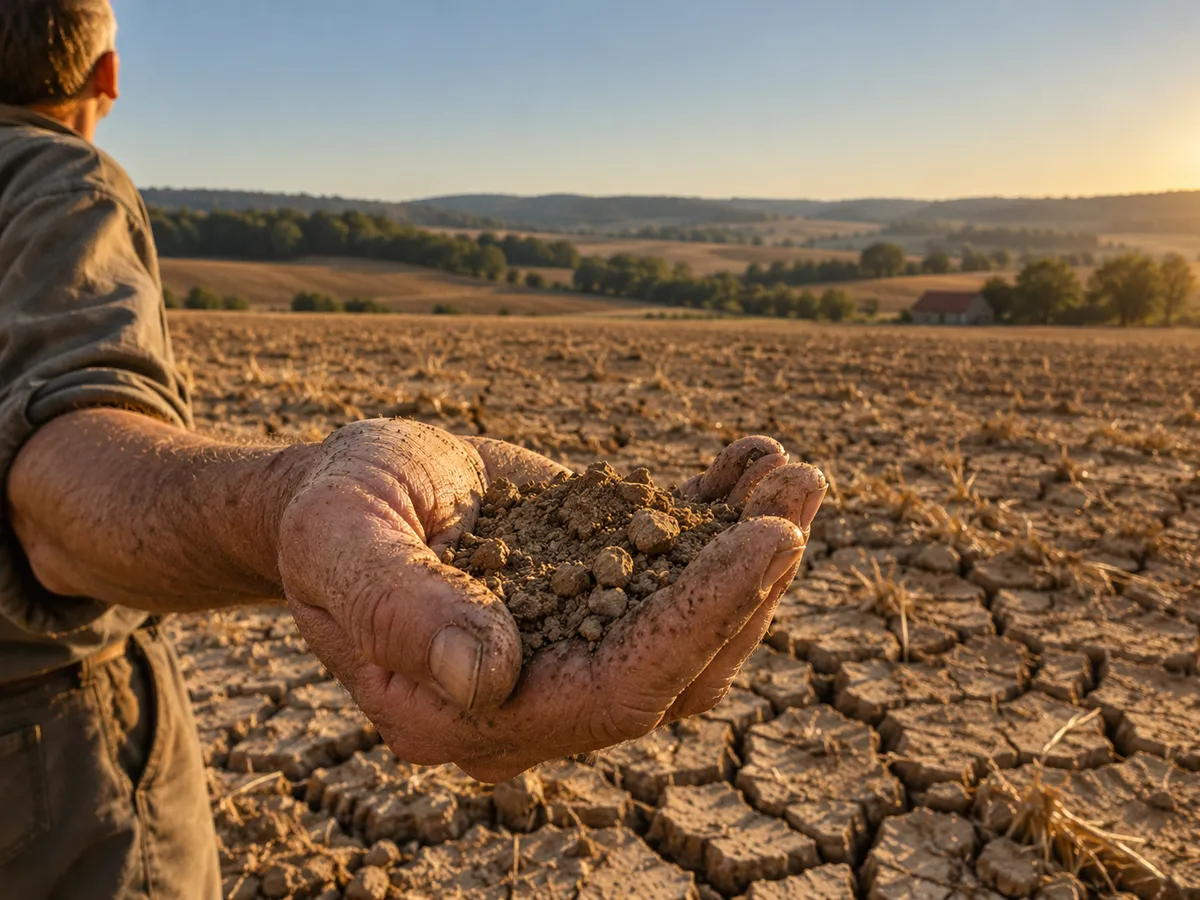
According to the InterSucho drought-monitoring project, this year's growing season has definitively ended in terms of wood formation, so trees will not grow any more this year. Soil drought, however, will keep deepening. The outlook of 15 October expects that within a few days the two worst levels of soil drought may cover almost a third of the territory of Czechia.
Drought also raises the risk of fires. The governor of Jihomoravský kraj (a region in the south-east of the country) declared a period of increased fire danger from 31 July until further notice, during which lighting open fires is banned in threatened places, including forests and the area within 50 metres of them. Jihočeský kraj (a region in the south) in turn declared a state of drought, which, among other things, makes it easier to handle outflow from reservoirs.
The Ministry of Agriculture publishes an overview of issued restrictions on water use as an annex to its monthly report on the state of water resources. In it you can find where the authorities have issued restrictions on water withdrawal.
06Return of water
When will the water return? One rainy week is not enough
Rain that falls on parched ground does not all soak in where we need it most. Part runs off the hardened surface, part evaporates and part is used by plants, so only the remainder reaches the river and the groundwater.
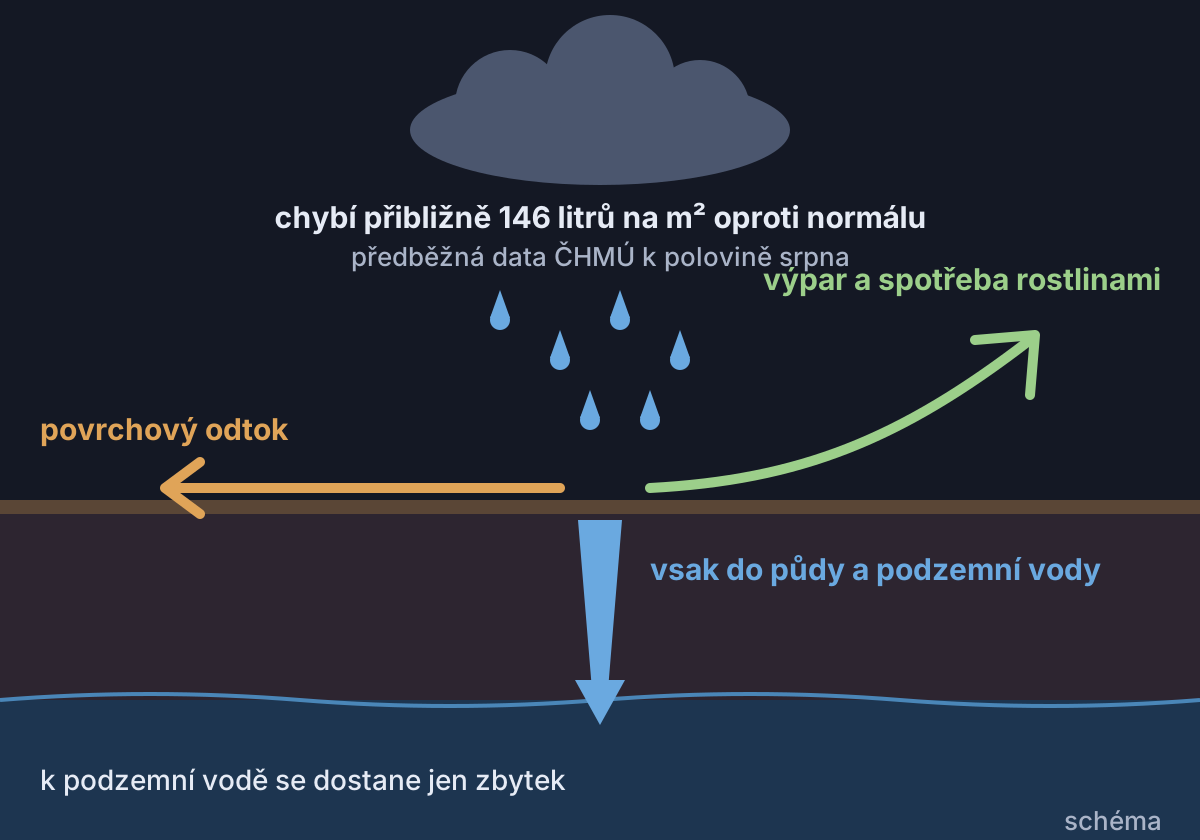
According to the InterSucho project, rainfall before the beginning of October barely saturated the surface layer of soil, and deeper layers have remained unsaturated since the start of spring. That is why water could not drain beneath the surface into rivers either.
By mid-August, according to preliminary ČHMÚ data, on average about 146 mm of precipitation was missing compared with the normal, that is 146 litres on every square metre. September did not wipe out the debt either, with only 44 mm falling in it, preliminarily, that is 73% of the normal. The drought also follows on from 2025, whose first half was the driest since 1961, and the winter of 2025/2026 did not sufficiently replenish water stocks in the landscape or in some reservoirs.
On 8 October the director of Povodí Vltavy estimated that a return to some normal state would require two, three or four months of rain. According to him, the rain that the ČHMÚ forecast for ten days from 8 October could not help the Vltava river basin.
In its outlook of 15 October, the ČHMÚ expects the number of river gauging profiles in a state of drought to keep growing and river levels to remain steady or only slightly fluctuating. In the week before 15 October they were still mostly well below average.
| Question | What we know | What we do not yet know |
|---|---|---|
| Did the rain forecast from 8 October help? | What we know: According to the director of Povodí Vltavy, the rain forecast for ten days from 8 October could not help the Vltava river basin. | What we do not yet know: How the weather will change in the coming weeks. |
| How long will the return take? | What we know: According to the director of Povodí Vltavy, a return to normal would need two to four months of rain, not one rainy week. | What we do not yet know: The exact time cannot be determined, because it depends on how much rain falls and when. |
| What will winter do? | What we know: Water stocks are replenished mainly in the cold half of the year, and in the winter of 2025/2026 this did not happen sufficiently. | What we do not yet know: How plentiful winter will be and whether a store of water will build up in snow. |
| Is drought the new normal? | What we know: According to hydrologists, in future there will be less snow and more rain in winter and snow melts earlier, so groundwater stocks cannot be replenished in time. | What we do not yet know: How often dry summers will recur, we cannot say reliably from the available material. |
So will water return to the rivers at all? It will, but not quickly, and it will return fully only after months of heavy rain and a winter that supplies the landscape with water. What kind of winter it will be, nobody knows yet, and it will decide whether the landscape enters spring in debt or with a reserve.
07What you can do
What you can do before the rain returns
According to the water company Veolia, the average inhabitant of Czechia uses 93 litres of water a day. The biggest savings often hide where water leaks away without our noticing.
| Situation | Consumption or loss |
|---|---|
| Bath | Consumption or loss: 150 to 200 litres |
| Shower | Consumption or loss: 50 to 60 litres |
| Dripping tap | Consumption or loss: 24 litres a day, a heavily dripping one up to 54 litres a day |
| Leaking toilet | Consumption or loss: 150 to 2,000 litres a day |
Five steps you can take right away
- 01
Water in the morning or evening
Morning or evening watering stops water from evaporating before plants can use it.
- 02
One bigger dose a week
One thorough watering a week does a garden more good than several short sprays that wet only the surface.
- 03
Catch rainwater
Use rainwater collected in barrels for watering, and keep them ready under the gutter for the next rain.
- 04
Fix what leaks
Repair a dripping tap and a leaking toilet as soon as possible, because they lose more water than you would think.
- 05
Check for restrictions and the fire ban
Check with your municipality or the authority whether water withdrawal from watercourses has been restricted in your area or lighting fires banned.
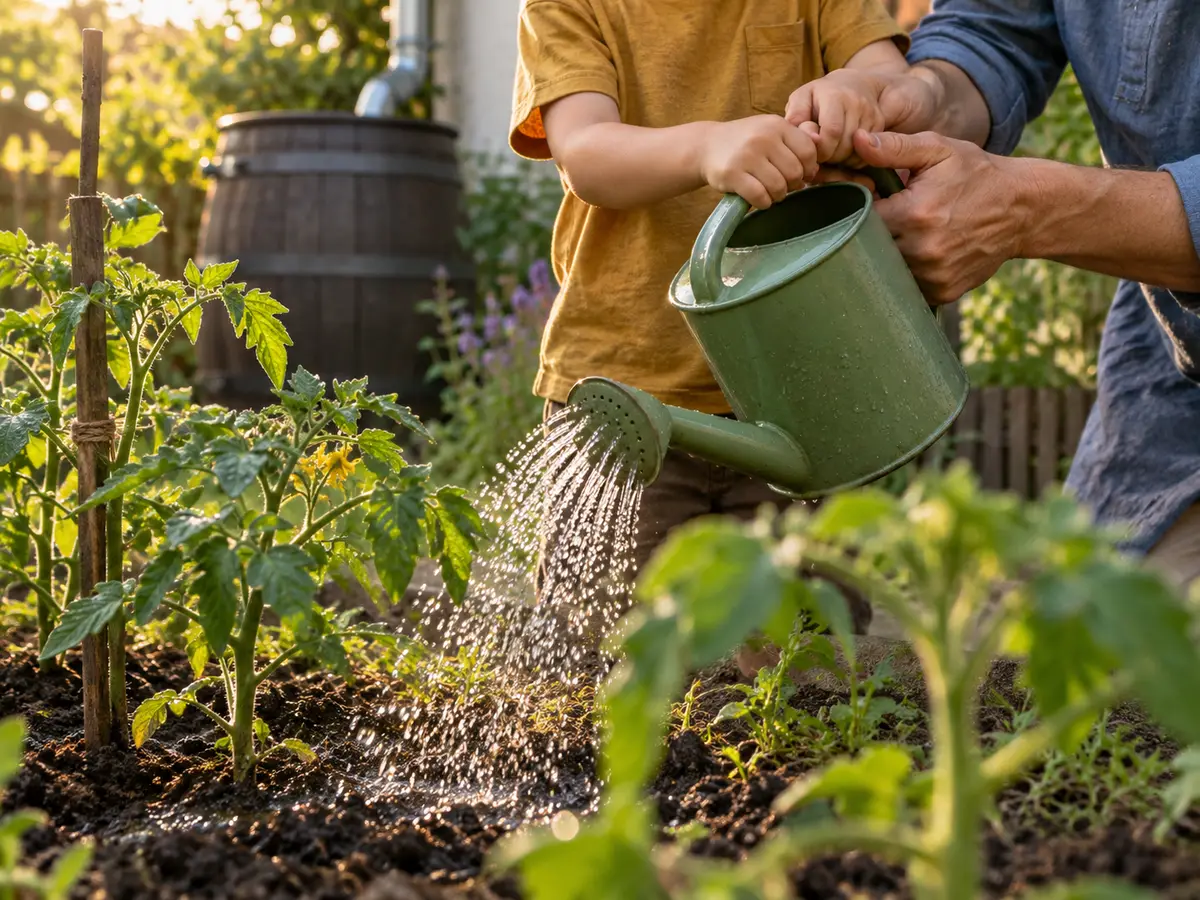
Rainwater tanks were subsidised by the Dešťovka (rainwater) programme, announced by the Ministry of the Environment in spring 2017. In 2021 it covered up to half of costs, and a family house could receive up to 105 thousand Czech koruna. These are, however, the conditions from 2021, so check the current offer.
Forecast for your placeSee when it is finally due to rain where you are and how long the rain will last.Open the forecast08Did you know
Did you know that drought…
Sources18 sources · specific figures come from the sources, the general explanation from expert knowledge
- ČHMÚ (Czech Hydrometeorological Institute) (in Czech)
- ČTK (e15.cz) (Czech News Agency report published by e15.cz) (in Czech)
- ČHMÚ (Czech Hydrometeorological Institute) (in Czech)
- České noviny (ČTK) (Czech News Agency report published by České noviny) (in Czech)
- ČHMÚ (Czech Hydrometeorological Institute) (in Czech)
- ČHMÚ (open data), výpočet Fakt počasí (open data of the Czech Hydrometeorological Institute, calculation by Fakt počasí) (in Czech)
- ČHMÚ (open data), výpočet Fakt počasí (open data of the Czech Hydrometeorological Institute, calculation by Fakt počasí) (in Czech)
- Statutární město Děčín (turistický portál iDĚČÍN) (city of Děčín, tourist portal iDĚČÍN) (in Czech)
- ČTK (České noviny) (Czech News Agency report published by České noviny) (in Czech)
- ČTK (České noviny) (Czech News Agency report published by České noviny) (in Czech)
- ČHMÚ (Czech Hydrometeorological Institute) (in Czech)
- Newstream.cz (zpráva z firem, Lesy ČR) (company news from Lesy ČR, the state forestry company) (in Czech)
- CzechGlobe, Bulletin Intersucho 41/2026 (Intersucho bulletin no. 41 of 2026) (in Czech)
- CzechGlobe (research institute CzechGlobe) (in Czech)
- HZS Jihomoravského kraje (Fire Rescue Service of Jihomoravský kraj) (in Czech)
- Ministerstvo zemědělství, Informace o stavu vodních zdrojů za srpen 2026 (Ministry of Agriculture, information on the state of water resources for August 2026) (in Czech)
- Veolia Česká republika (vodárenská společnost, firemní stránka) (company page of the water company Veolia) (in Czech)
- Státní fond životního prostředí ČR (aktualita z 27. 9. 2021) (State Environmental Fund of the Czech Republic, news item of 27 September 2021) (in Czech)