

In numbers
10.4miliardy světelných let
How far from the Earth the galaxy cluster XLSSC 122 lies
18segments
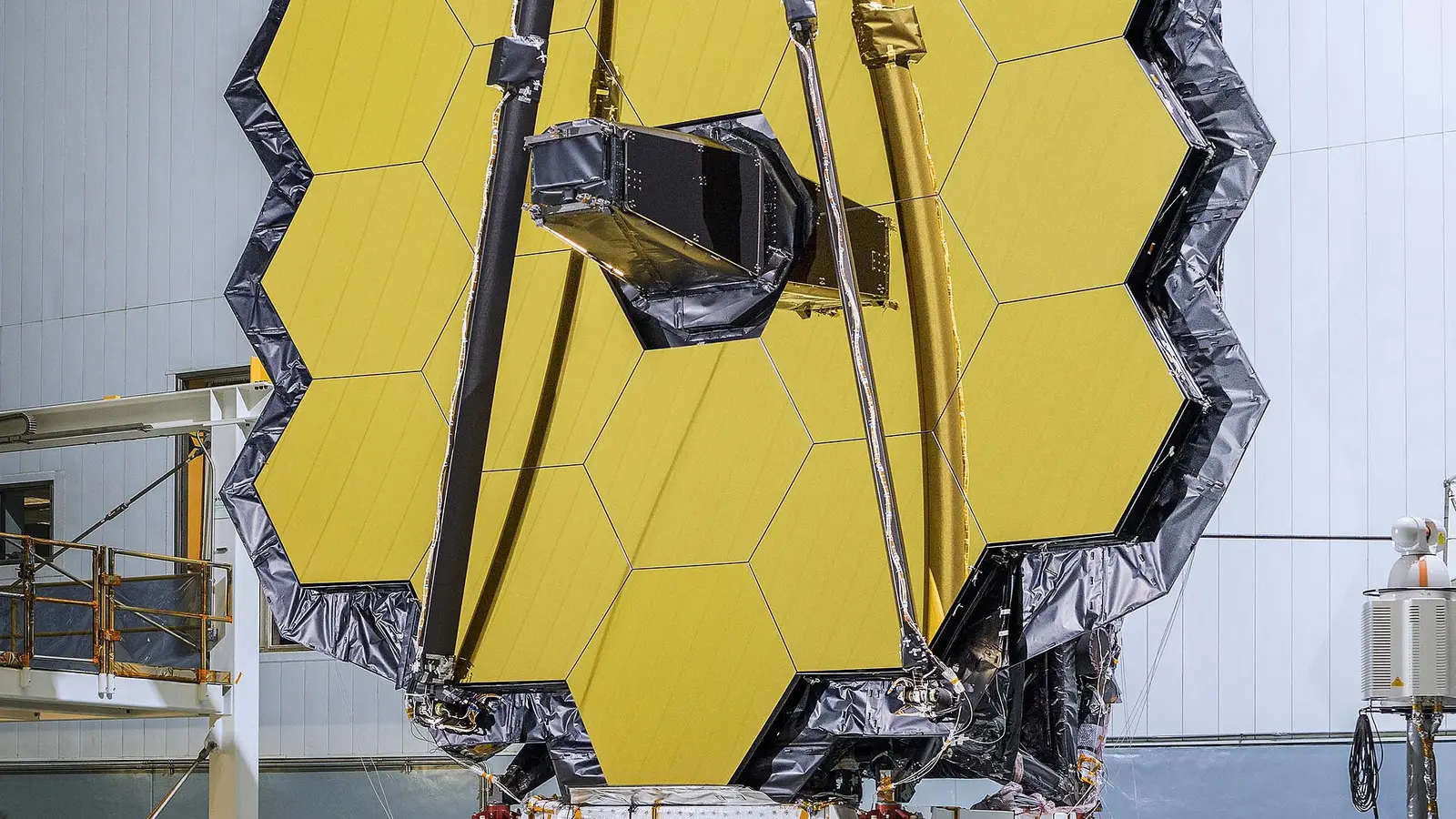
This many hexagonal pieces make up Webb's primary mirror
−225°C
The temperature at which the Webb telescope itself works
The distant galaxy cluster XLSSC 122 has a remarkable amount of mass packed into its centre. According to the study's lead author, this does not agree with what the cosmological model predicts. The cluster was measured by the James Webb Space Telescope, so we begin with the telescope itself, where it flies, what it measures with and why it can see so far back in time.
01What Webb is
A telescope that sees into the past
Where Webb flies and how it got there
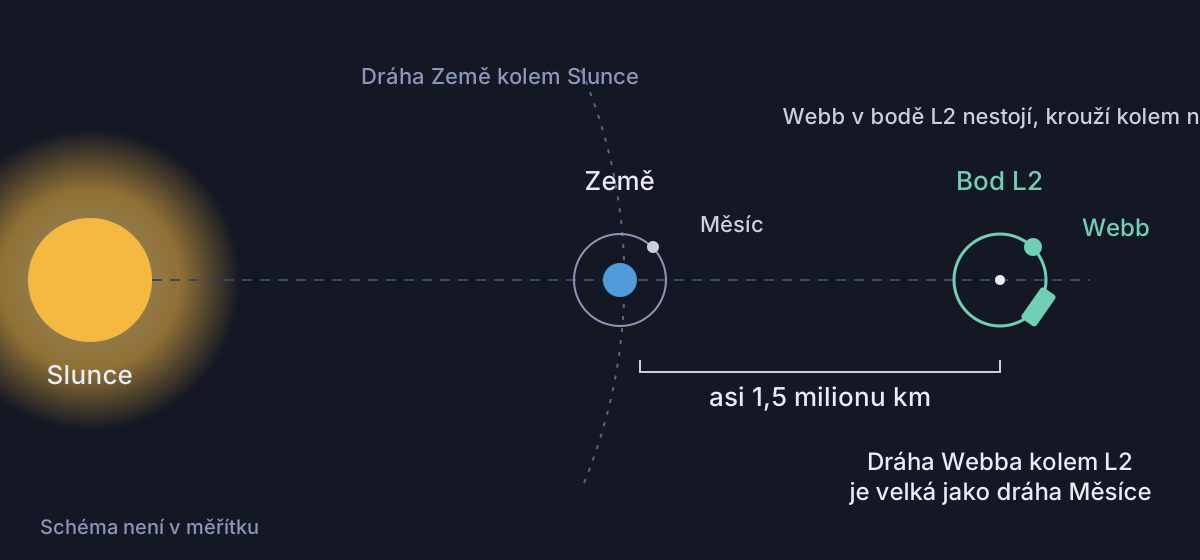
The James Webb Space Telescope launched on 25 December 2021. Unlike Hubble, which orbits only 560 kilometres above the Earth, Webb orbits the Sun about 1.5 million kilometres from us, at a point known as L2. The journey there took about 30 days, and it reached the Moon's orbit, about a quarter of the way, in just 3 days.
Webb does not stand still at L2 itself. It circles it on an orbit roughly as large as the Moon's orbit around the Earth, and one circuit takes it about six months.
The position at L2 has a big advantage. Webb stays in line with the Earth as it orbits the Sun, so its large sunshield protects it from the light and heat of the Sun, the Earth and the Moon.
Hubble dips into the Earth's shadow every 90 minutes, Webb does not, so it can observe continuously day and night. It receives commands and sends data to Earth through the Deep Space Network of antennas up to twice a day.
Webb's instruments
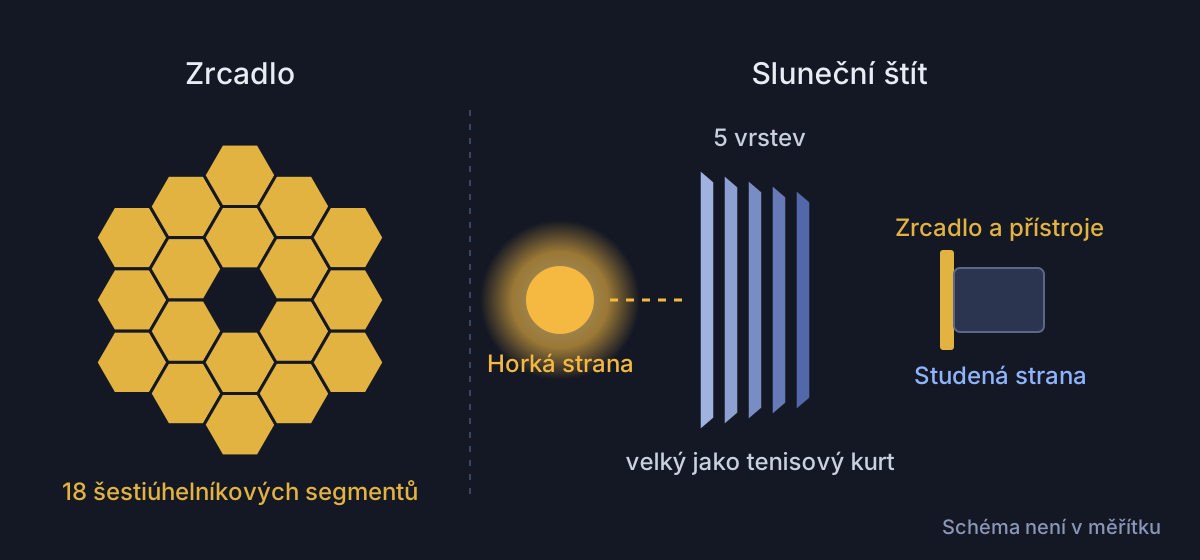
The most important part of the telescope is its primary mirror, made of 18 hexagonal segments of beryllium, a light and strong metal. A thin layer of gold covers them, because gold reflects well the infrared light that Webb collects.
Its mirror is roughly 6.5 metres across, against only 2.4 metres for Hubble's, and according to NASA its collecting area is about six times larger. To travel into space, the whole telescope therefore had to be folded up like origami to roughly a quarter of its size.
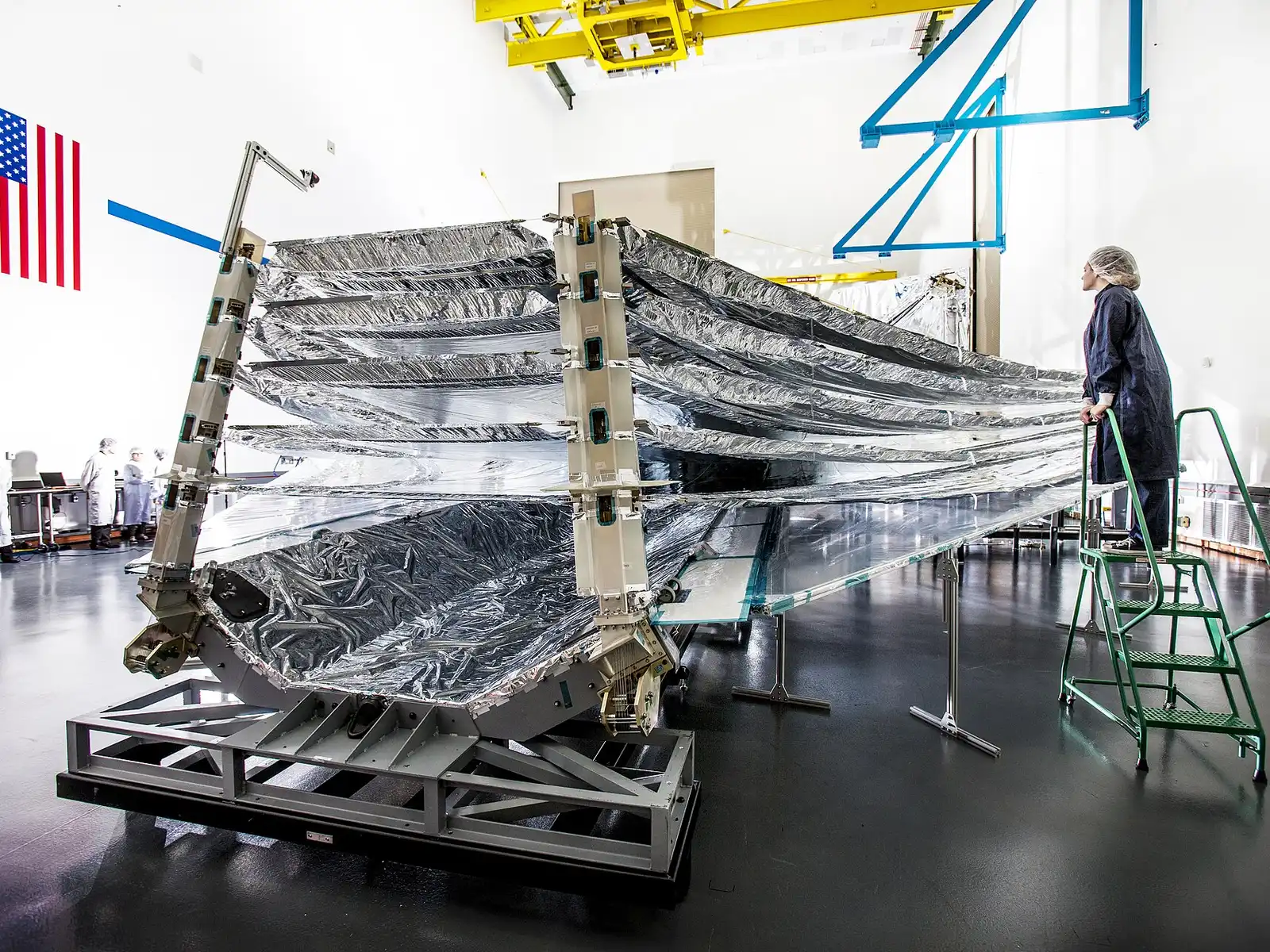

We sometimes feel infrared light as heat, which is why Webb has to shield itself from everything hot. The sunshield, as large as a tennis court and made of five thin layers of film, lowers the temperature from about 85 °C on the hot side to about minus 233 °C on the cold side. The telescope itself therefore works at about minus 225 °C.
The MIRI instrument has detectors that need a temperature below 7 kelvins, just 7 degrees above absolute zero. According to NASA, the shield gives the telescope protection like sunscreen with a factor of a million.
Why Webb sees farther than Hubble
The universe is expanding, so the light of distant objects is stretched to longer wavelengths on its way to us. What once shone blue or ultraviolet reaches us reddened and much fainter, which astronomers call redshift. That is why Webb observes mainly infrared light.
Webb sees light with wavelengths from 0.6 to 28.5 micrometres, Hubble from 0.1 to 2.5 micrometres. It picks up objects up to a hundred times fainter than Hubble, and in the near infrared it has roughly the same sharp resolution as Hubble in visible light.
| Parameter | Hubble | Webb |
|---|---|---|
| Launch | Hubble: 1990 | Webb: 25 December 2021 |
| Primary mirror diameter | Hubble: 2.4 m | Webb: roughly 6.5 m |
| Light it sees | Hubble: 0.1 to 2.5 micrometres | Webb: 0.6 to 28.5 micrometres |
| Position | Hubble: 560 km above the Earth | Webb: around the point L2, about 1.5 million km from the Earth |
| Earth's shadow | Hubble: every 90 minutes | Webb: none, it observes continuously |

We look into the past, not the future
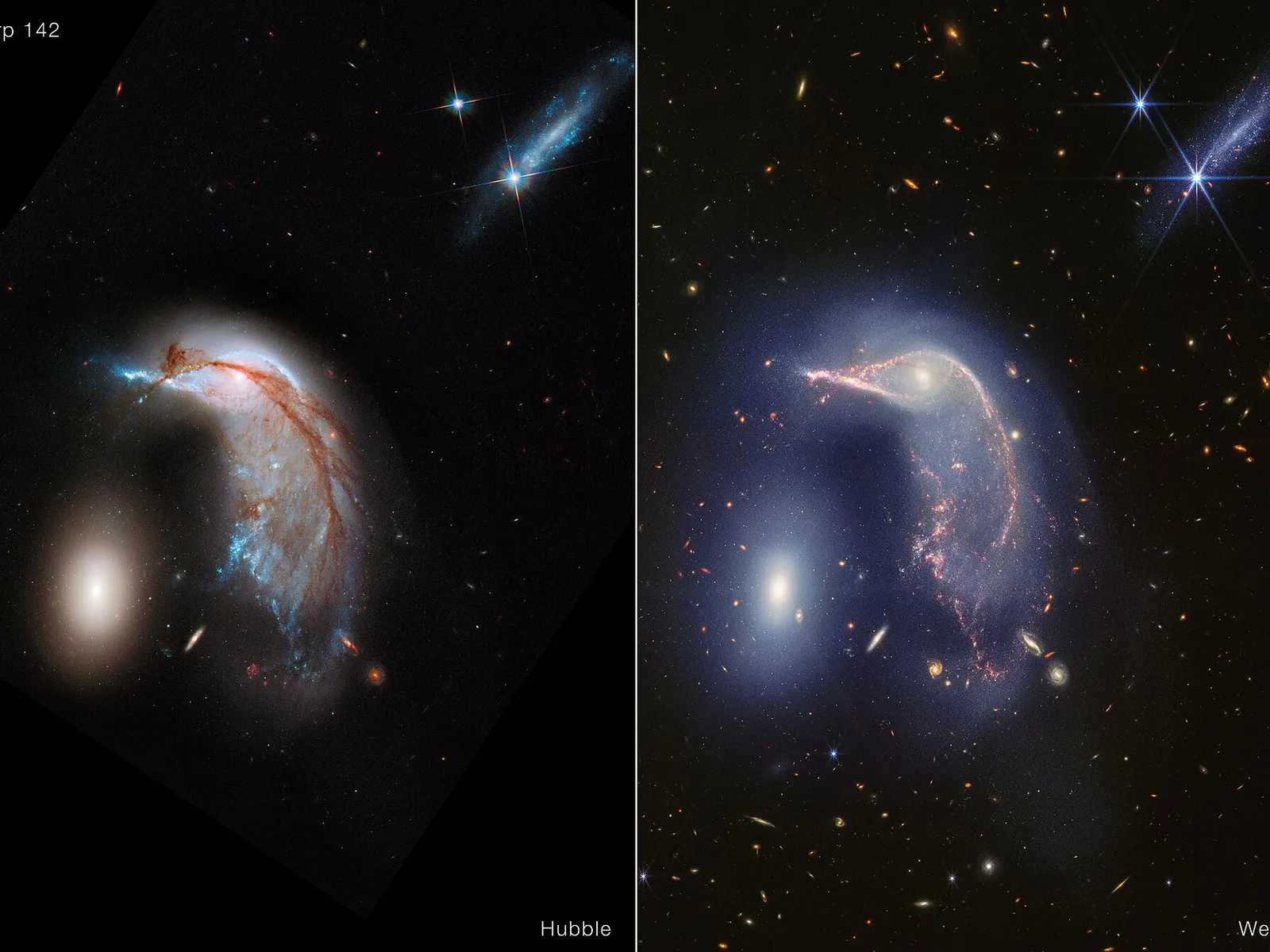
Light travels at a finite speed, so every look into the distance is also a look into the past. Light takes roughly eight minutes to reach us from the Sun and over four years from the nearest star. Webb can therefore see more than 13.5 billion years back, to the time of the first stars and galaxies.
The future cannot be seen, because light that has not yet been created cannot reach us. We therefore see the cluster XLSSC 122, roughly 10.4 billion light-years away, as it was about 10 billion years ago.
Galaxy clusters, dark matter and dark energy
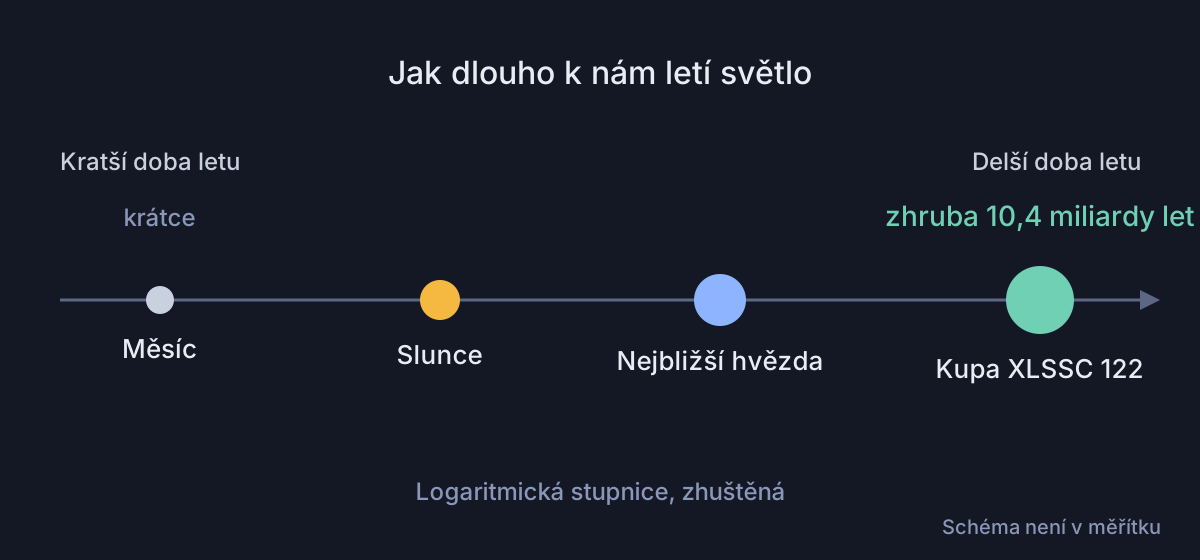
A galaxy cluster is a giant grouping of galaxies held together by their shared gravity. Clusters hold hundreds or thousands of galaxies, and the Coma cluster, for example, contains over a thousand.

Dark matter and dark energy only sound alike, otherwise they are two different things. Dark matter attracts through gravity, but it does not reflect, absorb or emit light, at least not in a way we can detect so far. It forms an invisible scaffolding that pulls in most of the ordinary matter in the universe, and scientists do not yet know what it actually is.
Dark energy, by contrast, is the name for the unknown cause of the universe expanding ever faster. According to the leading explanation, it acts as a repulsive force and pushes the universe apart, instead of pulling it together.
Infographic
What the universe is made of
Can Webb find aliens?
Not directly, but it can help. Webb studies the atmospheres of distant planets around other stars, measures the physical and chemical properties of planetary systems and, according to NASA, may find the building blocks of life elsewhere in the universe. It transmits nothing itself, its mirror only passively collects light, so it will not send any message to possible aliens.
Yet the building blocks of life are not life itself, and even if Webb found elsewhere a substance that organisms produce on Earth, it would remain only a hypothesis until further observations confirmed it.
02Curiosities
Gold, an elephant and a bicycle uphill
Five small facts about Webb
- 01
Just 50 grams of gold
All the gold on Webb's mirrors weighs only about 50 grams. A layer that thin is enough for the mirrors to reflect infrared light.
- 02
Precision to a hair
The mirror segments are aligned to within roughly one ten-thousandth of the thickness of a human hair.
- 03
As heavy as an elephant
On Earth, Webb weighed over 13,000 pounds, which is roughly six tonnes, almost as much as an adult African elephant.
- 04
Hubble's material would never get off the ground
A primary mirror the size of Webb's, made of the same material as Hubble's, would be too heavy to launch into space.
- 05
A bike ride uphill
NASA compares the journey to L2 to cycling uphill, where you pedal hard only at the start and coast the rest of the way.
03What it saw
The galaxy cluster XLSSC 122
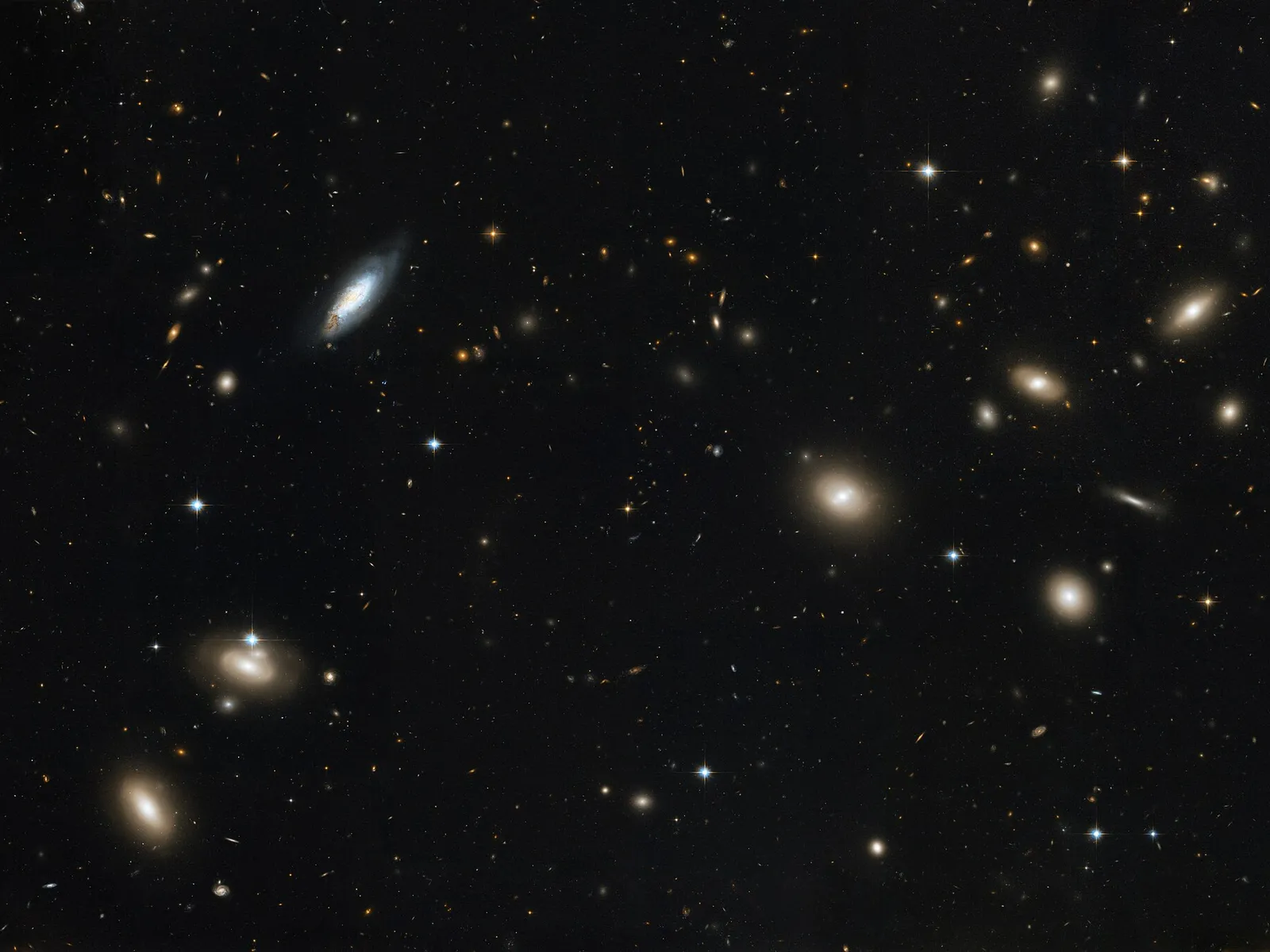
Webb targeted the cluster XLSSC 122, which astronomers discovered as early as 2014 in an X-ray survey by the European satellite XMM-Newton. It lies roughly 10.4 billion light-years from the Earth, and it caught astronomers' attention with its surprising maturity.
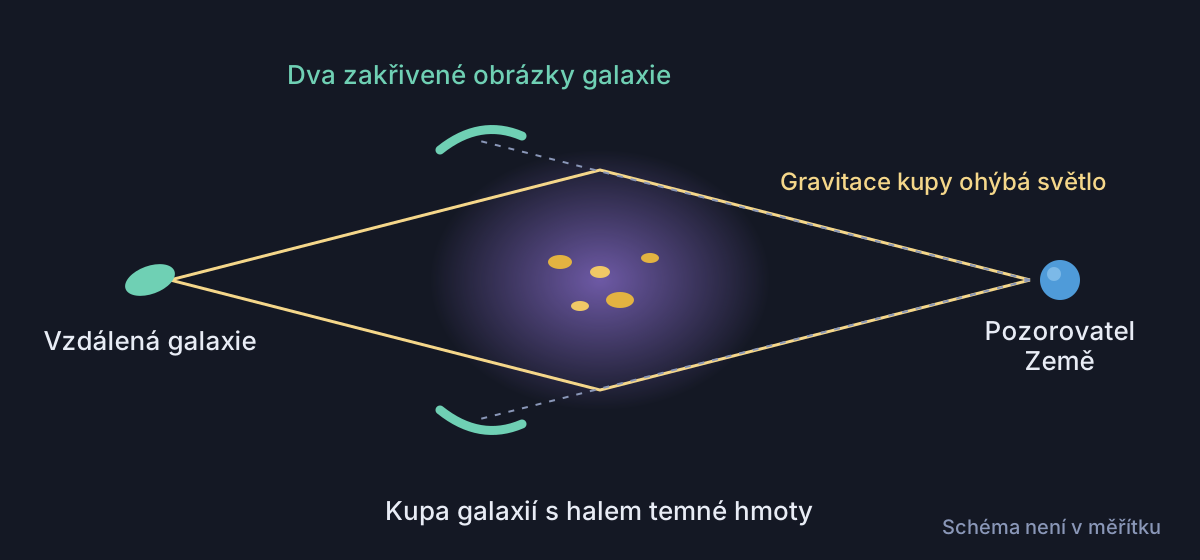
The enormous gravity of the cluster bends the light of galaxies lying far behind it, much like a lens. This creates curved arcs of light, and the effect is called strong gravitational lensing. Hubble did not clearly show it for this cluster, but Webb captured the characteristic arcs around its centre.
From how strongly the cluster bends light, its mass can be measured, including the dark matter that we cannot see at all. Most of the distortion is in fact caused by dark matter. XLSSC 122 is also the most distant galaxy cluster in which strong lensing has been observed.
When Webb saw it and when the world found out
The date the images of the cluster were taken has not been published. All we know is that the first study of this cluster's strong lensing was submitted to the arXiv server on 11 August 2025, so the images must have been taken earlier.
- When: 2014What happened: The cluster was discovered by an X-ray survey from the XMM-Newton satellite
- When: 11 August 2025What happened: The first study of strong lensing was submitted to the arXiv server
- When: December 2025What happened: The study was published in The Astrophysical Journal Letters
- When: 17 June 2026What happened: The team presented the results at the 248th meeting of the American Astronomical Society
- When: 13 October 2026What happened: A Caltech IPAC report on three studies of the cluster was published on the ScienceDaily website
How far back in time it is
The light from the cluster travelled for roughly 10.4 billion years. Subtract that from the age of the universe, about 13.8 billion years, and the universe was then only roughly 3.4 billion years old. It was the time of the most turbulent star formation, when galaxies made stars up to a hundred times faster than today.
What startled astronomers
There is a remarkable amount of matter packed into the centre of the cluster. Within about 326 thousand light-years of the centre alone, the authors estimated it at roughly 65 trillion solar masses, with an uncertainty of around a tenth. Lead author Kyle Finner says that such a concentration of matter does not match the predictions of the cosmological model.
Three recent studies by IPAC scientists analyse the cluster in all. According to them, the cluster is still merging, and Webb detected in it the oldest intracluster light known so far, a faint glow of stars between galaxies. In this cluster that light essentially follows the distribution of dark matter.
04Wrong?
Can Webb be wrong and how would we tell
We cannot see dark matter, so we weigh it by how it bends light. Strong lensing measures the mass near the cluster centre, while weak lensing shows how the mass is distributed in the outer regions. The team therefore combined the lensing results with X-ray and radio observations from other telescopes.
How densely matter is packed towards the centre is expressed by a number called concentration, and the authors found 6.3 ± 0.5. It is based on a model shape of the mass distribution to which the data were fitted, and weak lensing changes the shapes of distant galaxies so slightly that it can only be detected statistically.
Where errors can come from
| Source of error | What could happen | What we know about it |
|---|---|---|
| Mass estimate | What could happen: The result depends on the shape of the mass distribution that is put into the calculation | What we know about it: The authors state the uncertainty and supplemented the lensing with X-ray and radio observations |
| Weak lensing | What could happen: Galaxies are distorted so slightly that it cannot be seen in any single one | What we know about it: Astronomers therefore detect it statistically |
| Choice of objects | What could happen: One cluster may be the exception rather than the rule | What we know about it: The team wants to examine dozens of other clusters from a similarly early period |
| Narrow field of view | What could happen: Webb studies selected targets and cannot search large areas of the sky | What we know about it: The Sunyaev–Zeldovich effect may help to find other distant clusters |
| Distance (redshift) | What could happen: A wrong distance would also distort the age of the cluster | What we know about it: The study is based on a redshift of 1.98. How it was verified is not something we can read anywhere |
The authors report their results with some uncertainty, and according to the report on the discovery, a larger sample of clusters will be needed to decide whether this is an exception. The first study appeared in a scientific journal. No independent check by another team has been published yet, so the result is still awaiting confirmation.
05Tension with models
Why this troubles the models
According to the standard cosmological models, large structures in the universe should have grown gradually. XLSSC 122, however, according to the observations, matured unexpectedly early. The study's authors write that this adds to the signs that large structures in the early universe may have formed faster than the standard models assume.
At that time galaxy clusters were only becoming more common, as smaller systems gradually merged into larger ones. This cluster, however, already had the size and arrangement typical of today's galaxy clusters.
The authors do not give the size of the discrepancy as a single number. All we know is that the concentration of the core is exceptionally high and, according to Kyle Finner, disagrees with the model's predictions.
06Certain and open
What is certain and what is still hypothesis
| Certain (measured) | Open (we do not know yet) |
|---|---|
| XLSSC 122 is the most distant cluster in which strong lensing has been observed | Open (we do not know yet): Whether it is an exception or a common pattern of the early universe |
| Matter at the cluster centre is unusually packed, the concentration came out at 6.3 ± 0.5 | Open (we do not know yet): Whether it is enough to adjust the models or something new lies behind it |
| The cluster is still merging and the intracluster light follows the distribution of dark matter | Open (we do not know yet): Whether the same holds in other early clusters |
| Dark matter makes up about 27 % of the universe | Open (we do not know yet): What dark matter actually is |
Behind it all there may be a distorted mass estimate, the exceptional nature of this single cluster, a need to adjust the models, or dark matter of a different nature than we assume.
The team wants to find and study dozens of other clusters from similarly early times, and a method based on the Sunyaev–Zeldovich effect may help in the search. If other ancient clusters also turn out to have unexpectedly concentrated dark matter and unusually advanced development, scientists may have to rethink basic assumptions about how fast large structures formed.
Finner adds that only data on dozens to hundreds of such objects from this period of the universe will make it possible to truly test the cosmological models.
Look at the night skyYou can find what is visible above you right now, and when, on the sky page.Open the sky