
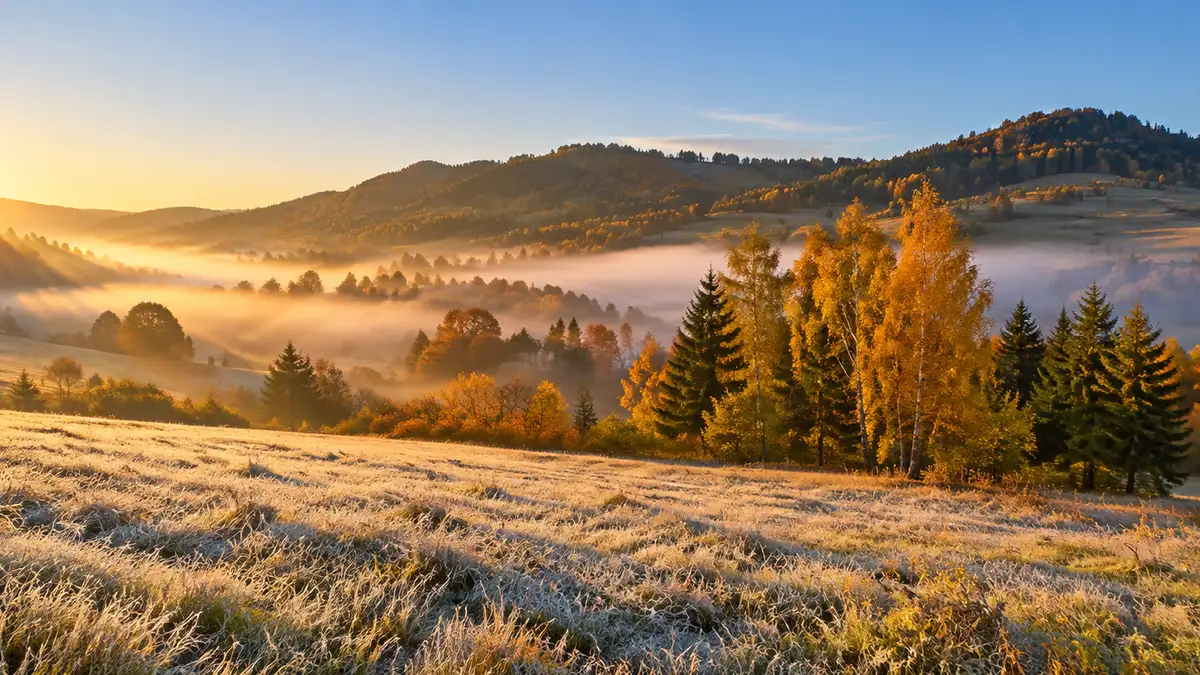
Babí léto (literally ‘old women’s summer’) is the Czech folk name for a settled spell of clear, chilly nights and warm, sunny days that follows the first cold snaps of autumn, much like what English speakers call an Indian summer. What surprises people most is the contrast. In the afternoon you can sit outside in a T-shirt, yet in the morning the grass may be white with hoar frost. The key to understanding it is the height above the ground at which temperature is measured.
01How it works
Why it is called babí léto and where the big temperature differences come from
Babí léto is one of the so-called singularities. These are fairly regular departures from the usual course of the weather through the year, and they arise because certain weather patterns occur more often at a particular time of year. On the long-term average, babí léto falls between 21 September and 2 October. In some years, however, it is barely noticeable, while in others it lasts several weeks.
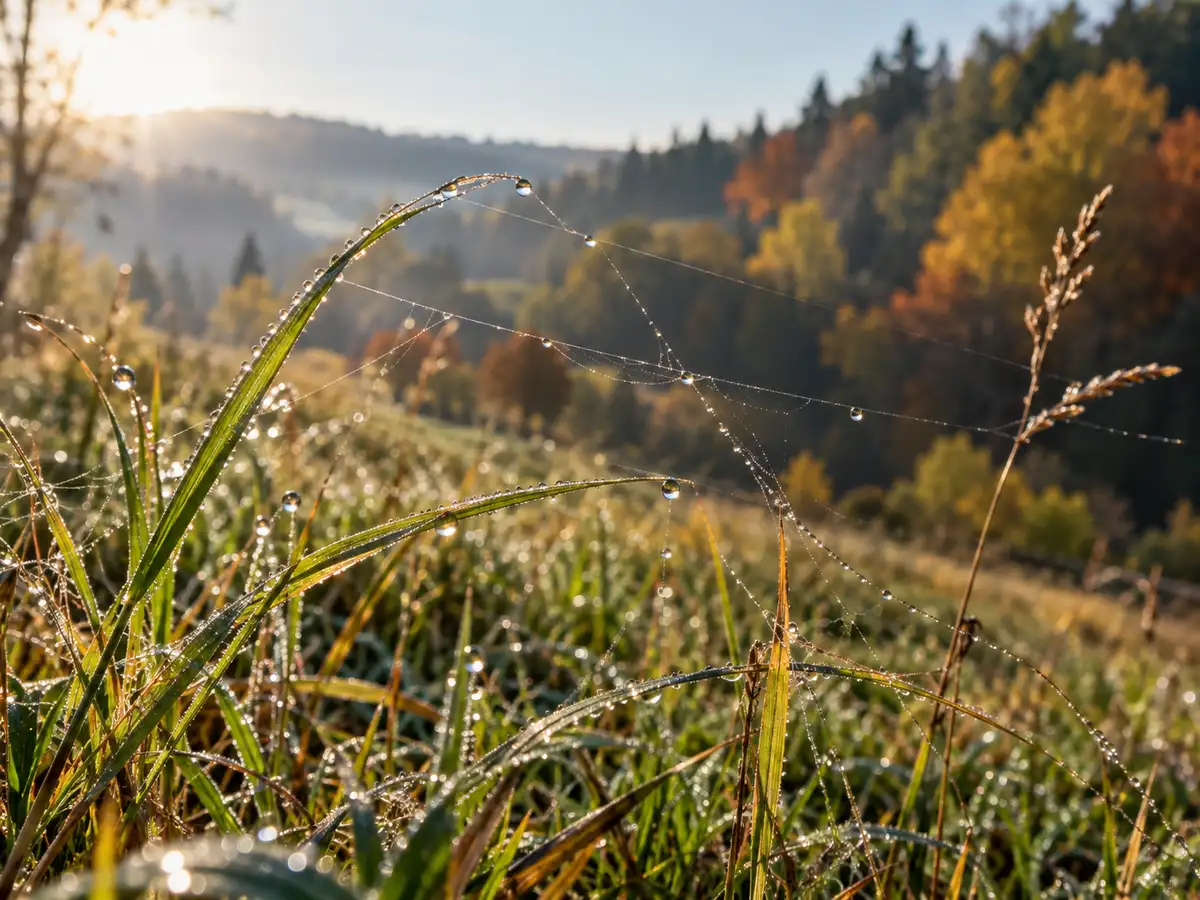
The name comes not from the weather but from cobwebs. The phrase ‘babí léto’ refers first and foremost to the threads of gossamer drifting through the air at the end of summer, and only figuratively to late summer itself.
The threads are released by young spiders. During the day the spiders let themselves be carried aloft on them by rising warm air, and in the evening, as the updraughts weaken, they sink back to the ground. Many flights fail or are short, so plenty of threads are left in the vegetation, where dew and the low autumn sun make them strikingly visible. As early as 1860, Jan Evangelista Purkyně, the Czech physiologist and naturalist, wrote in Živa, a Czech natural-science magazine, about spiders ‘spinning the so-called babí léto’.
Behind babí léto lies an extensive anticyclone, an area of high air pressure, which settles over central and south-eastern Europe in autumn. Within it the air slowly sinks and dissolves the cloud, the wind drops and conditions tend to be dry. During the day the sun therefore warms the landscape pleasantly, but at night, with no cloud cover, the heat escapes easily into space.
So how can you tell that it really is babí léto and not just a single, randomly warm day? Typical signs are several days in a row with clear skies, light winds and summery afternoon temperatures, along with cold nights, heavy dew and morning fog in places. One warm afternoon does not make babí léto. What matters is a persistent area of high pressure that keeps such weather going for several days.
A cloudless, windless night is decisive for the layer of air near the ground. The ground radiates heat, with no clouds little of it comes back, and there is no wind to mix the air, so the surface and the air just above it cool the most. Cold air is heavier than warm air, so it stays close to the ground, while two metres higher it is usually noticeably warmer.
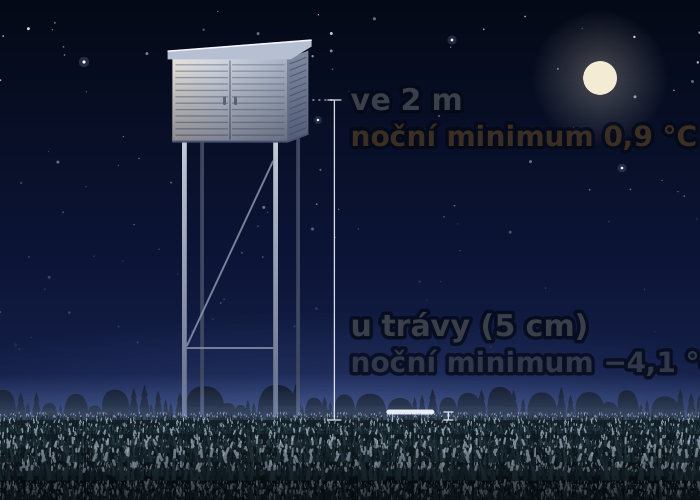
That is why it matters where temperature is measured. Air temperature is normally measured and forecast two metres above the ground, but the ground minimum temperature is recorded just five centimetres above it. When the ground temperature drops below freezing during the night, there is a ground frost, even if the temperature at two metres stays above zero.
02Weather service measurements
Strakonice and Doksany, frost in the morning and summer in the afternoon
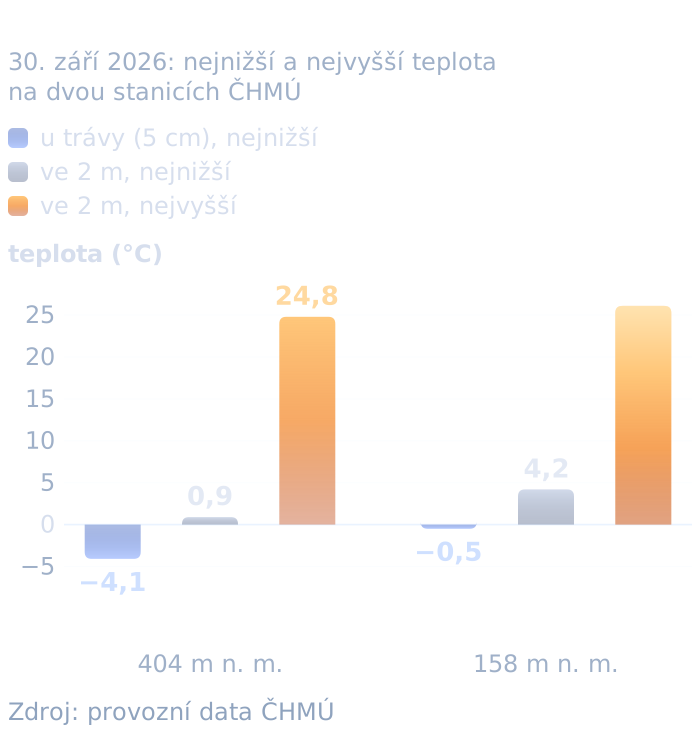
Two stations of the ČHMÚ (Czech Hydrometeorological Institute, the national weather service) show this clearly on 30 September 2026. In Strakonice the temperature five centimetres above the ground fell to −4.1 °C, but at two metres only to 0.9 °C, and in the afternoon, according to preliminary data, it warmed up to 24.8 °C. In Doksany the morning difference between the two heights was similar, around five degrees, and in the afternoon, according to preliminary data, 26.1 °C was recorded there.
| Station | Ground minimum (5 cm) | Night minimum (2 m) | Morning difference | Maximum (2 m) |
|---|---|---|---|---|
| Strakonice (404 m above sea level) | Ground minimum (5 cm): −4.1 °C | Night minimum (2 m): 0.9 °C | Morning difference: 5.0 °C | Maximum (2 m): 24.8 °C |
| Doksany (158 m above sea level) | Ground minimum (5 cm): −0.5 °C | Night minimum (2 m): 4.2 °C | Morning difference: 4.7 °C | Maximum (2 m): 26.1 °C |
So, according to standard measurements, there was no frost at two metres at either station, yet five centimetres above the ground the temperature was below freezing. The difference of almost 29 °C that, according to preliminary data, separates the morning minimum by the grass from the afternoon maximum at two metres in Strakonice therefore does not show how much a single thermometer warmed up. It arises from the contrast between two heights and two times of day.
03A week of ground frosts
Day by day in the Fakt počasí figures
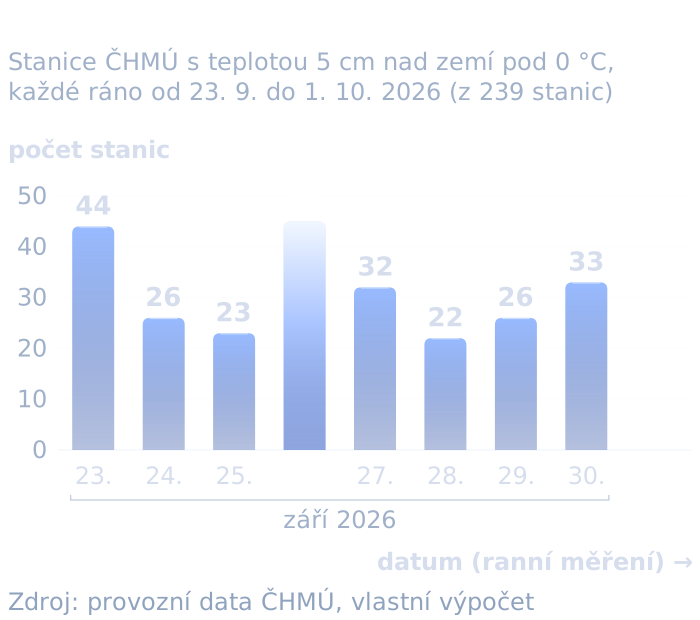
Frosty mornings at ground level kept recurring at the end of September. Using daily ČHMÚ data for 240 selected stations, we calculated how many of them recorded a ground temperature below zero between 23 and 30 September. Each morning it was between 22 and 45 stations, with the most on 26 September and the fewest on 28 September.
| Day | Below 0 °C at ground level | Stations with a valid measurement |
|---|---|---|
| 23 Sept | 44 | 239 |
| 24 Sept | 26 | 239 |
| 25 Sept | 23 | 238 |
| 26 Sept | 45 | 239 |
| 27 Sept | 32 | 239 |
| 28 Sept | 22 | 237 |
| 29 Sept | 26 | 239 |
| 30 Sept | 33 | 238 |
Strakonice and Doksany were not the only places where there was frost at ground level but not at two metres. On 30 September this was the case at 30 of the 237 stations with valid readings at both heights. It is exactly this kind of morning that forecasts during the growing season describe as a ground frost.
04Frost hollows
What happens in hollows, Jizerka and Kvilda
It is usually coldest in dips and basins. On a clear night, cold air drains down the slopes and collects at the bottom, forming what is known as a cold-air pool. Unless wind or sunshine stirs it up, it stays there and does not mix with the warmer air above.
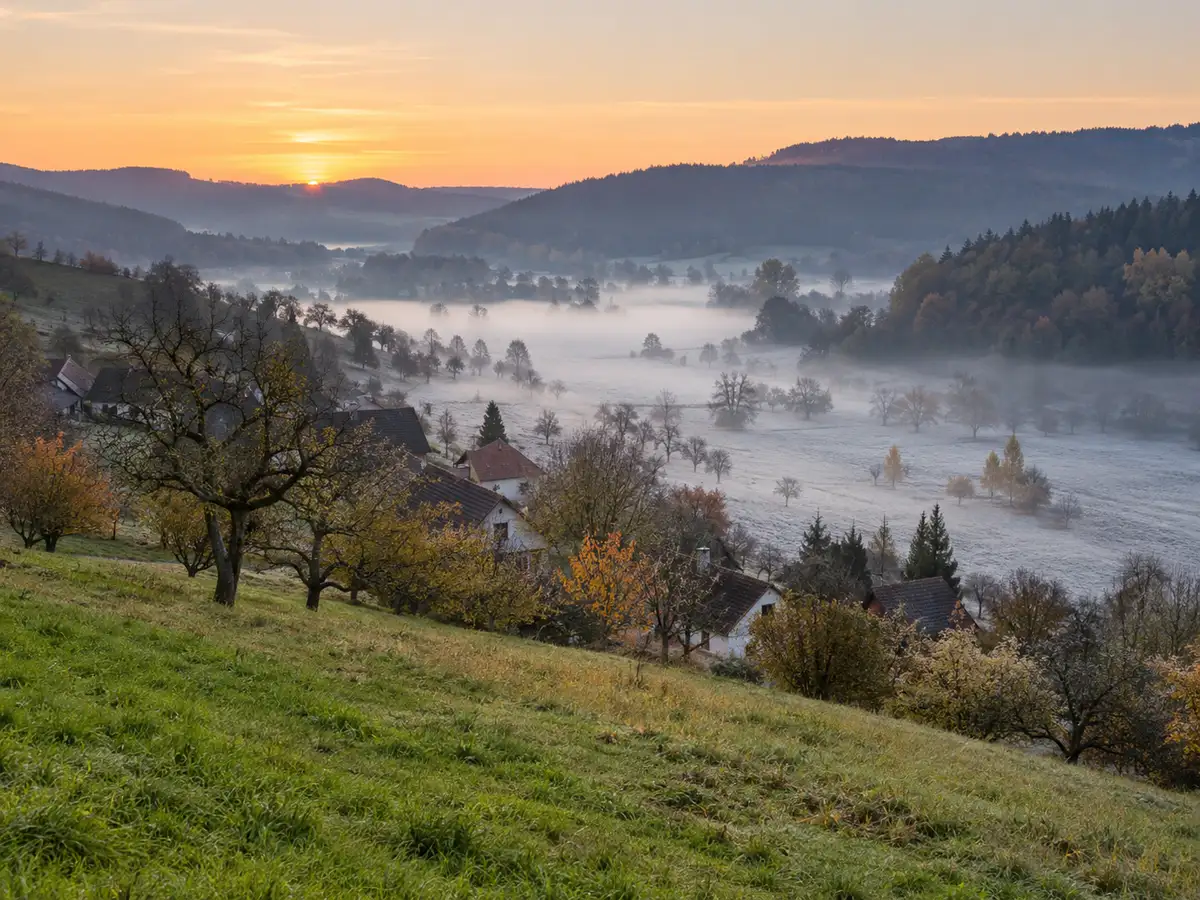
Czech frost hollows include Jizerka in the Jizera Mountains (Jizerské hory) in the north of the country and Horská Kvilda in the Šumava, a mountain range on the Czech–German border. The layer of cold air at the bottom of these hollows is several metres deep or more, so it occasionally freezes there even at two metres, not just at ground level. At Jizerka on 7 September 2026 the ground temperature fell to −3.7 °C and the temperature at two metres to −1.9 °C.
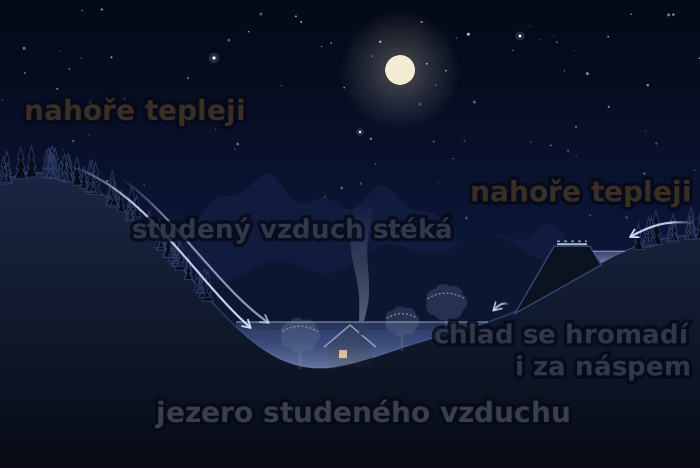
At Jizerka, a ground temperature as low as −5.3 °C was recorded on 26 September. In Volary, a town in the Šumava, it was −3.8 °C at two metres and −6.3 °C at ground level on 30 September, while in Strakonice and Doksany the thermometer at two metres stayed above zero.
Horská Kvilda holds the record for the lowest September temperature measured in the ČHMÚ’s standard network, −10.5 °C on 21 September 1997.
05Garden and field
How frost wreaks havoc in the garden
In autumn, frost can harm grapevines if it kills the leaves before the harvest. The sugar content of the grapes then stops rising, and the wood, which has to survive the winter, may also ripen less well.

For winter crops, the cereals and oilseed rape sown in autumn, a mild frost can even help. They gain frost resistance as temperatures fall gradually towards freezing, and short spells of mild frost down to −4 °C also support it. Prolonged autumn temperatures above 10 °C, by contrast, prevent high resistance from developing.
06Long-term trend
Frost days are becoming rarer, what that does and does not tell us
Frost days, that is days when the daily minimum air temperature drops below 0 °C, have been declining in Czechia over the long term.
| Period | Average number of frost days |
|---|---|
| 1961 to 1990 | 120.2 |
| 1991 to 2020 | 110.8 |
The decline, however, only means that there are fewer days when the air temperature at two metres drops below zero. It says nothing about ground frosts at five centimetres, because a frost day is defined by the temperature at two metres, nor about whether babí léto is becoming more or less frequent. Whether the number of ground frosts or the regularity of babí léto is changing would have to be shown by separate long-term measurements.
Sources21 sources · specific figures come from the sources, the general explanation from expert knowledge
- ČHMÚ, otevřená data (own calculation (preliminary data)) (in Czech)checked 2 October 2026
- Babí léto (in Czech)checked 2 October 2026
- babí (in Czech)checked 2 October 2026
- Altweibersommerchecked 2 October 2026
- Pavouci a babí léto (in Czech)checked 2 October 2026
- Meteorologická terminologie (in Czech)checked 2 October 2026
- ČHMÚ, otevřená data (own calculation (preliminary data)) (in Czech)checked 2 October 2026
- Bodenfrostchecked 2 October 2026
- ČHMÚ, otevřená data, metadata klimatologických stanic (in Czech)checked 2 October 2026
- ČHMÚ, otevřená data (own calculation) (in Czech)checked 2 October 2026
- Mrazová kotlina (in Czech)checked 2 October 2026
- ČHMÚ, otevřená data (own calculation) (in Czech)checked 2 October 2026
- ČHMÚ, otevřená data (own calculation) (in Czech)checked 2 October 2026
- Historické extrémy počasí (in Czech)checked 2 October 2026
- Mráz (in Czech)checked 2 October 2026
- Vitipendium (německá vinařská encyklopedie), „Frost“Frost (revised 28 June 2018, based on work by DLR Rheinpfalz)checked 2 October 2026
- Grape Grower's Handbook (Apex Publishers), kap. 28 „Vineyard Frost Protection“Vineyard Frost Protectionchecked 2 October 2026
- I. T. Prášil, P. Martinek, P. Prášilová (VÚRV Praha-Ruzyně), „Globální oteplování a vymrznutí polních plodin“, Vesmír 83, 692 (2004/12)Globální oteplování a vymrznutí polních plodin (in Czech)checked 2 October 2026
- Ing. Pavla Prášilová, VÚRV Praha-Ruzyně, „Přezimování a mrazuvzdornost ozimů“, Úroda.czPřezimování a mrazuvzdornost ozimů (in Czech)checked 2 October 2026
- Mendelova univerzita v Brně, Atlas poškození dřevin, „Poškození mrazem“Poškození mrazem (in Czech)checked 2 October 2026
- Klimatologická ročenka České republiky 2024 (in Czech)checked 2 October 2026