
In numbers
about10days
Roughly this many days after heavy rain and warm weather mushrooms grow most, according to the ČHMÚ (Czech Hydrometeorological Institute)
30days
Length of the period over which the ČHMÚ adds up rainfall into the API30 index for the mushroom growth map
44mm
Average rainfall in Czechia in September 2026, preliminary (73% of normal)
14.2°C
Average temperature in Czechia in September 2026, preliminary, 1.2 °C above the 1991–2020 normal
The mushroom we carry home in a basket is only a small part of the whole. The real organism lives hidden in the soil as a tangle of fine threads, and it produces fruiting bodies only when the soil holds enough water and the weather turns warm but not hot. This year that has happened only in places, which is why some forests are filling up while others stay empty.
01Conditions
What mushrooms like, and why they take their time
Many of the mushrooms we like to pick live in partnership with tree roots, a relationship called mycorrhiza. The mycelium helps the tree with water and nutrients, and the tree gives it sugars in return, which is why boletes do not grow just anywhere but only near their trees. A spruce bolete (Boletus edulis, also known as penny bun or porcini) can therefore appear outside the forest, but only where the roots of its partners reach.
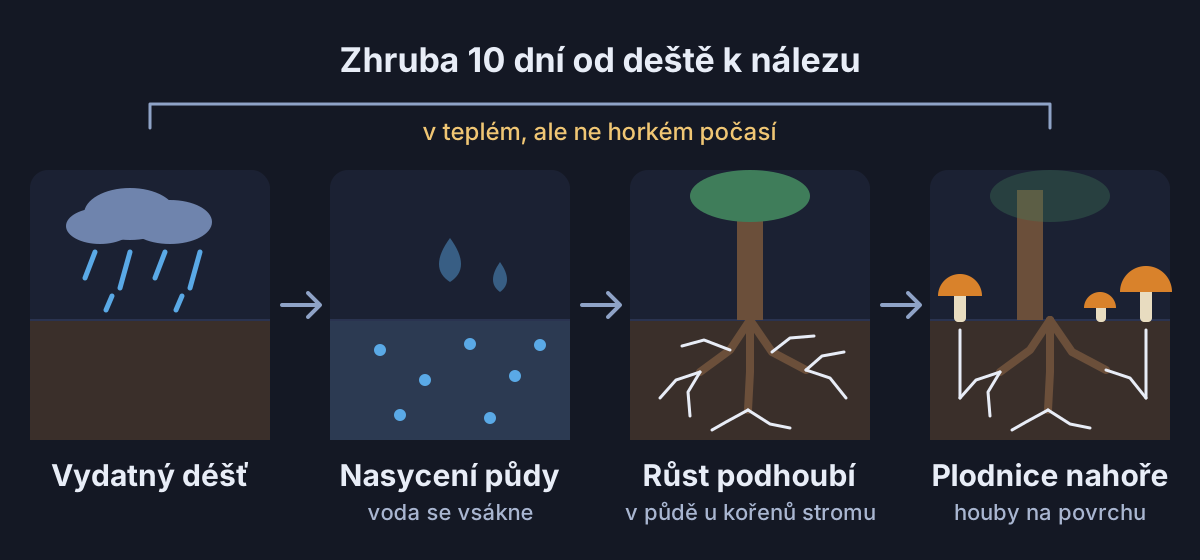
The mycelium needs saturated soil, not just a wet surface. For its mushroom growth map, meteorologists at the ČHMÚ (the Czech Hydrometeorological Institute) therefore add up daily rainfall over the previous 30 days and adjust the result for temperatures from the previous seven days, because in the warmest months far more of the fallen water evaporates. What matters is the water balance, that is, how much water actually stays in the soil.
That is why a single shower is not enough and mushrooms appear with a delay. According to the ČHMÚ, as a general rule they start growing most about 10 days after heavy rain followed by warm but not hot weather, mostly between July and September. In autumn, on the other hand, ground frosts can slow growth or stop it altogether.
02Curiosities
Things happen under the moss that you would not expect
The mycelium is the largest structure that fungi can build. The mycelium of a honey fungus in the American state of Oregon is among the largest known organisms on Earth, spreading over almost ten square kilometres and estimated to be thousands of years old. We pick only its small fruits, and the rest stays underground.
Fungi are also not plants, and they are closer to animals than to plants. They do not make food from sunlight, but obtain nutrients by breaking down dead matter or in cooperation with tree roots. Without them nature would not know what to do with most of its biological waste, which they help to recycle.
03The last weeks
What the summer and the start of autumn were like in Czechia
Preliminary ČHMÚ data show that the summer was rather poor in water. Rainfall reached only 57% of normal in July, 91% in August and 73% in September, while temperatures were above normal by 0.9, 2.1 and 1.2 degrees. The soil therefore entered autumn more dried out than saturated.
According to preliminary ČHMÚ data, September brought on average 44 mm of rain and an average temperature of 14.2 °C. Heavier rain fell only on a few days, most of all on 9, 16 and 20 September, and there was a noticeable difference between Čechy (the western part of the country) with 38 mm and Morava and Slezsko (the east) with 54 mm. The coolest spell of the month came at the start of the third ten-day period, when daily maximums mostly did not exceed 20 °C.
Infographic
Rainfall in Czechia, preliminary data (mm)
| Region (kraj) | July | August | September |
|---|---|---|---|
| Czechia | July: 57% | August: 91% | September: 73% |
| Prague and Středočeský | July: 62% | August: 124% | September: 65% |
| Jihočeský | July: 44% | August: 79% | September: 71% |
| Plzeňský | July: 44% | August: 93% | September: 58% |
| Karlovarský | July: 49% | August: 97% | September: 48% |
| Ústecký | July: 62% | August: 118% | September: 65% |
| Liberecký | July: 54% | August: 132% | September: 82% |
| Královéhradecký | July: 59% | August: 126% | September: 80% |
| Pardubický | July: 61% | August: 81% | September: 74% |
| Vysočina | July: 42% | August: 66% | September: 80% |
| Jihomoravský | July: 51% | August: 61% | September: 80% |
| Olomoucký | July: 65% | August: 76% | September: 81% |
| Zlínský | July: 77% | August: 69% | September: 79% |
| Moravskoslezský | July: 82% | August: 71% | September: 82% |
The table shows that July was dry everywhere, from 42% of normal in Vysočina to 82% in the Moravskoslezský region. August was above normal in the Liberecký, Královéhradecký and Ústecký regions and in Prague and the Středočeský region, while the Jihomoravský region, Vysočina and the Zlínský region received only 61 to 69% of normal. September was driest in the west of Čechy, with just 48% of normal in the Karlovarsko area and 58% in the Plzeňský region.
Groundwater is in the worst state. According to preliminary data its level in the shallow circulation was extremely below normal in September, as was spring discharge. From this point of view it was the driest September since 1981. According to the ČHMÚ report of 15 October, rain in the second half of the previous week, mainly in Čechy, did ease soil drought in places, but groundwater levels remained extremely below average.
The picture for the month up to 12 October is milder. According to the ČHMÚ the weather was mostly above average, except for a cooler week from 21 to 27 September, and rainfall was average with weekly totals around 10 mm, with only the week from 28 September to 4 October dry. That rhythm gives mushrooms a chance, though not everywhere equally.
04Where to go
What this means for this year’s mushroom picking
The numbers point to a cautious conclusion. The summer was dry and groundwater is extremely below average, but rainfall over the last month stayed around average, and foragers in some places report finds, though not everywhere and not equally. The best hope lies in forests where it rained more heavily about a week or two ago and where moisture has stayed in the soil.
| Area | Source | What is reported |
|---|---|---|
| Kladensko (the Kladno area) | Source: reports from foragers | What is reported: abundant growth of boletes, gilled mushrooms and others for several days in a row |
| Ústecký region | Source: report from a forager, 14 October | What is reported: abundant growth of boletes |
| Vysočina | Source: reports from foragers, 12 and 13 October | What is reported: one report of abundant growth, and a day later two reports with not a single find |
| Moravskoslezský region | Source: commercial traffic-light rating, 15 October | What is reported: 85 points out of 100 |
| Liberecký region | Source: commercial traffic-light rating, 15 October | What is reported: 82 points out of 100 |
| Pardubický region | Source: commercial traffic-light rating, 15 October | What is reported: 79 points out of 100 |
The reports are unverified, and the traffic-light rating is an assessment by a commercial service, not a measurement by meteorologists. The ČHMÚ mushroom growth probability map, in turn, shows only areas with more suitable moisture conditions, not actual finds, and it is often the particular forest that decides, not the region on the map.
The next few days bring only half-good news for mushrooms. According to the ČHMÚ report of 15 October the weather will stay changeable, with a chance of light rain at the weekend, and above-average temperatures will prevail during the day, but on some nights the temperature may fall to freezing point. Light rain, however, is not the heavy rain after which, according to the ČHMÚ, mushrooms grow most about 10 days later.
The longer outlook is mixed for mushrooms. The ČHMÚ monthly outlook of 12 October expects, with higher probability, average or slightly below-average weather until 8 November, rather drier in the first half with totals up to 5 mm and wetter in the second. Night minimums are expected around 2 °C, with temporary frost on some days, and it is precisely ground frosts that can slow mushroom growth or stop it.
See the forecast for your forestFind out whether it will rain near you in the next few days and when the first frosts will arrive.Forecast for my location05Safely
How to recognise an edible mushroom when no general sign exists
The most important sentence in this article is that there is no general sign of edibility. Poisonousness cannot be recognised by colour, smell or taste, and it does not matter whether slugs nibble the mushroom either. The only mushroom you can eat is one that you safely know as a species and that has enough features for a reliable identification.
In Czechia, according to the Česká mykologická společnost (Czech Mycological Society), dozens of foragers are poisoned by toxic mushrooms every year. The folk tests handed down through generations seem sensible, yet not one of them reliably exposes a poisonous mushroom.
Myths that kill
| Folk test | How it really is |
|---|---|
| Poisonous mushrooms are always colourful | How it really is: No. The deadly death cap (Amanita phalloides) and the fool’s webcap (Cortinarius orellanus) are not colourful. The conspicuously red fly agaric (Amanita muscaria) is less dangerous, but it is poisonous too. |
| Slugs and worms do not nibble poisonous mushrooms | How it really is: No. Snails and insects have a different metabolism from humans, and a poison that harms us need not harm them. |
| Boiling or drying destroys the poison | How it really is: No. Dangerous poisonous species contain heat-stable toxins that boiling does not destroy. Drying does not destroy the deadly poison of the death cap either. |
| A silver spoon or an onion turns black from the poison | How it really is: Nonsense. No known mushroom poison causes such a reaction with silver, and the onion test does not work either. |
| A poisonous mushroom tastes bitter or smells bad | How it really is: No. Deadly poisonous mushrooms are mostly inconspicuous, smell good and taste good. People poisoned by the death cap often claimed they had never eaten a better mushroom dish, and by tasting you cannot recognise a poisonous mushroom. |
| I can identify a mushroom from an internet photo | How it really is: No. A photograph does not capture smell, taste, sliminess or stickiness. |
| All boletes are edible except the bitter ones | How it really is: Not even that holds without exception. Satan’s bolete (Rubroboletus satanas) is not bitter, and yet when insufficiently cooked it causes intestinal upset. Mycologists also warn that rules established here may not apply elsewhere. |
Boletes and gilled mushrooms
You recognise boletes by the tubes, the spongy layer under the cap, in place of gills. There are few poisonous species among them here, but Satan’s bolete causes intestinal upset when insufficiently cooked, and the bitter bolete (Tylopilus felleus) has flesh so bitter that it spoils a whole dish. No simplified rule therefore holds even for boletes, and you should pick only species that you know.
The greatest risk is with gilled mushrooms, which have gills instead of tubes under the cap. Edible and deadly poisonous species grow side by side there, so it pays to pick only those that you know safely. Young fruiting bodies or ones altered by the weather may also not have all their typical features developed, and they are not suitable for picking.
Warning signs of the death cap
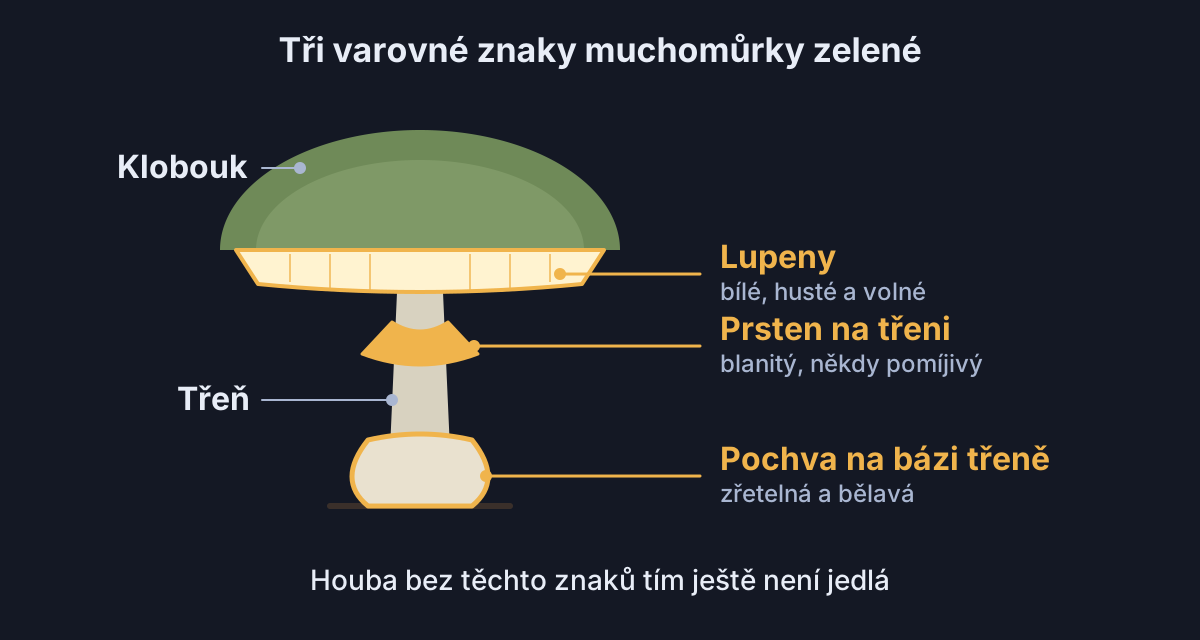
On a death cap look for dense white gills, a membranous, faintly grooved ring on the stem and a distinct whitish sheath at the base of the stem, nicknamed the cup of death. The cap is usually olive green to yellow-green, but sometimes almost white, so you cannot recognise it by colour. The ring is sometimes fleeting and the sheath stays in the ground when the mushroom is cut off, so always take the mushroom out whole.
It grows most often in warm broadleaf forests under oak, beech and hornbeam, exceptionally also under conifers, from the lowlands to the mountains. Inexperienced foragers most often mistake it for field mushrooms (Agaricus), but also for parasol mushrooms or brittlegills. The rare spring destroying angel (Amanita verna) is equally poisonous, has a white cap and a smooth stem, and grows in spring.
The reverse, however, does not hold. A mushroom without a ring and sheath is still not edible for that reason, and the fool’s webcap, which lacks these features, is deadly poisonous, for example. Only a safely known species decides edibility.
How and when poisoning shows
| Mushroom | Onset of symptoms | What happens |
|---|---|---|
| Death cap | Onset of symptoms: 6 to 48 hours | What happens: Vomiting and diarrhoea for about two days, later serious damage to the liver and kidneys, and with a higher dose or without medical help death within 5 to 6 days. |
| Fool’s webcap | Onset of symptoms: 2 to 17 days | What happens: First increased, later reduced or stopped production of urine, stomach pain, vomiting, dry mouth. Death follows from kidney damage. |
| Panther cap (Amanita pantherina) | Onset of symptoms: 0.5 to 3 hours | What happens: Nausea, vomiting, headache, palpitations, dilated pupils and later hallucinations. It usually passes the next day. |
| Common ink cap (Coprinopsis atramentaria) | Onset of symptoms: after alcohol, up to 3 days after a meal of the mushroom | What happens: Poisoning is triggered by the combination of the mushroom and alcohol. Symptoms usually disappear within 2 hours, but they may return after more alcohol. |
The delay is the most treacherous part. The death cap does not hurt straight away and the first symptoms come after many hours, when the liver and kidneys are often already damaged. In a fatal poisoning there may also be a temporary improvement, after which the liver and kidneys fail within a few days, so anyone who waits until they feel better is losing time.
06Uncertainty
Why mushrooms cannot be predicted exactly
The ČHMÚ mushroom growth probability map is based on a model that adds up rainfall, adjusts it for temperature and adds a seasonal coefficient for how the abundance of mycorrhizal mushrooms changes through the year. The ČHMÚ keeps tuning the parameters and consults the Česká mykologická společnost on preparing the map. But the map expresses only how suitable the moisture conditions are, not that a basket is already lying somewhere.
The model, moreover, covers only part of mushroom picking. It best reflects fleshy mycorrhizal mushrooms, that is, the ones foragers care about most, but it is not accurate for wood-dwelling species or heat-loving species of dry habitats. It also does not know the soil under your forest, the local microclimate, the state of the mycelium from previous years, or chance.
Climate change comes into play too. Higher temperatures increase evaporation and reduce the amount of water available to mushrooms, which is why the ČHMÚ expects a negative impact on the growth of mycorrhizal mushrooms in future. How much individual years differ is shown by the death cap, for example, which in some years grows only sporadically and in others very abundantly.
07Species
The most common mushrooms in Czechia and what they look like
Below you will find the most commonly picked mushrooms and their dangerous or unpleasant look-alikes. Photos help with learning, but you cannot identify a mushroom from a single photograph, because it does not capture smell, sliminess or stickiness. Treat them as an aid alongside a field guide and an experienced forager, not as identification instructions.
Boletes
The spruce bolete is our best-known and often most popular bolete. It grows very abundantly from June to October in all types of forest, most of all in young spruce stands or at their edges, from lower elevations to the mountains, and it prefers more acidic soils. Its pores are white when young, yellow to yellow-olive in adulthood, and the flesh is white and does not change when cut.
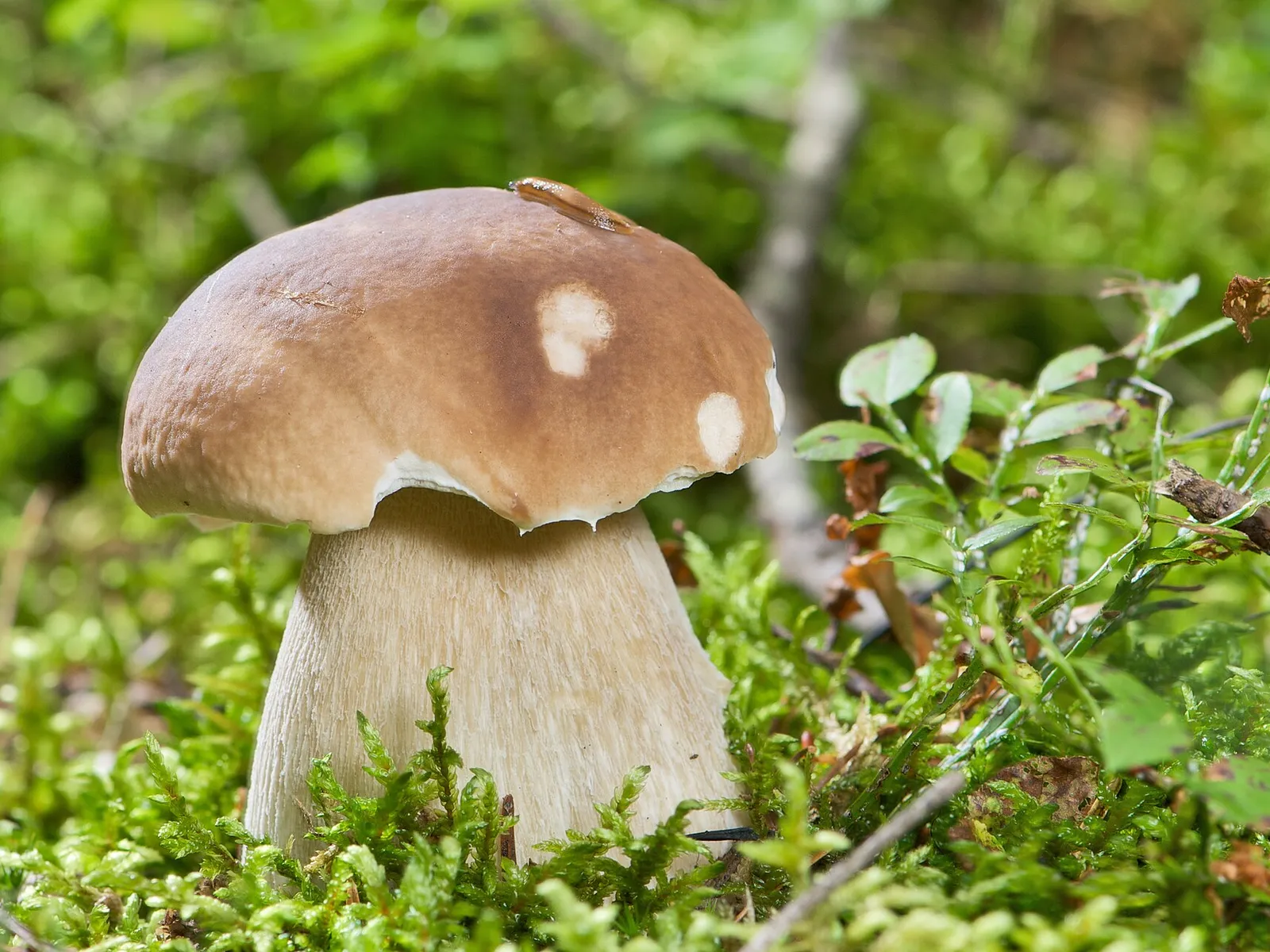

Similar edible boletes can be told apart from the spruce bolete. The summer bolete (Boletus reticulatus) has a cap skin that stays frosted for a long time and a more prominent net on the stem, the pine bolete (Boletus pinophilus) has a reddish tint to the skin, and the bronze bolete (Boletus aereus) is darker with olive or bronze shades and grows with oaks on calcareous soils. The bitter bolete, on the other hand, is given away by tubes that gradually turn pink.
Satan’s bolete does not belong in the basket, because when insufficiently cooked it causes intestinal upset. It has a whitish to greyish cap, red pores and a red net on the stem. Other boletes also have red pores, however, so even here one feature is not enough and only safe knowledge of the species decides.
Parasol mushroom, chanterelle and honey fungus
The parasol mushroom (Macrolepiota procera) has a scaly cap, a snakeskin pattern on the stem and a movable ring, but no sheath at the base of the stem, whereas the death cap has a smooth cap and a sheath. With young, still closed parasol mushrooms there is a risk of confusion with Amanita species, so it is safer to pick only opened fruiting bodies with all their features. The chanterelle (Cantharellus cibarius) is yellow, funnel-shaped and has veined ridges, whereas the false chanterelle (Hygrophoropsis aurantiaca) is more orange and has thin, forked gills.
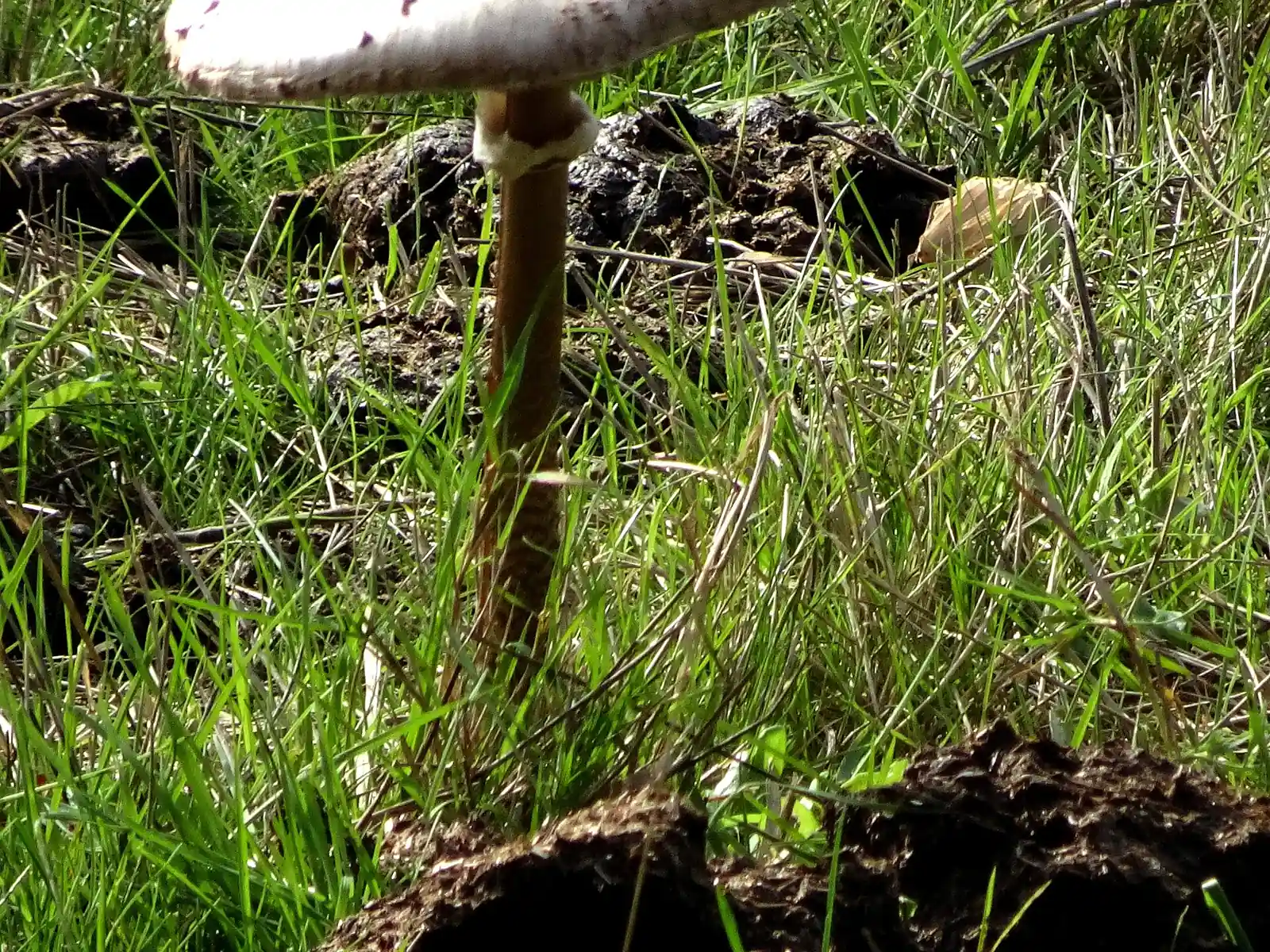

Honey fungus (Armillaria mellea) grows in clusters on stumps, trunks and roots and must be cooked for a longer time, otherwise vomiting and diarrhoea are a risk. In clusters on dead wood, from early spring to late autumn, there also grows the poisonous sulphur tuft (Hypholoma fasciculare), which is sulphur yellow and bitter. The deadly poisonous funeral bell (Galerina marginata) also grows on wood, so pick clusters of mushrooms from wood only when you safely know the species.
Dangerous and treacherous ones
Among the most dangerous are the death cap and the fool’s webcap with its orange-brown cap, whose poisoning shows only after 2 to 17 days. The panther cap and the fly agaric contain the poison muscimol, and the tiger tricholoma (Tricholoma pardinum) causes vomiting and diarrhoea. The mildly poisonous and very common false death cap (Amanita citrina) has no prominent sheath and often keeps remnants of the veil on its cap.
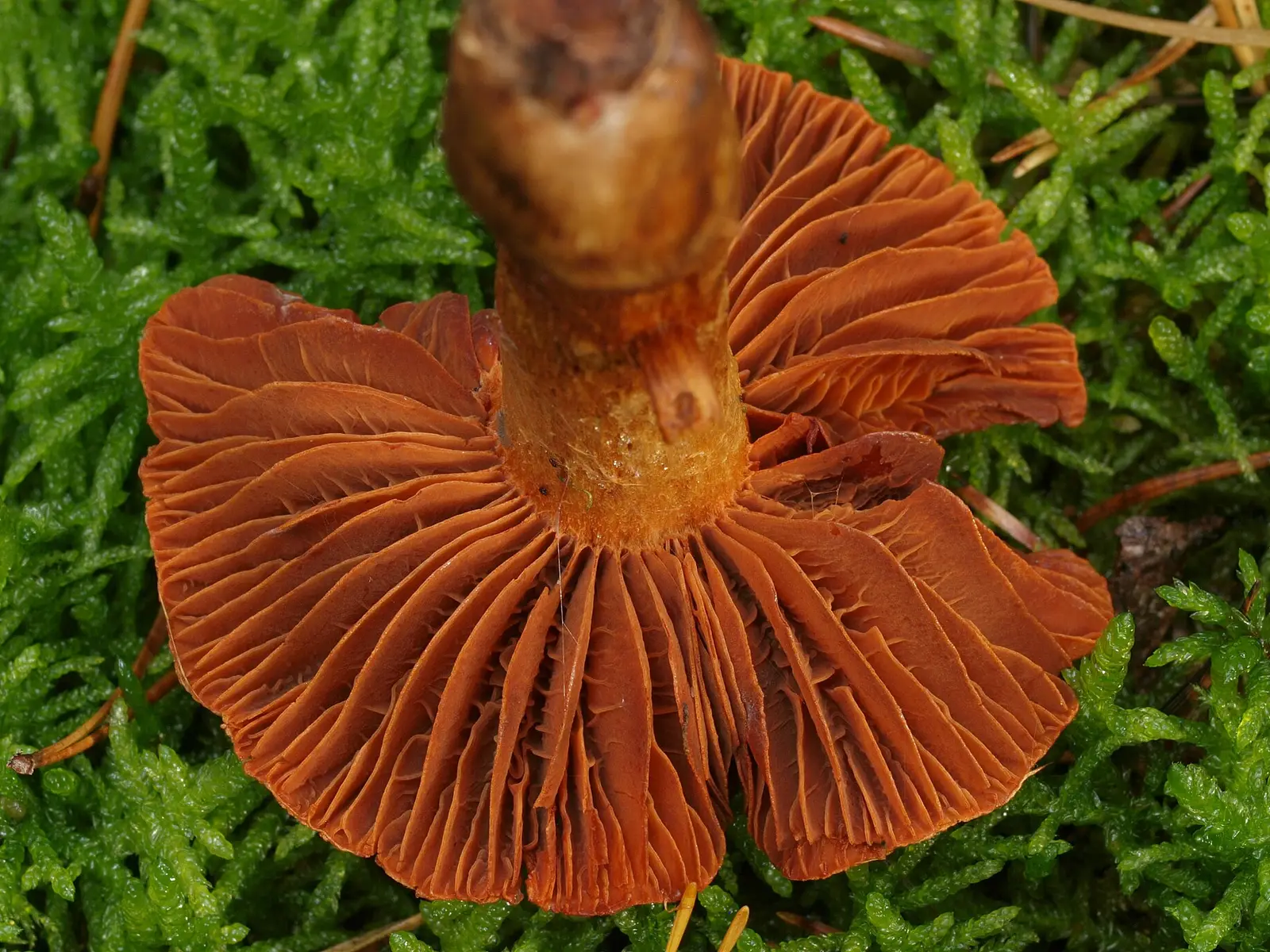

Not all Amanita species are equally dangerous, but do not pick any without certainty. The blusher (Amanita rubescens) is poisonous raw and edible only after thorough cooking, and only for someone who can safely tell it from the panther cap. Many other edible species are also poisonous raw.
| Edible mushroom | Look-alike | How to tell them apart |
|---|---|---|
| Spruce bolete | Look-alike: Bitter bolete | How to tell them apart: The spruce bolete has pores white when young, later yellow to yellow-olive, and white flesh that does not change. The bitter bolete has tubes that gradually turn pink and very bitter flesh. |
| Spruce bolete | Look-alike: Summer, pine and bronze bolete (also edible) | How to tell them apart: The summer bolete has a skin that stays frosted for long and a more prominent net, the pine bolete a reddish tint, and the bronze bolete is darker with an olive or bronze tint. |
| Parasol mushroom | Look-alike: Death cap | How to tell them apart: Both have white gills and a ring. The parasol mushroom has a scaly cap, a snakeskin pattern on the stem and a movable ring, the death cap a smooth cap and a sheath at the base of the stem. |
| Field mushroom, especially the wood mushroom (Agaricus silvicola) | Look-alike: Death cap | How to tell them apart: The death cap has white gills and a sheath at the base of the stem. The wood mushroom has gills that stay pale for a long time and may grow next to it, so always check the base of the stem. |
| Brittlegills (Russula) | Look-alike: Death cap | How to tell them apart: Both have white gills. A brittlegill has neither ring nor sheath, while the death cap has a sheath and a ring, which may however be missing, so always take the mushroom out whole. |
| Chanterelle | Look-alike: False chanterelle | How to tell them apart: The chanterelle is yellow with veined ridges, the false chanterelle more orange with thin, forked gills. |
| Honey fungus | Look-alike: Sulphur tuft (poisonous) | How to tell them apart: The sulphur tuft is sulphur yellow and bitter and grows in clusters on dead wood for most of the year. |
| Blusher (edible only after boiling for at least 20 minutes) | Look-alike: Panther cap | How to tell them apart: The blusher turns red when cut and where damaged and has a grooved ring. The panther cap does not turn red, has pure white warts on the cap, a smooth ring and a bulb with a sharp rim. |
08Calendar
When which mushrooms grow
The mushroom season starts already in spring with morels and lasts until winter, but most species form fruiting bodies at the end of summer and in autumn. The spruce bolete grows from June to October and the sulphur tuft from early spring to late autumn. The velvet shank (Flammulina velutipes) and the oyster mushroom, on the other hand, are mushrooms of the cold months.

09Picking and pantry
How to pick, store and dry mushrooms
Mushrooms do not belong in a plastic bag but in a wicker basket, which lets air through, so they do not sweat in it. Pick healthy, well-developed fruiting bodies, because very young ones may not have all their identifying features and old or wormy ones spoil quickly. Wipe the soil and needles off them already in the forest.
Cut or pull out
Established habit says to cut a mushroom off with a knife, but expert advice points elsewhere. Species with dangerous poisonous look-alikes in particular should be taken out of the ground whole, and the National Museum mycologist Jan Holec advises never cutting mushrooms off above the ground. The base of the stem carries important identifying features, for instance the lobed sheath of the death cap.
When picking, think of the forest too. Gently cover the hole left by a pulled mushroom with moss or needles so that the soil does not dry out needlessly, and do not trample around the fruiting body, because you would tear the strands of mycelium that supply it with water and nutrients.
From the forest to the pantry
- 01
Into a wicker basket
A basket lets air through and mushrooms do not sweat in it, while a plastic bag is a trap for them.
- 02
Take it out whole
Carefully pull the mushroom out together with the base of the stem and cover the hole with moss or needles.
- 03
Clean it already in the forest
Remove soil, needles and obviously damaged parts on the spot, and you will save time at home.
- 04
Process as soon as possible
Ideally the same day, because mushrooms spoil easily or grow moulds.
- 05
The fridge only for a short while
In a fridge at a temperature slightly above zero, store mushrooms for as short a time as possible and loosely in the open air.
- 06
Dry, freeze, cook
Mushrooms can be dried, boiled, pickled in vinegar or salt, frozen or fermented.
Spoiled mushrooms are a separate risk. Mushrooms very quickly suffer from unfavourable storage conditions and substances harmful to humans form in them, so even an edible species can cause poisoning. The poison is produced by microorganisms and moulds that have multiplied in improperly stored mushrooms.
Only fresh and healthy fruiting bodies are suitable for drying, in an airy place or in a dehydrator at a mild temperature, so that the mushrooms dry out and do not cook. Dried mushrooms are best properly cooked before eating because of microbiological risks. Freezing is also possible, but frozen mushrooms too should be thoroughly cooked before eating.
Remember too that many edible species are poisonous raw. The scarletina bolete (Neoboletus luridiformis) and honey fungus need longer cooking, and the blusher, according to mycologists, at least 20 minutes of boiling. Mushroom dishes are not suitable for small children, because they are hard to digest and a child is at much greater risk than an adult in a poisoning.
Anyone may pick mushrooms in the forest for their own use, but picking is not permitted in nature reserves and in the first zones of national parks. Picking on landfills, near busy roads or on radioactive heaps by uranium mines is not recommended, and the car belongs in an official car park, with the walk into the forest done on foot. Only a person with a certificate of mushroom knowledge may sell picked mushrooms or process them further for food purposes.
10Did you know
Did you know that mushrooms…
The answer to the question in the title is therefore honestly uncertain. This year mushrooms are growing mainly where moisture could be held, and ground frosts may close the season early. Go into the forest with a basket and patience, and take home only the species you truly know.
Sources14 sources · specific figures come from the sources, the general explanation from expert knowledge
- ČHMÚ (Czech Hydrometeorological Institute) (in Czech)
- arecenze.cz (zprostředkovaně hlášení houbařů na NaturAtlas) (arecenze.cz (foragers’ reports relayed from NaturAtlas)) (in Czech)
- ČHMÚ (Czech Hydrometeorological Institute) (in Czech)
- ČHMÚ (Czech Hydrometeorological Institute) (in Czech)
- Česká mykologická společnost (Czech Mycological Society, spruce bolete) (in Czech)
- Státní zemědělská a potravinářská inspekce (State Agriculture and Food Inspection Authority) (in Czech)
- ČHMÚ (Czech Hydrometeorological Institute) (in Czech)
- ČHMÚ (Czech Hydrometeorological Institute) (in Czech)
- ČHMÚ (Czech Hydrometeorological Institute, monthly outlook)
- ČHMÚ (Czech Hydrometeorological Institute) (in Czech)
- Česká mykologická společnost (Czech Mycological Society, poisonous mushrooms) (in Czech)
- Ministerstvo zemědělství (Bezpečnost potravin) (Ministry of Agriculture (Food Safety portal)) (in Czech)
- Česká mykologická společnost (Czech Mycological Society, death cap) (in Czech)
- Národní muzeum (mykolog Jan Holec) (National Museum (mycologist Jan Holec)) (in Czech)