
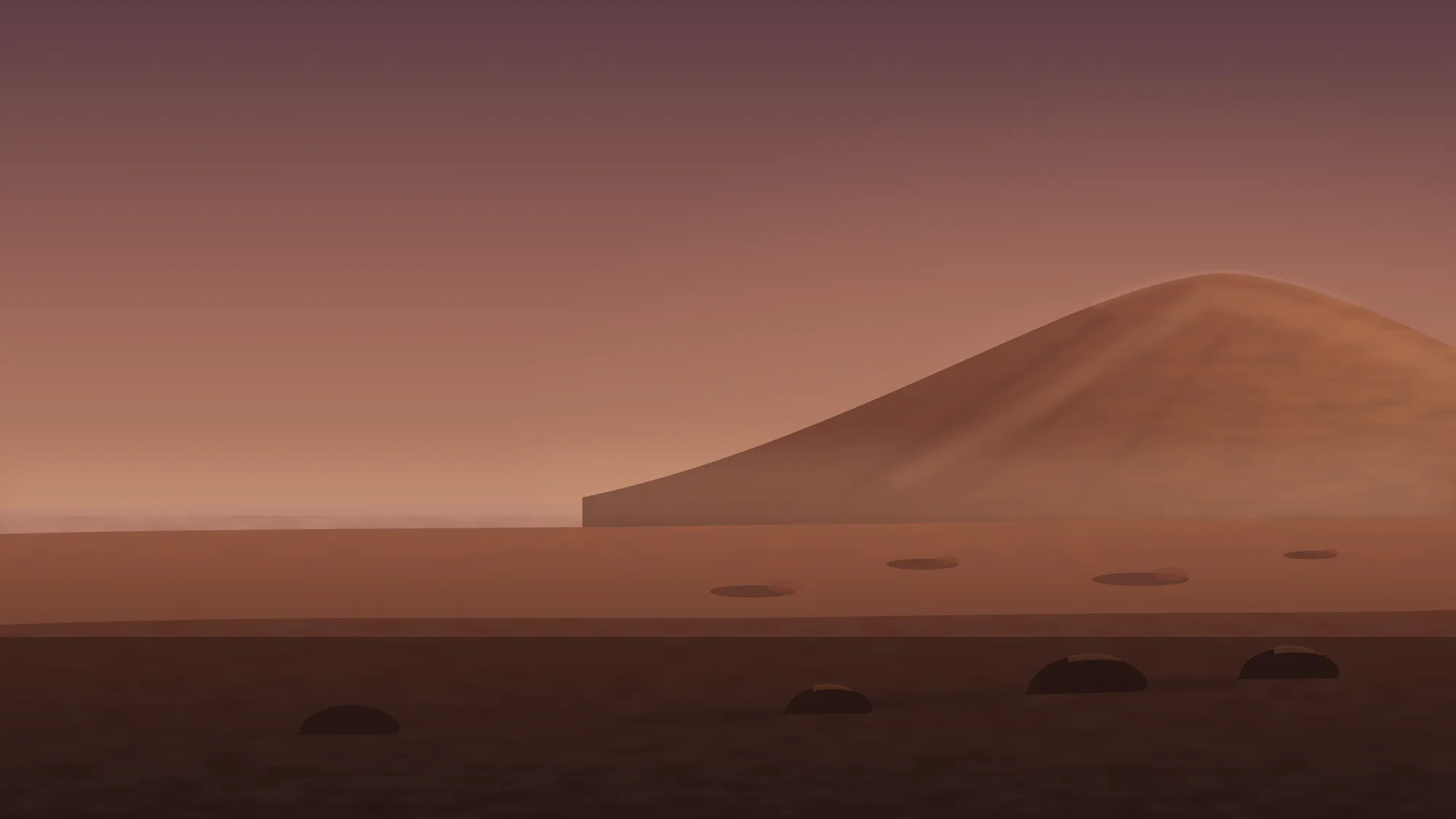
Hydrogen chloride appeared above rows of narrow fissures on the volcano's flank, at a time of year when the ExoMars Trace Gas Orbiter had not found it anywhere else on the planet. The European Space Agency describes the new study in the journal Science Advances as the first hint of young volcanic activity on present-day Mars. Nobody has seen an eruption, however, and the gas could also form through chemical reactions.
01Measurements
The gas is above the fissures, but it need not come from them
The probe measures the composition of the thin Martian atmosphere. Near Alba Mons it picked up only a tiny amount of hydrogen chloride, on the order of two molecules per billion air molecules. Scientists traced it to fissures on the northern flanks of the volcano.
On 3 February 2023 the CaSSIS camera on the same probe photographed a patch of terrain about 20 × 20 kilometres on the northern flanks of Alba Mons, centred around 64.6° north and 274.4° east. According to the agency, the white patches in the image, which ESA published on its blog, may be deposits around vents through which gas could be escaping from the planet's interior. The image itself does not capture any escape.
Beneath some of the places where the orbiter detected the gas lie rows of dozens to hundreds of fissures. They are narrower than a metre, up to hundreds of metres long and, according to the authors, probably younger than a million years. According to National Geographic, however, the team is not certain that the hydrogen chloride escapes from them.

02Signal
An unexpected signal and a return to the same spot
Hydrogen chloride first showed up north of Alba Mons in Martian year 35, in two exceptional observations made in northern summer, when Mars is near aphelion, its farthest point from the Sun. It did not appear anywhere else on the planet during this period. Planetary scientists count time in Martian years, each of which lasts 687 Earth days.
In Martian year 37 scientists returned with a targeted search using the ACS instrument, and several observations detected hydrogen chloride in the Alba Mons region again. The gas is not evenly mixed in the atmosphere and does not last long there. The authors conclude that there may be a local source above the region.
The study was published in Science Advances in early November 2026, but the team had already presented its results at the EPSC-DPS conference in 2025. The lead author is Alexander Trokhimovskiy of the Space Research Institute in Moscow, and one of the co-authors is Daniel Mège of the Space Research Centre of the Polish Academy of Sciences.
The signal appears only in summer. According to National Geographic, in winter the ground is covered with ice that holds back the escaping gas. According to ESA, the seasonal freezing and thawing of the upper layer of permafrost may trap gases for a time and then release them again.
03Curiosities
A volcano as vast as the USA and a long period of quiet
Alba Mons covers roughly the same area as the United States without Alaska and Hawaii, making it by far the most extensive volcano on Mars. According to NASA, however, it is only 6.8 kilometres high. The tallest is Olympus Mons, which the same agency puts at 21.9 kilometres, roughly two and a half times the height of Mount Everest.
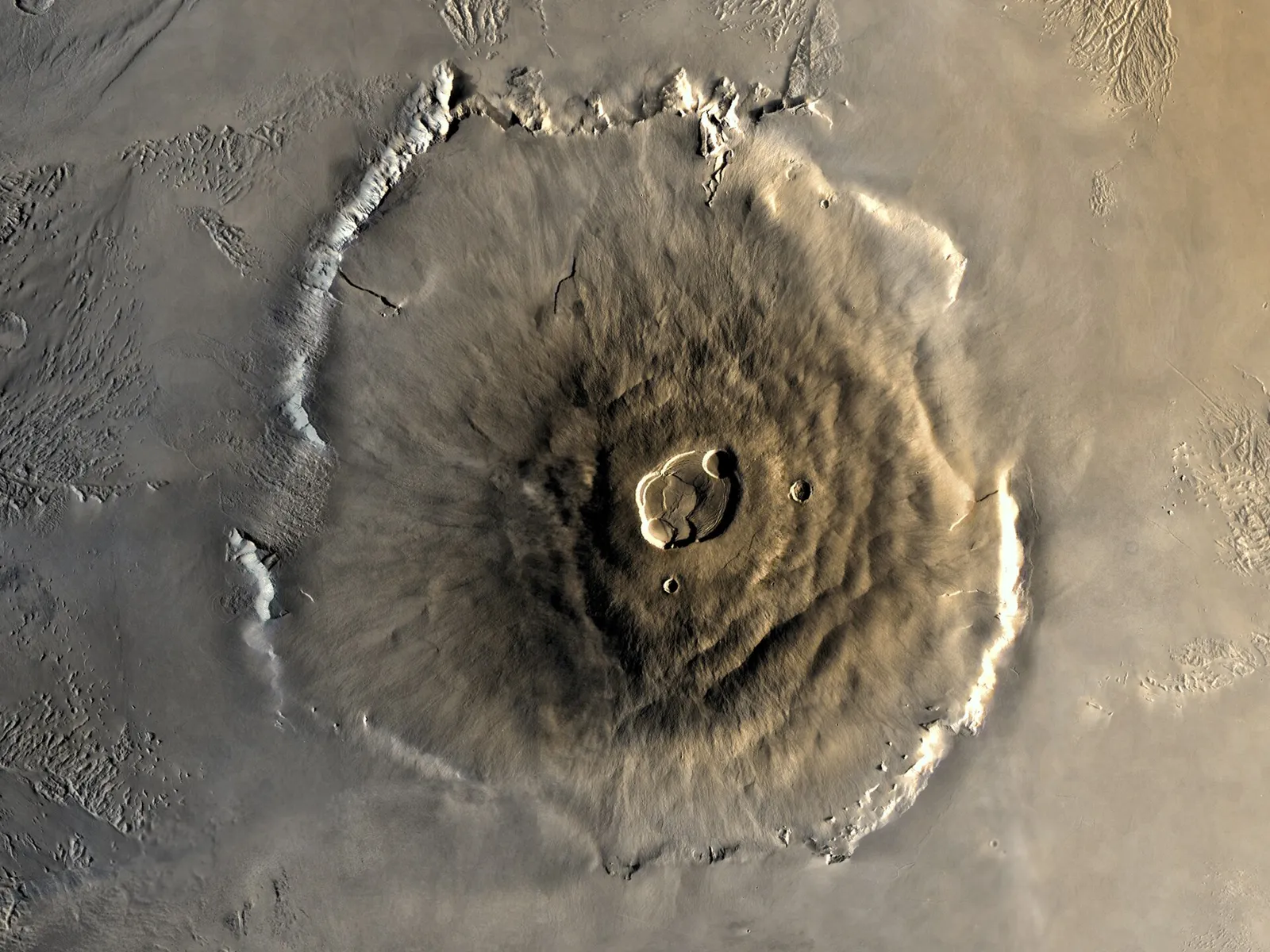

According to ESA, periods of quiet between eruptions can last tens of thousands of years. The fact that nobody has ever seen an eruption or flowing lava on Mars does not in itself mean that the planet is volcanically dead.
Alba Mons is covered with young lava flows, which point to volcanic activity in the recent geological past. According to images from orbit, some flows on Mars are only one to two million years old, possibly even less.
04Doubts
Volcano or chemistry, the dispute continues
The case for a volcano rests mainly on the nature of the gas. According to ESA, hydrogen chloride is almost absent from hot underground water systems. National Geographic points out, however, that a reaction of hot water with metal chlorides can easily produce it as well, so a chemical origin cannot be ruled out.
The missing sulphur dioxide counts against a volcano. According to Korablev et al. (2021), hydrogen chloride from magma should be accompanied in the atmosphere by a range of other gases containing sulphur and carbon. Yet, as the same study notes, nobody had detected sulphur dioxide on Mars up to that point.
| Argument | Where it points | Who raises it |
|---|---|---|
| Hydrogen chloride is mainly a gas from magma and is almost absent from hot underground water | Where it points: For a volcano | Who raises it: European Space Agency |
| The signal recurs in the same place on the northern flank | Where it points: For a local source | Who raises it: Kevin Olsen, University of Oxford |
| The fissures are probably younger than a million years | Where it points: For a volcano | Who raises it: Authors of the study |
| Nobody has observed an eruption or a lava flow | Where it points: No evidence | Who raises it: European Space Agency |
| Magmatic hydrogen chloride should come with sulphur dioxide, but nobody had found it by 2021 | Where it points: Against | Who raises it: Korablev et al. 2021 |
| InSight did not detect convincing magmatic signals | Where it points: No evidence | Who raises it: National Geographic |
| The gas also forms through a chemical reaction between hot water and chlorides | Where it points: Against | Who raises it: National Geographic |
| Earlier observations were explained by photochemistry involving water vapour | Where it points: Alternative explanation | Who raises it: Authors of the study |
| Dust storms can release chlorine from salts in the dust | Where it points: Alternative explanation | Who raises it: Korablev et al. 2021 |
That same 2021 study linked hydrogen chloride on Mars to dust. It says processes in dust storms can release gaseous chlorine from salts in the dust, for example from halite. According to the interpretation of Korablev et al., hydrogen chloride then forms through chemical reactions on dust particles lifted into the atmosphere.
The authors of the new study point out that, according to earlier observations, the behaviour of hydrogen chloride was governed mainly by reactions involving water vapour. Where the gas on Mars originally comes from, they say, remains a mystery.
The InSight lander's seismometer detected no convincing signs of magma movement from the Alba Mons area or from the whole Tharsis volcanic highland. Even if the gas came from hidden magma, nobody is predicting an imminent eruption.
Atmospheric physicist Kevin Olsen of the University of Oxford told National Geographic that the nature of the source is unknown. According to the magazine, evidence of present-day volcanic activity on Mars remains ambiguous, and magma beneath Alba Mons is so far only a hypothesis.
05Observing
Mars rises before midnight, but is highest only in the morning
From 8 to 9 November, Mars will be above Prague mainly in the second half of the night. It rises on 8 November at 23:09, is highest on 9 November at 6:31 at an altitude of about 56°, and sets at 13:52, already in daylight. Whether you will see it depends mainly on cloud cover.
| Date | Rise | Culmination | Altitude | Set |
|---|---|---|---|---|
| 8 November 2026 | 23:09 | 6:33 | 55.7° | 13:55 |
| 9 November 2026 | 23:08 | 6:31 | 55.6° | 13:52 |
Sources9 sources · specific figures come from the sources, the general explanation from expert knowledge
- National Geographic
- EPSC-DPS 2025 abstrakt (EPSC-DPS 2025 abstract) (in Czech)
- ESA blog
- NASA
- EPSC 2026 abstrakt (EPSC 2026 abstract) (in Czech)
- NASA/JPL/ASU, THEMIS Image of the Day
- NASA Photojournal PIA26055
- Korablev a kol. 2021, Science Advances (Korablev et al. 2021, Science Advances) (in Czech)
- Výpočet Fakt počasí (Fakt počasí calculation) (in Czech)