
Every October the fast meteors of the Orionid shower streak across the sky, born from the dust of Halley's Comet. This year the shower peaks on the night of 21 to 22 October, but a bright Moon will shine for most of the night, spoiling the view, and in Prague, the Czech capital, it does not set until 2:51. Early risers will have just under three hours of darkness between moonset and astronomical dawn, and a chance of a fine show.
01Origins of the shower
What the Orionids are and why Halley's Comet matters
Every meteor, popularly known as a shooting star, is a tiny particle that enters the atmosphere at enormous speed and burns up. In the case of the Orionids, it is dust shed, along with ice, by the nucleus of Halley's Comet each time it returns to the inner solar system. Most of the grains range from the size of a grain of sand to that of a pea and burn up long before they could reach the ground.

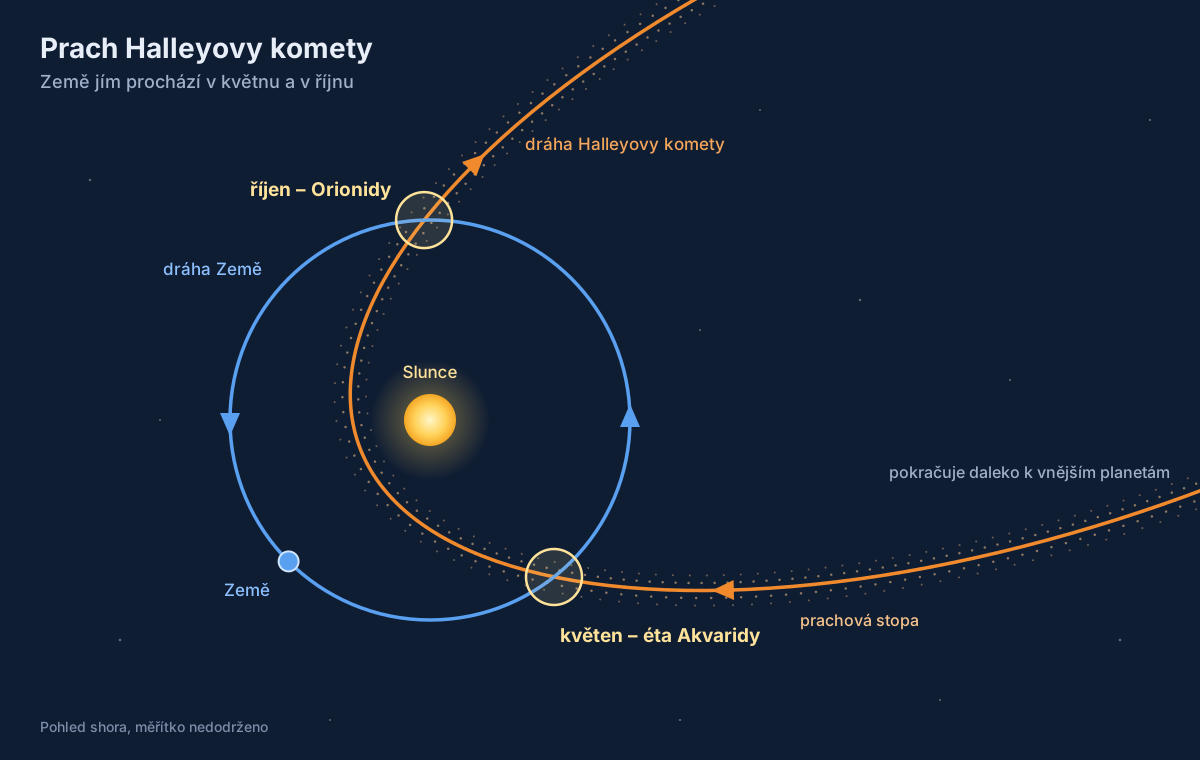
The released dust gradually spreads out along the comet's orbit into a long trail, which the Earth crosses every year. With Halley's Comet this happens twice a year, at two different points on the Earth's journey around the Sun. That is why May brings the Eta Aquariids and October the Orionids, two showers with the same parent body.
A comet that comes back
Until Edmond Halley's time, a comet was thought to pass through the solar system just once and then vanish. In 1705 Halley calculated the orbits of several comets and noticed that those of the bright comets of 1531, 1607 and 1682 were strikingly similar. He therefore proposed that they were a single comet that keeps coming back.
It takes roughly 76 years to orbit the Sun, and records of its returns go back more than two thousand years. It will not be back in the inner solar system until 2061. We will have to wait for the comet itself, then, but its dust reaches us every year.
Infographic
Halley's Comet and its dust
- · Halley realises it is a single returning comet
- · Orionid outburst
- · An even stronger peak
- · The comet back in the inner solar system
When the shower suddenly strengthens
The Orionids are usually a fairly modest shower, but in 2006 they grew markedly stronger. Astronomers call such a surge an outburst, and that one lasted from roughly 19 to 23 October, peaking around 21 October. Measurements by a Spanish camera network showed roughly two to three times the meteor rate of a typical year, and a year later the peak was higher still.
| Year | Meteors per hour (ZHR) |
|---|---|
| Typical year | 15 to 25 |
| 2006 | about 50 |
| 2007 | about 80 |
The authors of one scientific study link the heightened activity in 2006 to 2010, as well as in 1933 to 1938 and 1436 to 1440, to what is known as a 1 to 6 resonance with Jupiter. This is a state in which the orbit of part of the dust around the Sun falls regularly into step with Jupiter's orbit. Whether this year's shower will see a similar surge cannot be reliably predicted in advance.
02When to look
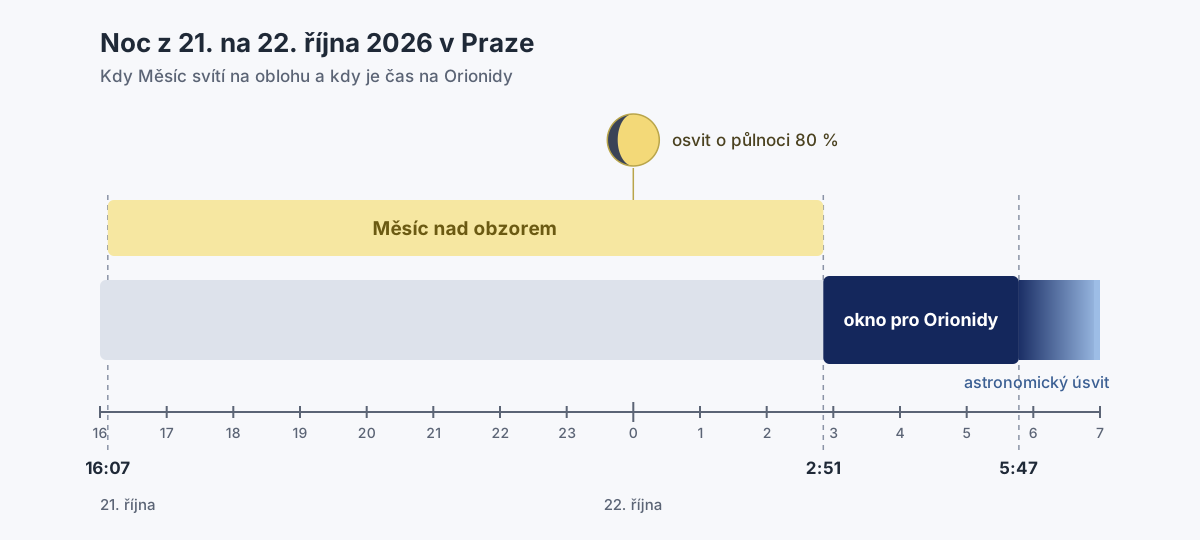
Look for the Orionids on the night into 22 October, but only after 2:51
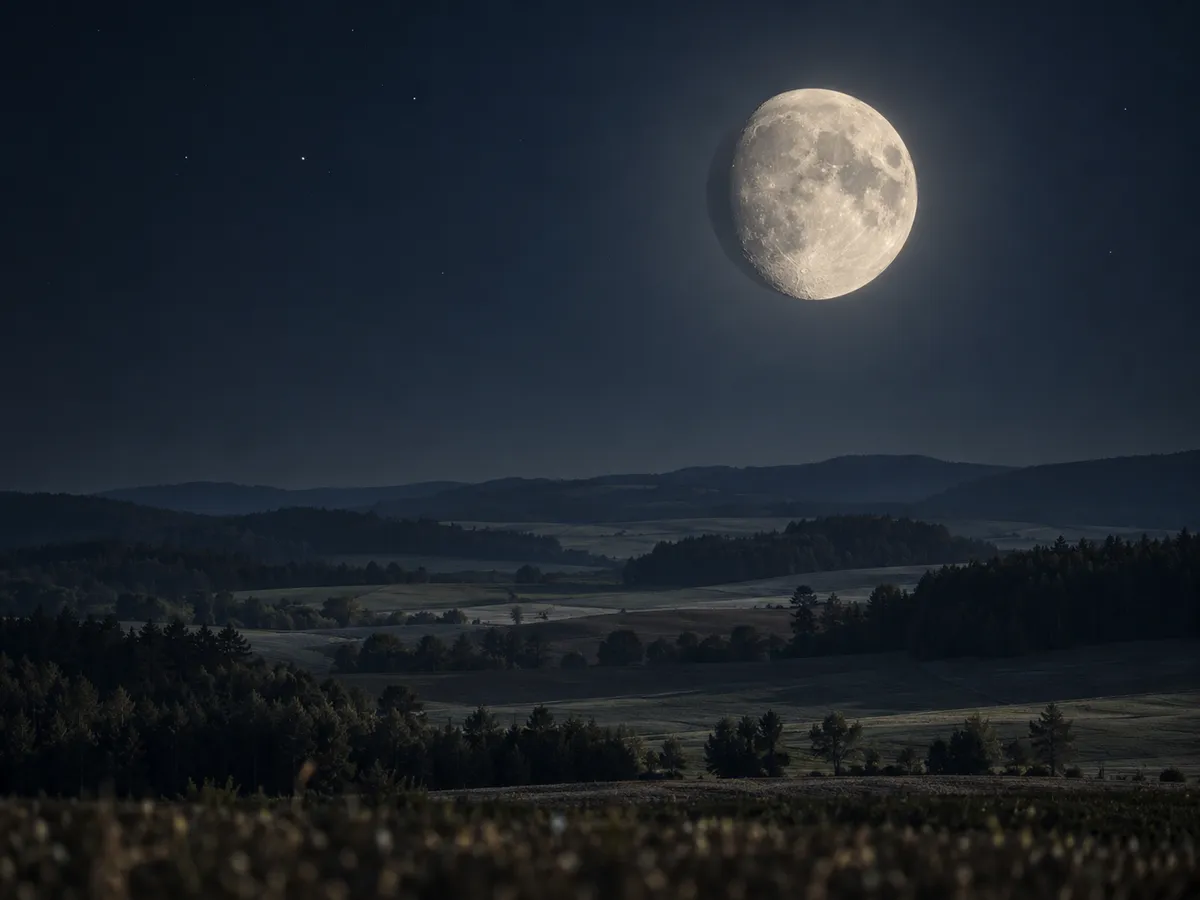
The Orionids are active from early October to early November, but the night of 21 to 22 October will bring the most meteors. This year it will be disturbed by a bright waxing Moon, which will drown out some of the fainter meteors. The best chance is therefore likely to come only in the last hours before dawn, after moonset.
| Item | Time or value |
|---|---|
| Moonrise | 21 October at 16:07 |
| Moon illumination at midnight | 80% |
| Moonset | 22 October at 2:51 |
| Start of astronomical dawn | 22 October at 5:47 |
03Radiant
What the radiant is and where to find it
The radiant is the point in the sky from which all the meteors of a shower seem to fly out. It is a trick of perspective, much like parallel railway tracks that appear to converge on a single point in the distance. The dust grains actually travel in parallel, and the radiant simply shows the direction from which they enter the atmosphere.
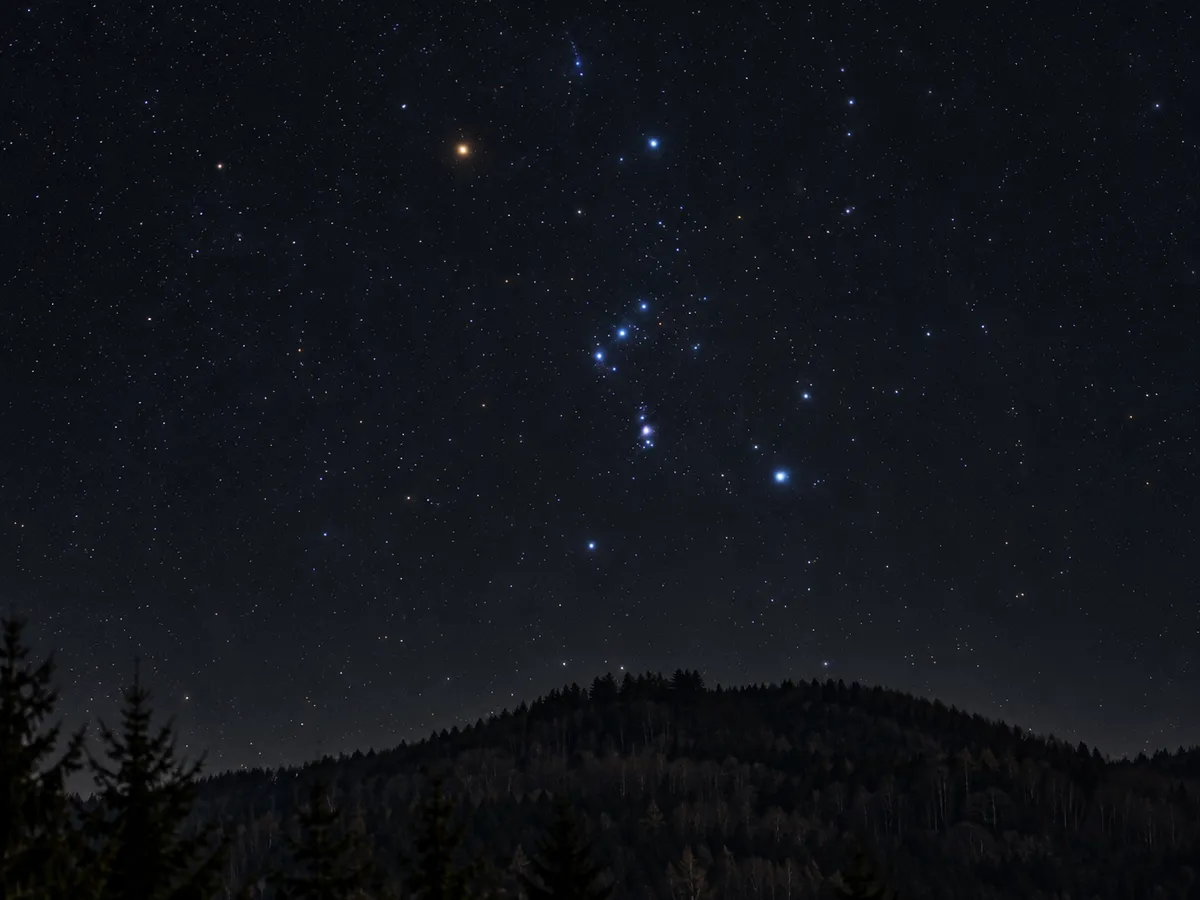
For the Orionids, the radiant lies on the border between the constellations of Orion and Gemini, north-east of the reddish star Betelgeuse. In the morning sky, when Orion is in the south, look for it a little up and to the left of Betelgeuse, towards Gemini.
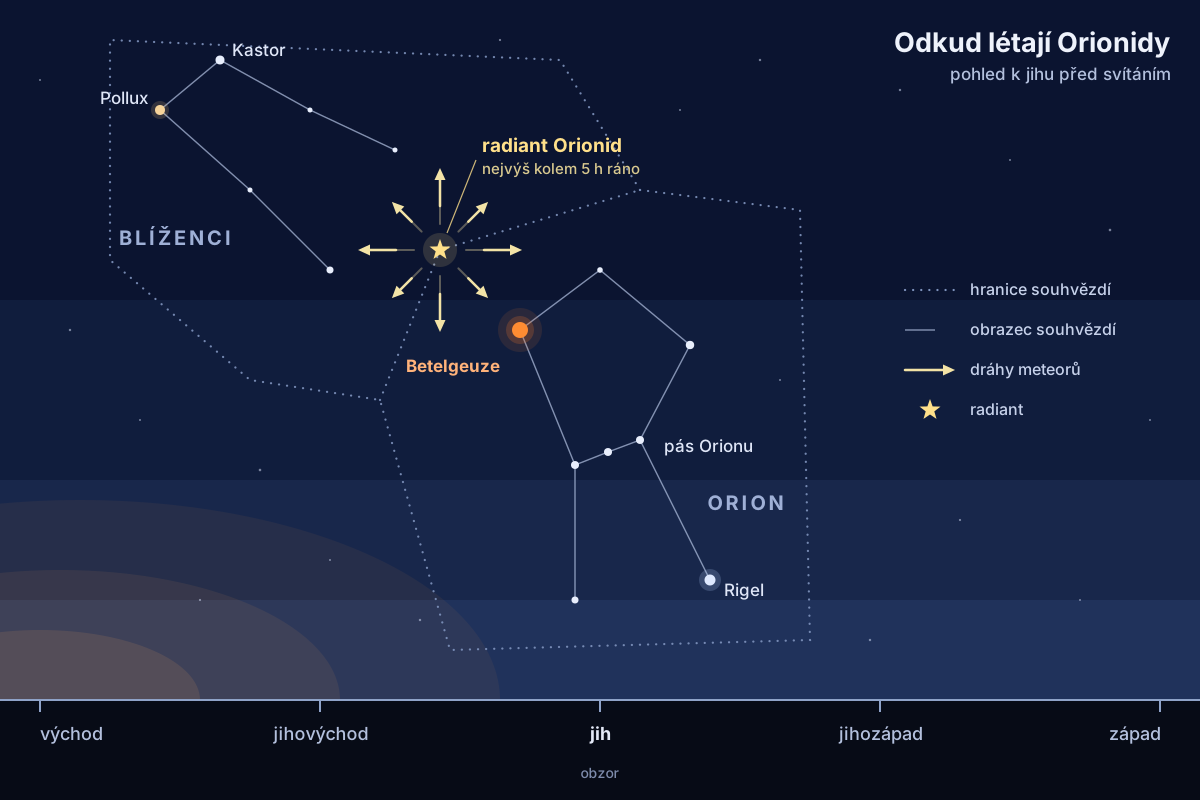
According to astro.cz, the website of the Czech Astronomical Society, the radiant culminates, that is, climbs highest above the horizon, at around five in the morning. The higher the radiant, the more meteors you will usually see. This year, conveniently, the radiant's highest point coincides with the darkness after moonset.
04How to observe
How to watch so you see everything that matters
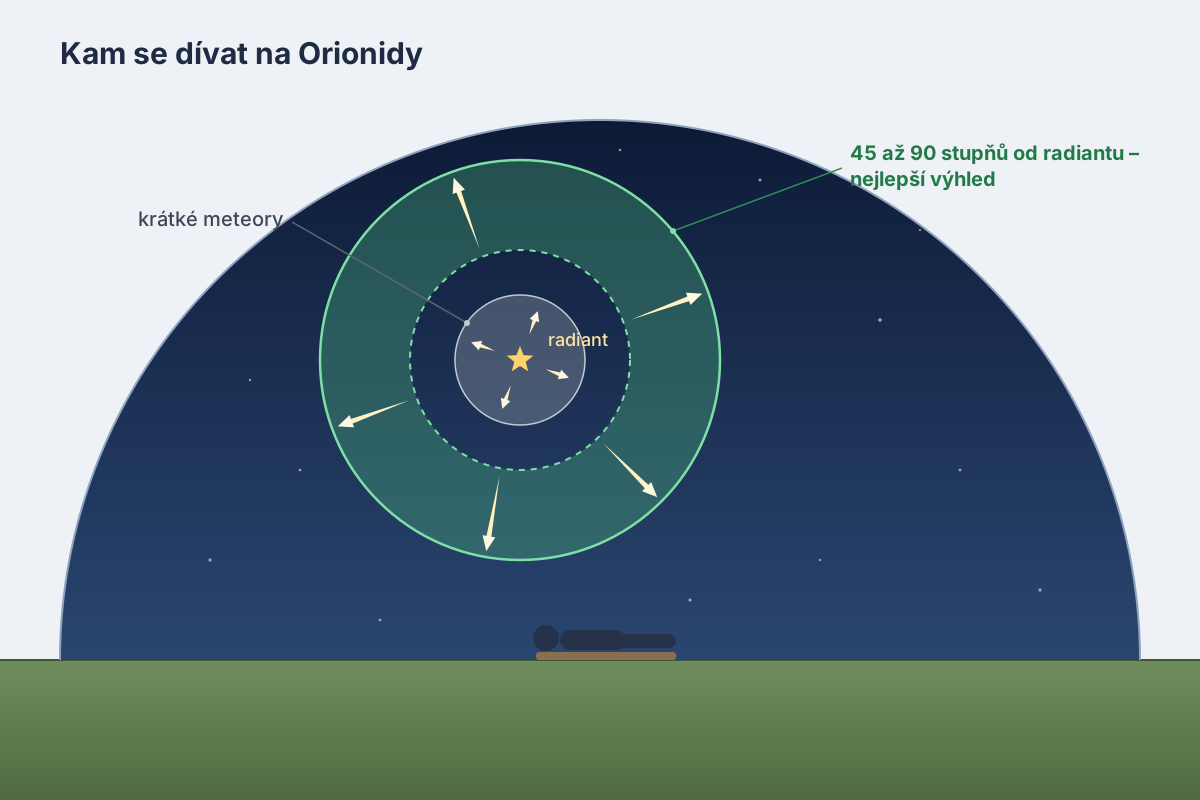
Staring straight at the radiant does not pay off, because meteors near it are heading almost towards you and so look short. It is better to look 45 to 90 degrees away from it. To give you an idea, 90 degrees is the distance from the horizon to directly overhead.
Your eyes adjust to the dark in just under half an hour, and only then do they start to pick up fainter meteors. Every glance at a lit screen partly undoes this, so keep your phone in your pocket the whole time. If you must have a light, a dim red torch will do.
Under a truly dark sky the Orionids produce about 10 to 20 meteors an hour. They enter the atmosphere at around 66 kilometres per second. Unlike the slow Draconids of early October, they cross the sky in the blink of an eye.
Fast meteors occasionally turn into a fireball, brighter than Venus. Such a flash stands out even in a moonlit sky, but there is no predicting when one will come.
Where to find darkness
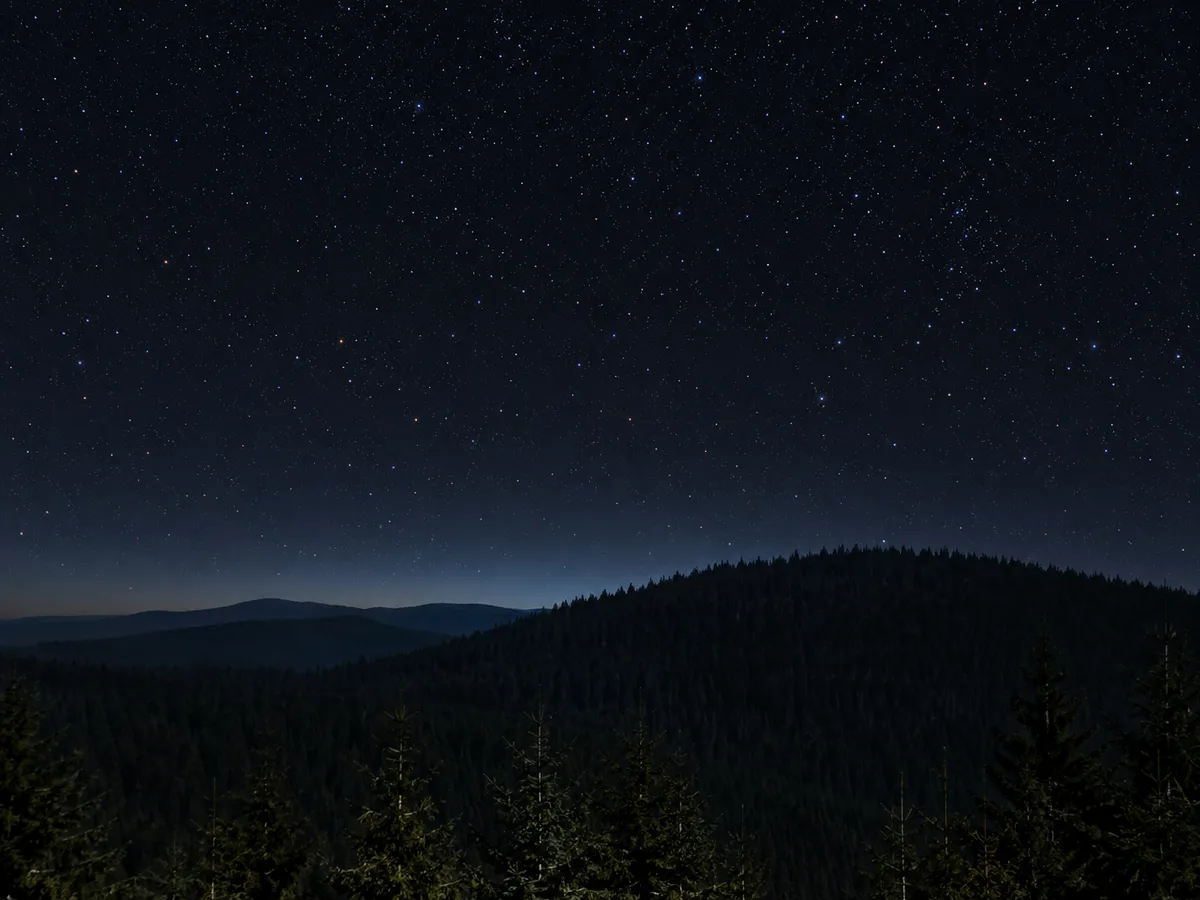
You will see the most meteors far from city lights. In remote places such as the Šumava, a mountain range on the Czech–German border, the Jizerské hory (Jizera Mountains) in the north or the Beskydy (Beskids) in the east, around two thousand stars can be counted in the sky. The more stars you can see, the more faint meteors you will catch.
Before you set off
- 01
Choose a dark spot
The further from towns, the better. A mountain meadow or a field with an open view of as much sky as possible is ideal.
- 02
Wait for the Moon to set
Be outside after moonset, which in Prague is at 2:51 on 22 October. Darkness lasts until the start of astronomical dawn at 5:47.
- 03
Dress for winter
An October night can be cold. Warm clothes, a blanket and a sleeping mat will help you stay out lying down for longer.
- 04
Phone in your pocket
Put your phone away and let your eyes adjust to the dark. Within half an hour you will start to see fainter meteors too.
- 05
Look to the side
Fix your gaze 45 to 90 degrees from the radiant. Leave the binoculars at home, as meteors are watched with the naked eye.
In the end the weather will decide, because even perfect timing is no help under an overcast sky. We do not know in advance exactly how many meteors will arrive this year, and the Orionids have surprised before. The best chance, though, is likely to come in the hours between moonset and astronomical dawn.
What the sky will be like on the night into 22 OctoberCheck the cloud forecast and pick a place where the sky will be clear.Sky forecastSources9 sources · specific figures come from the sources, the general explanation from expert knowledge
- science.nasa.govchecked 2 October 2026
- NASAchecked 3 October 2026
- science.nasa.govchecked 2 October 2026
- Fakt počasí (astronomical calculation (ephem library)) (in Czech)checked 3 October 2026
- Sekhar & Asher, Meteoritics & Planetary Science (arXiv:1303.2928)
- science.nasa.govchecked 3 October 2026
- CBET 698, Central Bureau for Astronomical Telegrams (IAU)
- www.astro.cz (in Czech)checked 2 October 2026
- www.astro.cz (in Czech)checked 2 October 2026