

The first light frosts usually arrive in October, sometimes as early as the end of September, and often sooner in the mountains and foothills. In the garden, what matters is the temperature just above the ground, which at night tends to be lower than the figure at two metres given in an ordinary forecast. Geraniums, tomatoes and other tender plants are therefore best moved under cover or protected in good time.
01Two frosts
Two frosts, one at ground level and one at two metres
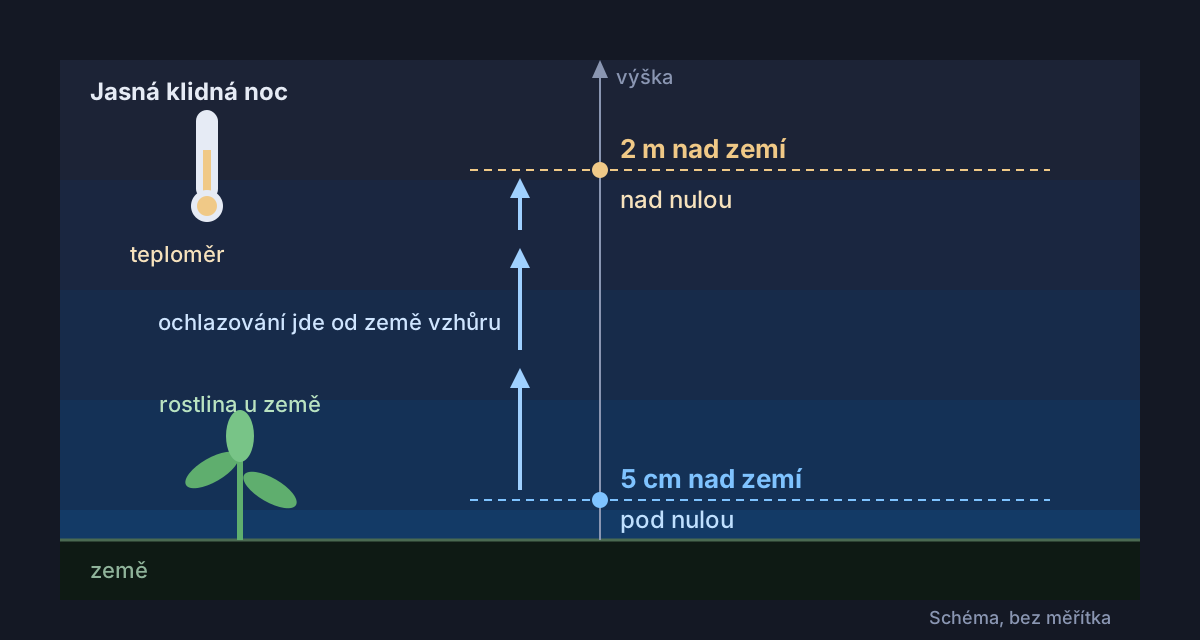
A temperature forecast usually gives the value at two metres above the ground. Plants grow much lower down, and because the air cools overnight from the surface upwards, it is usually colder near the ground.
Ground frost is the term used when the temperature five centimetres above the ground falls below zero while at two metres it stays above zero. The difference is usually two to three degrees, and in extreme cases more than ten, so a geranium or a tomato plant can freeze even when the forecast promises temperatures above zero.
British meteorologists regard frost as harmful to plants once a minimum thermometer just above the grass shows minus 0.9 °C or less. Even a night when the temperature at two metres stays a few degrees above zero can bring the lawn down to that value, most easily under clear skies and in calm air.
02Curiosities
Curious facts about frost


In a sloping garden the lower part may freeze while the upper part survives. Cold air is denser than warm air, so it flows downhill and collects in low-lying spots. At night the air that flows this way is mainly air that has been cooled by heat radiating away from the surface.
Valleys and basins where cold air flows down in large quantities are called frost hollows (mrazové kotliny in Czech). In Czechia such lakes of cold air form, for example, in some areas of the Šumavské pláně (the Šumava plains, an upland area on the Czech–German border) and in the valleys of the Krušné hory and Jizerské hory (mountain ranges on the Czech–German and Czech–Polish borders). With little cloud and light wind, the temperature in frost hollows can fall even below minus 20 degrees.
03How much time
How much time is left, going by average first-frost dates
October is only the usual range, and you cannot read an exact day from it. If you garden in the mountains or the foothills, you generally have less time, and an individual cold night can come earlier or later than the average suggests.
In the Polabská nížina (a lowland along the upper Elbe in central Bohemia), the first autumn frost generally shifted to a later date between 1961 and 2011, by at most 0.18 days per year. Over fifty years that comes to roughly nine days at most, so more a matter of days than of weeks gained.
| Location | What we know about the first frost |
|---|---|
| Ordinary location | The first light frosts usually come in October, sometimes already at the end of September |
| Mountains and foothills | The first frost often comes even earlier |
| The Elbe lowlands (Polabská nížina), 1961 to 2011 | A trend towards a later date, by at most 0.18 days per year |
04Order of jobs
What to get done before it arrives, and in what order
Start with heat-loving plants, which frost damages first and worst, and only then deal with what can tolerate the cold. Plants in containers can be moved to a sheltered place, and meteorologists advise covering tomatoes, cucumbers and pumpkins before a frost.

| Plant or item | How frost harms it | What to do |
|---|---|---|
| Geraniums in containers | How frost harms it: They cannot tolerate frost | What to do: Move to a sheltered place before the frost |
| Tomatoes, cucumbers, pumpkins | How frost harms it: Ground frost damages leaves and fruit alike | What to do: Cover, or pick the ripe fruit if need be |
| Low vegetables and other heat-loving plants | How frost harms it: Cold at ground level hits them even when the temperature at two metres is above zero | What to do: Cover, for example with a pale non-woven fabric |
| Hoses and garden water pipes | How frost harms it: The water in them freezes and may burst them | What to do: Disconnect, drain and store |
| Barrels and containers of water | How frost harms it: Ice may crack the container | What to do: Empty out the water, or at least do not leave them full to the brim |

05Risky nights
How to tell a night when frost is truly a worry
Frost at ground level, known technically as radiation frost, arrives mainly under a clear sky, in calm air and with dry air. In the evening forecast, therefore, look for a clear night with a light wind. Cloud or wind usually softens the cooling at ground level, so an equally cold day can end differently.
When frost threatens where you live is shown by the frost forecast in the Zemědělství (agriculture) tool on the Fakt počasí website. See there what the coming night looks like for your location before you start tidying the garden.
Sources9 sources · specific figures come from the sources, the general explanation from expert knowledge
- ČT24 (s odkazem na ČHMÚ) (ČT24 (Czech Television news website), citing the ČHMÚ (Czech Hydrometeorological Institute)) (in Czech)
- Toprecepty.cz (článek podle dat ČHMÚ) (Toprecepty.cz (a Czech recipe and tips website), article based on ČHMÚ (Czech Hydrometeorological Institute) data) (in Czech)
- AMS Glossary of Meteorology
- Ohio State University Extension (Ohioline HYG-1262)
- University of California (R. L. Snyder, Principles of Frost Protection)
- ČT24 (ČT24 (Czech Television news website)) (in Czech)
- TN.cz (Nova), moderátorka počasí A. Bábovská (TN.cz (Nova news website), weather presenter A. Bábovská) (in Czech)
- UF/IFAS Extension Okaloosa County
- Potop a kol., Natural Hazards (2014) (Potop and colleagues (et al.))