
In numbers
0.3mag
Brightness of Saturn at opposition, a smaller number means a brighter object
1.26mld. km
Distance of Saturn from Earth at the 2026 opposition, in billions of km
19.7arcseconds
Largest apparent diameter of Saturn's disc in a telescope
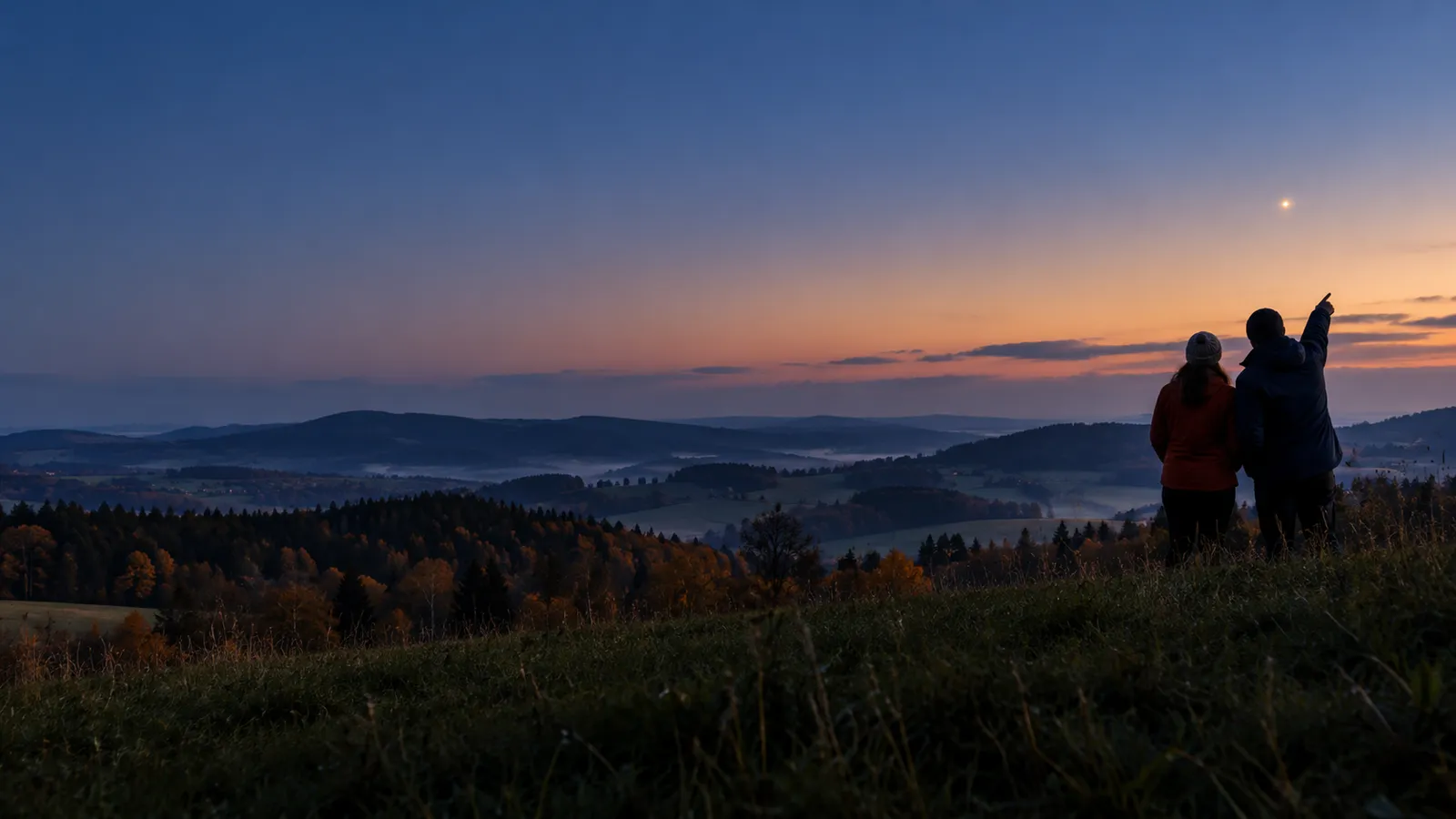
This evening, look towards the eastern horizon. That steady, yellowish point, brighter than any star in the eastern sky, is Saturn. Around its opposition, which took place on 4 October, it is closest to Earth and brightest of the whole year, and yet plenty of people overlook it.
01Opposition
Why Saturn is at its brightest right now
Opposition means that the Earth lies between the Sun and Saturn, with all three bodies lying roughly in a straight line. This year it happened on 4 October at around 12:00 Universal Time, which was the afternoon in Czech time, when Saturn was still below the horizon over Prague. At opposition a planet is at its closest and brightest of the whole year.
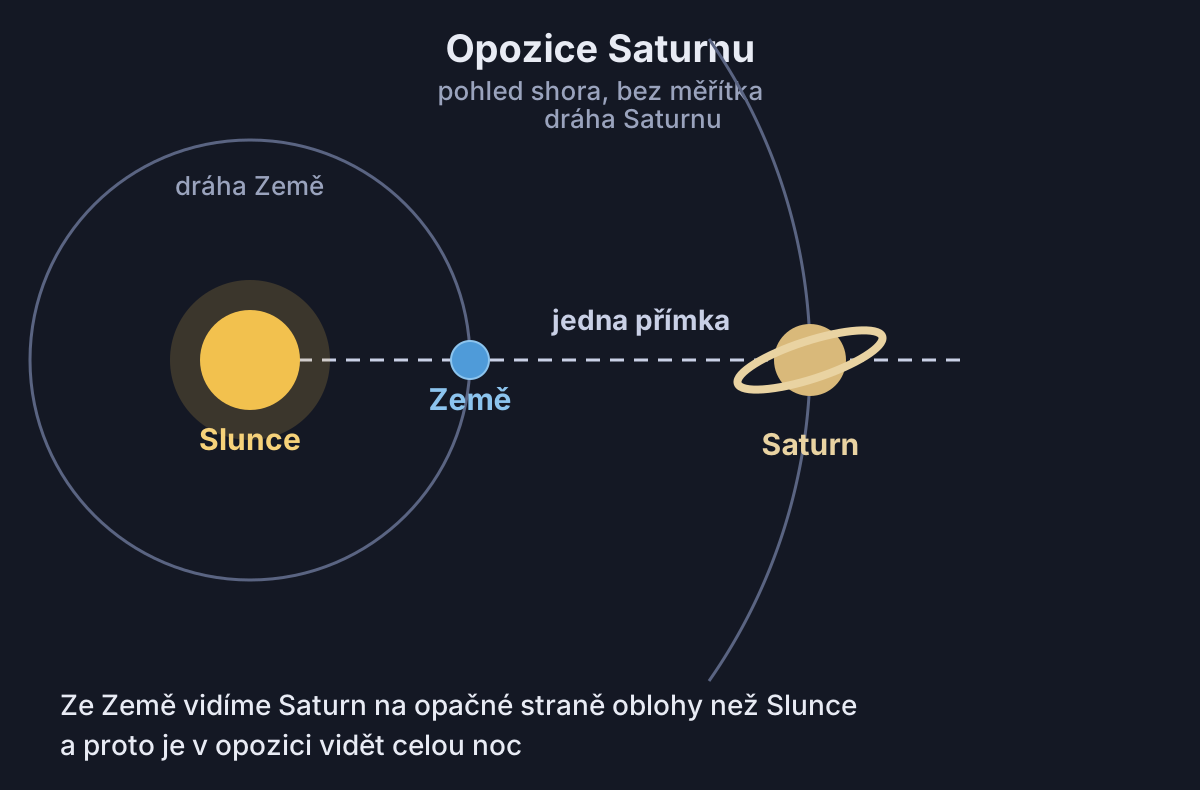
At opposition Saturn rises in the east just as the Sun sets in the west, and it stands highest in the middle of the night. It is therefore in the sky for almost the whole night, and you do not need to wait for the late hours. Over Prague it rose at 18:41 on the day of opposition.
At opposition Saturn reached a brightness of 0.3 magnitudes, and the smaller this number is, the brighter the object shines. That makes it as bright as the brightest stars or brighter, though it is the faintest of all the bright planets and looks a little unassuming in the night sky. Just after sunset, however, no star in the eastern sky shines more brightly, so if you know where to look, it is easy to find.
| Item | Value |
|---|---|
| Brightness at opposition | Value: 0.3 magnitudes |
| Distance from Earth | Value: about 1.26 billion km, or 8.43 astronomical units |
| Light travel time from Saturn to Earth | Value: roughly 70 minutes |
| Constellation in the background | Value: Cetus (the Whale) |
| Largest diameter of the disc in a telescope | Value: 19.7 arcseconds |
| Next opposition | Value: 18 October 2027 |
After opposition Saturn moves away from Earth and fades only slowly, so it is worth observing throughout the autumn. Oppositions of Saturn come roughly every 378 days, about two weeks later each year, and the next one arrives on 18 October 2027.
02Curiosities
Did you know that Saturn would float in a bath?
Saturn is much more than a bright point above the horizon. It hides several things that sound made up, yet they are confirmed by scientists at NASA and ESA.
03Where to look
Where and when to find Saturn from Czechia
After sunset, turn to face the east. Golden Saturn rises almost exactly at the east point of the horizon, and because it outshines the stars around it, you can recognise it easily. According to the calculation for Prague, it rises at 17:44 on 18 October and at 17:28 on 22 October, so by the time it gets dark it is already a little above the horizon.
During the night it climbs up and to the right, and at its highest, which astronomers call culmination, it stands exactly in the south, about 41.5 degrees above the horizon. That is roughly halfway from the horizon to the point overhead. Culmination comes a little earlier each day, at 23:54 on 18 October and already at 23:38 on 22 October.
| Date | Rises | Highest point (culmination) | Height at culmination | Sets (morning) |
|---|---|---|---|---|
| 18/10/2026 | Rises: 17:44 | Highest point (culmination): 23:54 | Height at culmination: 41.5° | Sets (morning): 6:08 |
| 22/10/2026 | Rises: 17:28 | Highest point (culmination): 23:38 | Height at culmination: 41.4° | Sets (morning): 5:51 |
| 31/10/2026 | Rises: 15:52 | Highest point (culmination): 22:00 | Height at culmination: 41.2° | Sets (morning): 4:12 |
| 14/11/2026 | Rises: 14:55 | Highest point (culmination): 21:02 | Height at culmination: 40.9° | Sets (morning): 3:13 |
| 30/11/2026 | Rises: 13:51 | Highest point (culmination): 19:57 | Height at culmination: 40.8° | Sets (morning): 2:07 |
On Sunday 25 October the clocks go back one hour to Central European Time, so all of Saturn's times shift one hour earlier on your watch. According to the calculation it then culminates at 22:00 on 31 October, at 21:02 on 14 November and already at 19:57 on 30 November. It still rises in daylight, but after dark you will find it higher and higher, and at the end of November it stands at its highest before eight in the evening.
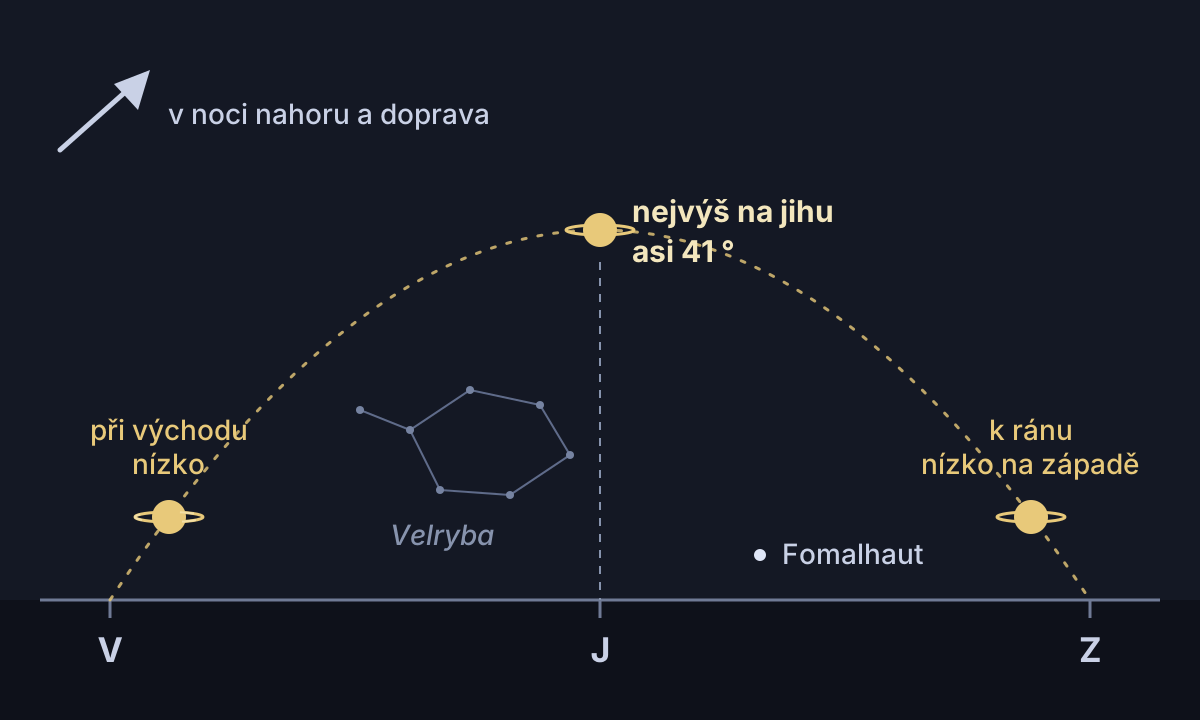
Saturn now stands in front of Cetus, the Whale, a constellation with no bright stars, so nothing near it in the sky shines as strongly as it does. It keeps company with the fainter star Fomalhaut in Piscis Austrinus (the Southern Fish), which you will find low above the southern horizon. You will not mistake it for Saturn, because the planet shines more brightly and steadily.
04Rings
Why the rings are only narrow this year
The rings lie in the plane of Saturn's equator, and because the planet's axis is tilted by 26.73 degrees, they are tilted too. Saturn orbits the Sun in about 29.4 years, and over that time we look at the rings once from above, once from below and, in between, twice exactly edge-on. That is why their appearance changes in a cycle of 13 to 15 years, from almost fully open to a thin line and back again.
The Earth was last exactly in the plane of the rings in March 2025, and according to the calculation their tilt was zero on 23 March. It could not be observed, however, because Saturn stood too close to the Sun in the sky. The rings are also so thin that around such a moment they vanish for several weeks even in small telescopes.
Since then the rings have been opening again. This year they are turned towards us with their southern side, and on the day of opposition their tilt was 7.5 degrees, which in a telescope is a very slender ellipse, almost a dash, but not quite. Over the coming weeks the tilt will, according to the calculation, shrink a little further, to 6.1 degrees at the end of November.
| Date | Tilt | Which side faces us |
|---|---|---|
| 15/10/2017 | Tilt: 27.0° | Which side faces us: northern |
| 23/3/2025 | Tilt: 0.0° | Which side faces us: none, the Earth was in the plane of the rings |
| 4/10/2026 | Tilt: 7.5° | Which side faces us: southern |
| 17/10/2026 | Tilt: 7.0° | Which side faces us: southern |
| 30/11/2026 | Tilt: 6.1° | Which side faces us: southern |
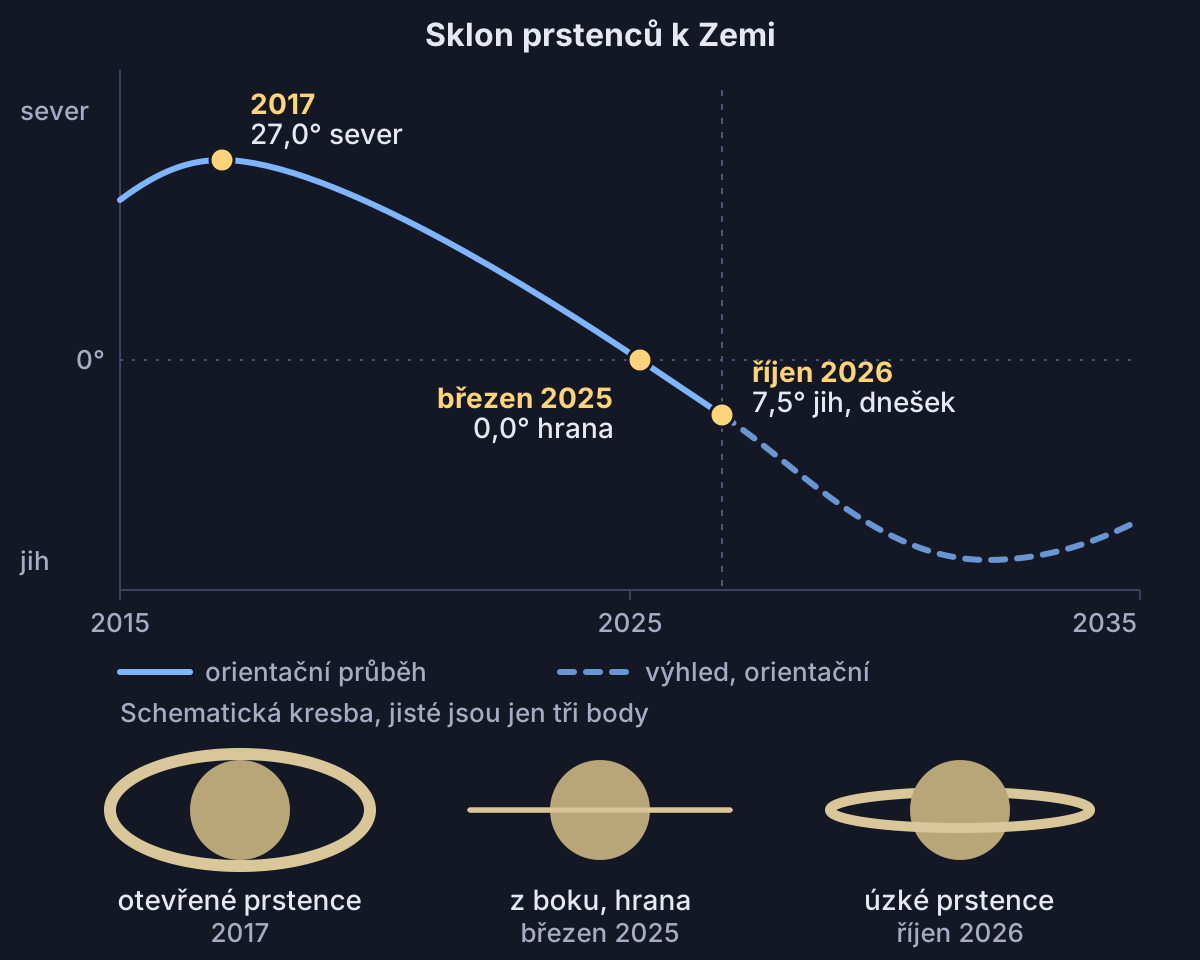
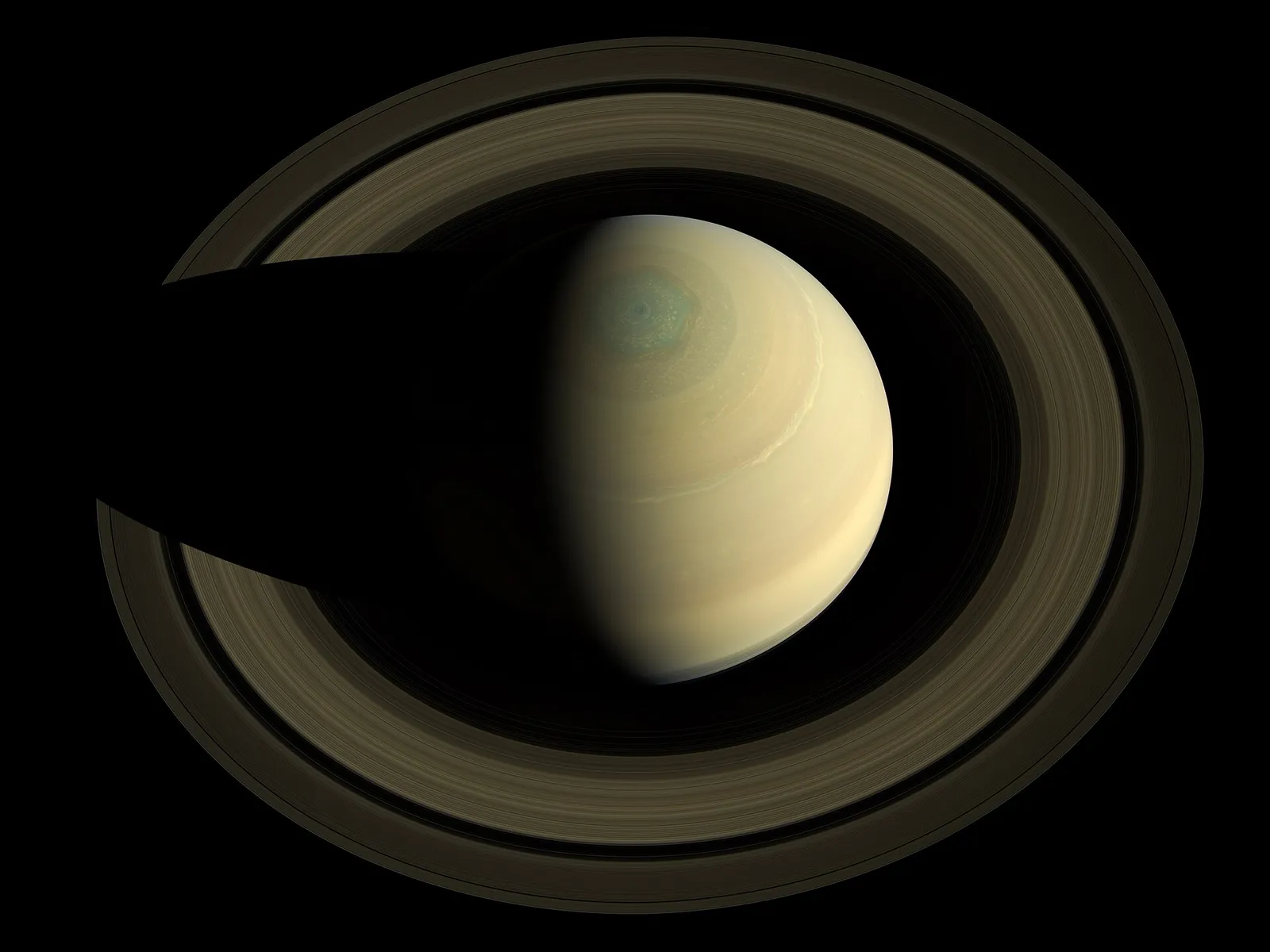

Saturn last showed itself in full glory around 2017, when the tilt of the rings on 15 October was 27.0 degrees and the northern side faced us. In September of that year the mission of the Cassini probe, which had worked at Saturn since 2004, came to an end.
A small consolation for Czech observers comes from another direction. In 2017 the rings had their full tilt, but Saturn climbed over Prague to only 17.8 degrees above the horizon at its highest. This year it is 41.6 degrees, so you are looking at it through a thinner layer of air and the image is often steadier.
In the long term the rings are opening, and they will be most open, this time with their southern side, at roughly 2032. The next good edge-on view of the rings awaits Earth only at the triple crossing in 2038 and 2039. Today's slender shape is therefore just one of the many forms that Saturn will show during its long year.
05Observing
What you will see with the naked eye, binoculars or a small telescope
The more equipment, the more detail, but the first experience needs none of it. Even Galileo, with his crude telescope that magnified twenty times, realised that Saturn is no ordinary dot, and he saw it as a triple shape.
| What you look with | What you will see | What to watch out for |
|---|---|---|
| Naked eye | What you will see: A bright, steady, yellowish point, above the eastern horizon in the evening and in the south around midnight. | What to watch out for: Its light twinkles less than that of stars, and its colour is more golden than white. |
| Binoculars | What you will see: A bright oval disc. The rings cannot be seen through binoculars. | What to watch out for: Hold the binoculars firmly or mount them on a tripod, otherwise the image shakes. |
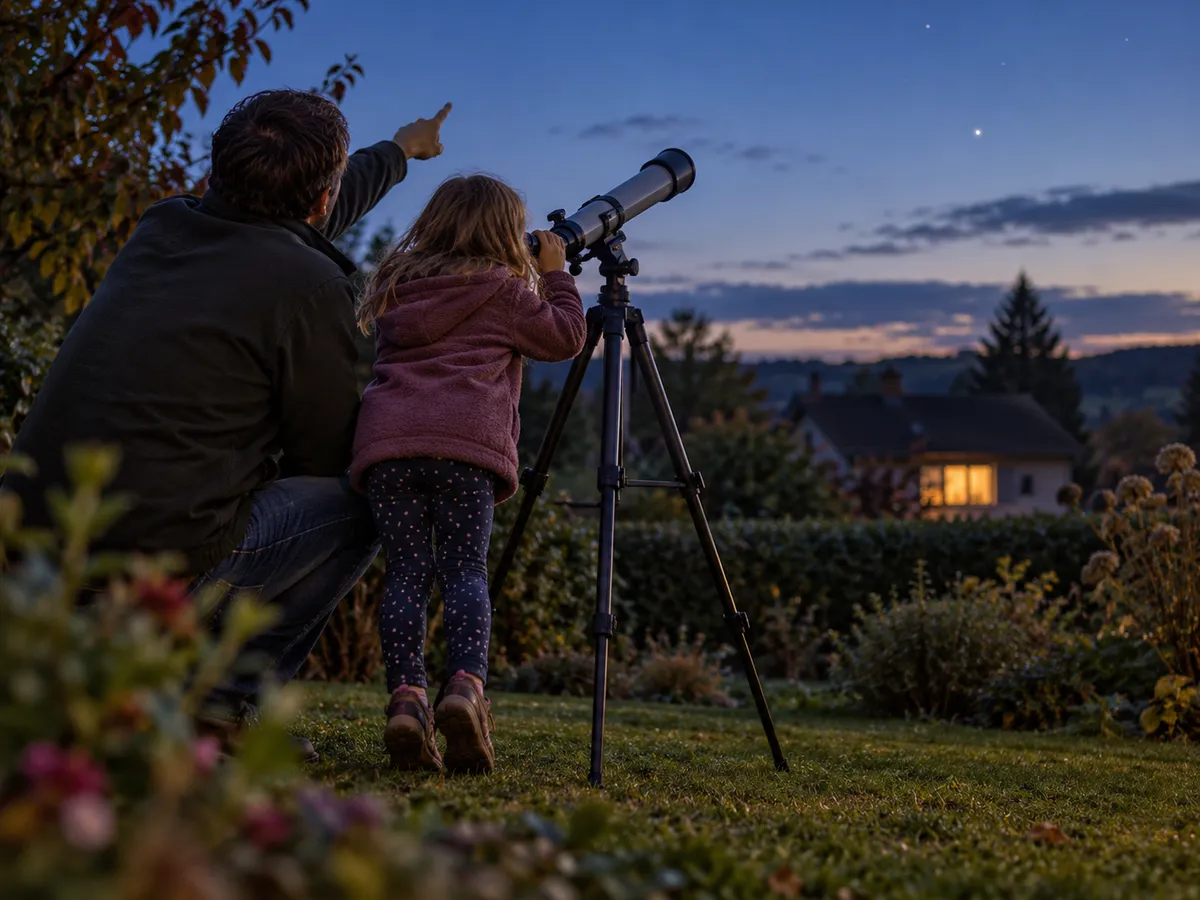
| Children's telescope | What you will see: A pale disc, and with good optics and a firm stand even narrow rings. | What to watch out for: Toy telescopes with a wobbly tripod may not show the rings, and a better instrument will help. |
| Small telescope | What you will see: The disc of the planet, narrow rings and a faint little star next to the planet, the moon Titan. | What to watch out for: The rings are much slimmer this year than in the familiar photographs from 2017. |
NASA describes the colour of the planet as a mix of shades of yellow, brown and grey. The faint colour differences are probably caused by compounds of sulphur or phosphorus or by complex hydrocarbons, but with the naked eye or a small telescope you will see mainly a golden tinge.
Titan orbits Saturn in 15 days and 22 hours, and so its position relative to the planet changes markedly from night to night. If you spot a faint little star next to Saturn in a telescope that shifts from one evening to the next, it may well be Titan. You will not see Titan's surface, because it is hidden by a golden haze.
If you do not have a telescope of your own, you can go to a public observing evening at an observatory, where experienced people will point a telescope for you and advise where to look. While you are outside, look around for the October Orionids too, which we covered separately, and enjoy Saturn throughout the whole autumn.
What is in the sky this eveningAn overview of what is visible right now in our sky above Czechia.Open the skySources9 sources · specific figures come from the sources, the general explanation from expert knowledge
- EarthSky (astronomy news website, not an institution)
- Výpočet Fakt počasí (Fakt počasí calculation) (in Czech)
- NASA Science: Saturn Facts
- NASA Science: Saturn Moons
- NASA Science: Titan Facts
- NASA: Changing Colors in Saturn's North (text of 2016)
- NASA: Saturn is Losing Its Rings (text of 2018)
- ESA: Saturn's rings
- NASA/Hubble: Hubble Views Saturn Ring-Plane Crossing (text of 1995)