

In numbers
2cm
How much continuous snow lay on Sněžka on the morning of Monday 12 October
60km/h
The wind speed up to which the upper section of the Sněžka cable car may run
1603.3m
How many metres above sea level Sněžka, Czechia's highest mountain, stands
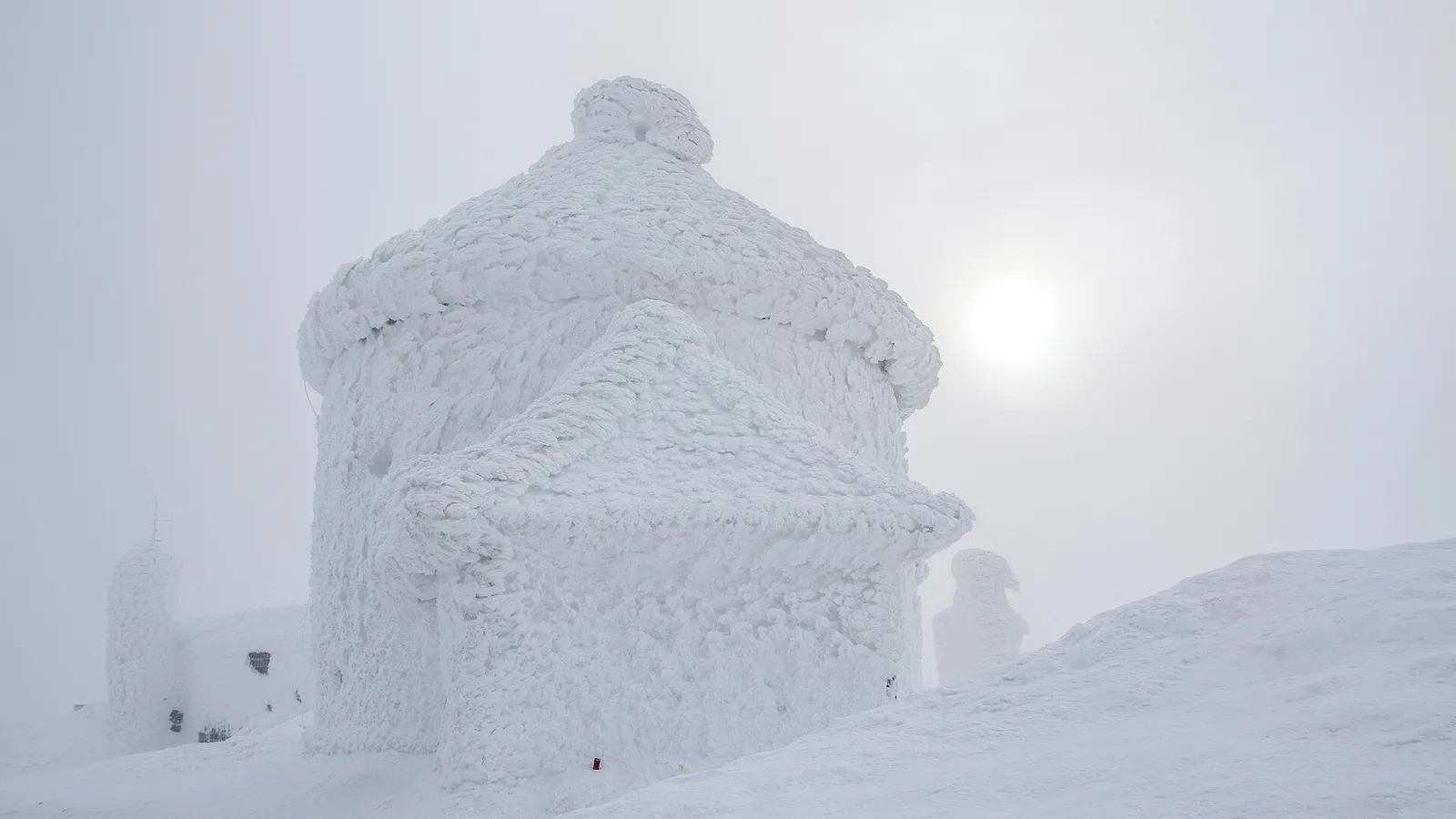
Czechia's highest mountain turned white on Monday 12 October. It was the first day of this winter on which a station of the Czech Hydrometeorological Institute (ČHMÚ) reported a continuous snow cover at the morning measurement at eight o'clock. In the lowest areas, such as Polabí (the Elbe valley region) or jižní Morava (the south of the Moravian region), the first snow arrives, on the long-term average, only after 20 November.
01Snow and altitude
Why snow falls on Sněžka first
Sněžka stands 1603.30 metres above sea level and, despite its modest height, has an Arctic and high-mountain climate. Warmth decreases with altitude and the open summit is also exposed to wind, so snow reaches the top earlier than the lowlands.
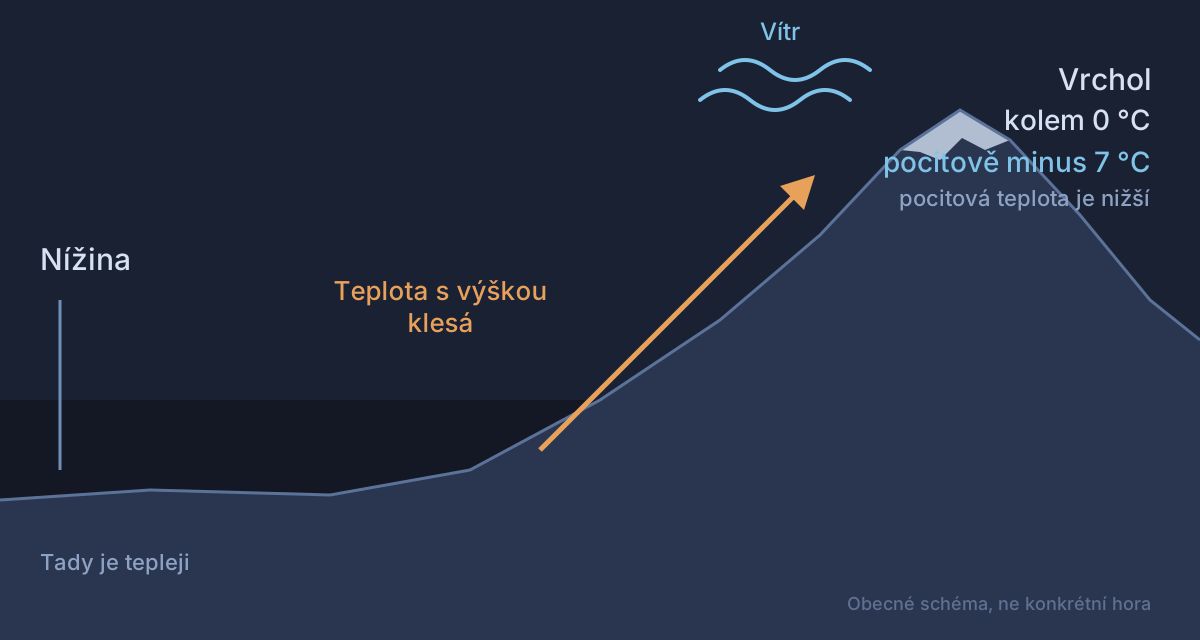
At noon on 12 October the temperature on the summit was around zero, but the wind made it feel like minus seven degrees. A falling flake does not yet mean snow that stays on the ground. The first flakes appeared on Sněžka this year as early as 24 September, but they did not settle.
Snow had already begun falling on Sunday 11 October, and during the day it lay on the ridges of the Krkonoše mountains, in the Jizerské hory mountain range and in the Šumava mountains. Monday 12 October therefore brought the season’s first measured continuous snow cover, rather than its first snowfall, with a depth of 2 centimetres on Czech mountain Sněžka. The outlook quoted at the time in the report of 12 October expected mountain temperatures to rise above freezing in the following days, making a thaw likely.
02Comparison
Last year snow lay here ten days earlier. Is this year late?
This year, Sněžka had its first snow cover on 12 October, compared with 2 October last year and as early as 12 September in 2024. The snow did not last, and by the morning of 13 October the station was reporting a snow depth of zero. In 2023, the first snow in the mountains did not fall until 15 October, although that date does not refer specifically to Sněžka.

More than a month separates the earliest and the latest of these dates, so a single year says little about the arrival of winter. According to ČHMÚ, the first snowfall in the mountains appears on the long-term average before 20 October, and meteorologists routinely record snow there in September. This year is therefore not lagging behind the average, although the average refers to the first snowfall, not to a lying layer.
03Curiosities
The weather on the summit is measured by Poles and wind can stop the cable car
On the summit stands a mountain meteorological observatory of the Polish Institute of Meteorology and Water Management, IMGW for short, and the snow-cover figure for Sněžka is supplied to ČHMÚ by these Polish colleagues. Temperature, air humidity, cloud base and pressure are measured there, and the first measurements took place as early as 1880. The meteorologists work in shifts so that there are always at least two of them.
The weather was watched here even earlier, though. The Chapel of St Lawrence on the summit has served as a mountain shelter since 1665, and irregular meteorological observations took place in it from 1824.
| Measure | Value |
|---|---|
| Height above sea level | Value: 1603.30 m |
| Average annual temperature at the summit | Value: 0.5 °C |
| Lowest recorded temperature | Value: minus 33.4 °C in 1956 |
| Wind gust on the Polish side on 23 February 2020 | Value: 223 km/h |
| Wind gust during storm Kyrill in 2007 | Value: 216 km/h |
| Almost completely calm conditions | Value: about 1% of days each year |
The weather on the mountain can also change very abruptly, so it is worth checking whether the cable car is running before a trip. When it is not running, a route 2.5 kilometres long leads on foot from Růžová hora to the summit.
04Outlook
When snow will fall in the lowlands too and what meteorologists say
No outlook gives the exact date of the first snow in the lowlands, because long-range outlooks describe whole periods, not individual days. Meteorologists also point out that details remain uncertain even for the nearest days.
The four-week outlook from ČHMÚ, the Czech Hydrometeorological Institute, anticipates wetter weather later on, when snow in the mountains could lie for several days during colder spells. According to long-range outlooks quoted in the media, the first ten-day period of November could bring temperatures of around 10 to 13 °C, with cooling only in the second and third ten-day periods. By the end of November, precipitation could fall as a mixture of rain and snow, or as snow, even at lower elevations.
ČHMÚ’s long-term average offers a better guide. At elevations between 400 and 600 metres above sea level, the first snow falls in the first ten-day period of November, while the lowest areas, such as the Polabí lowlands and southern Morava, a region in eastern Czechia, have to wait until after 20 November. In the mountains, snow that may stay on the ground usually falls in November.

05Practical advice
What to do this week
Winter tyres are compulsory in Czechia from 1 November to 31 March if there is a continuous layer of snow, ice or frost on the road, or such conditions can be expected. On stretches with the ‚Zimní výbava‘ (winter equipment) sign the obligation applies regardless of the weather. The tread of winter tyres must be at least 4 millimetres deep.
The tyre maker Continental recommends going by a threshold of 7 °C, that is, changing tyres when temperatures fall below it. This is a recommendation, not a legal obligation, and it is worth booking an appointment at the tyre shop in advance.
Follow the forecast for your placeWhen temperatures where you live drop below 7 °C, you will see on the main page forecast.Show forecast
| Place | What is happening | What to do |
|---|---|---|
| Lowlands | What is happening: Autumn still prevails, and the first snow arrives, on the long-term average, only after 20 November. | What to do: Plan the tyre change by temperature, as the maker advises a threshold of 7 °C, and check the tread, which should be at least 4 mm. |
| Mountain road | What is happening: On stretches with the Zimní výbava sign winter tyres apply regardless of the weather, elsewhere from 1 November in snow, ice or frost. | What to do: Have winter tyres on the car and watch for the Zimní výbava sign. |
| Ridge | What is happening: On Sněžka on 12 October snow lay and it felt like minus seven degrees, and the upper section of the cable car runs only up to a wind speed of 60 km/h. | What to do: Bring warm layers, check that the cable car is running before the climb, and expect that the route from Růžová hora is 2.5 km on foot. |
Sources12 sources · every number and claim in the article comes from them
- Expats.cz (news website)
- ČTK (České noviny) (Czech News Agency) (in Czech)
- ČTK (České noviny) (Czech News Agency) (in Czech)
- Deník (s citací ČHMÚ) (Deník newspaper, quoting the Czech Hydrometeorological Institute) (in Czech)
- ČHMÚsněhová pokrývka H6SNEZ01, data IMGW (in Czech)
- PAP (Nauka w Polsce) (Polish Press Agency science service)
- Architektura & biznes (Polish architecture magazine)
- Karpacz Ski Arena (report by the local operator, 24 February 2020)
- Správa KRNAPRočenka 2017, kapitola 10 let od Kyrillu (in Czech)
- Expats.cz (news website)
- EnergoZrouti.cz s odkazem na ČHMÚ (news website, referring to the Czech Hydrometeorological Institute) (in Czech)
- Continental (výrobce pneumatik) (tyre manufacturer) (in Czech)