
In numbers
- 01
A third
fewer grapes than in a normal year are expected by the winegrowers’ union this year
- 02
Up to 70%
of the crop was lost by growers where the summer hailstorm passed through
- 03
80 to 20
is this year’s ratio of white to black grapes harvested
01
First drought, then hail
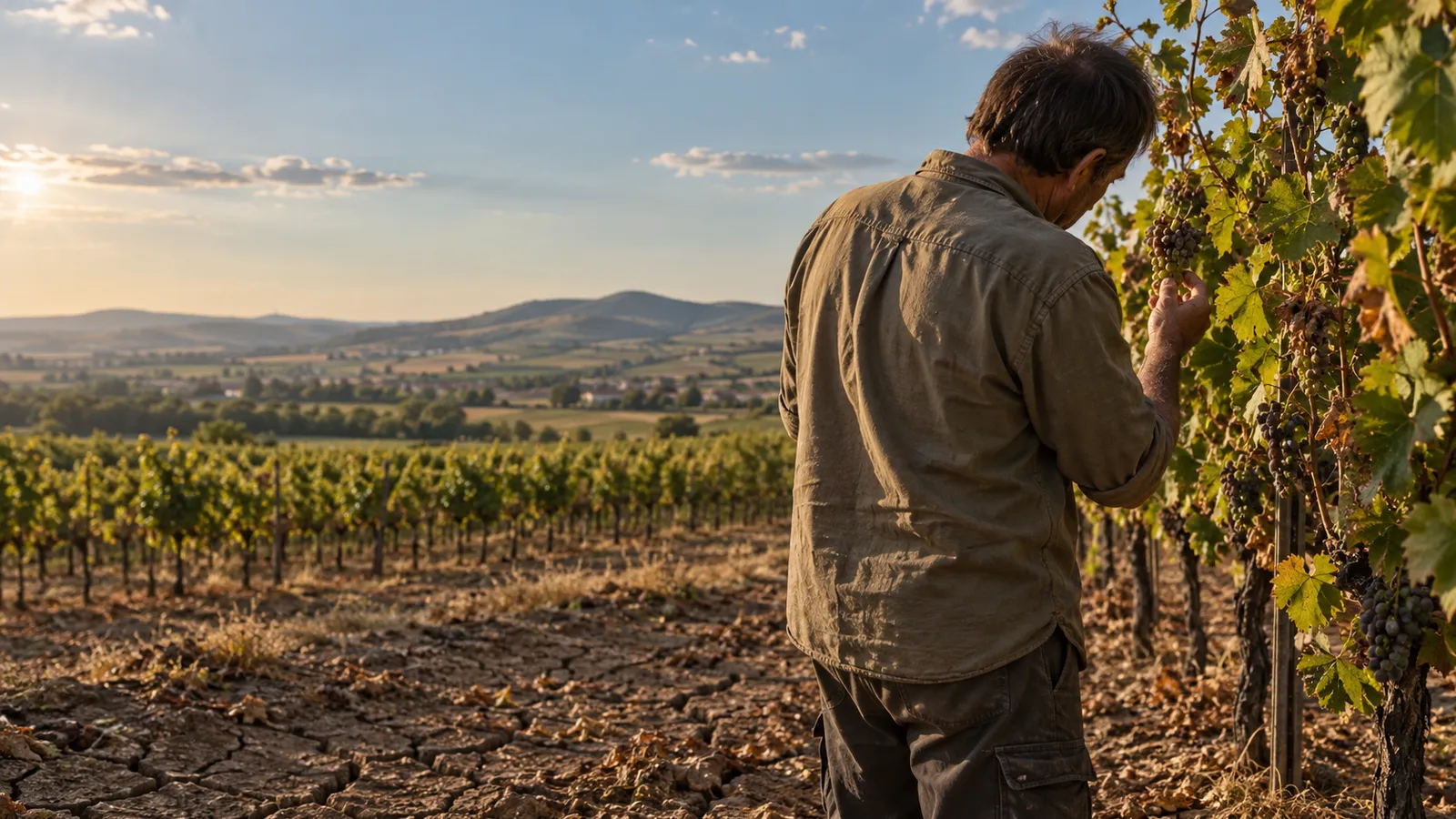
In the summer, the winegrowers’ union expected 30 to 40 per cent fewer grapes. September rains helped a little, but the crop will still be roughly a third smaller than usual. “With a long-term average yield of around 5.6 tonnes per hectare, we are coming in significantly lower this year,” says the union’s executive director, Martin Půček. Where a severe summer hailstorm added to the drought, growers lost up to 70 per cent of their crop, according to the union.
The drought also left the grapes with less juice. The berries stayed small, did not ripen evenly everywhere and yielded less must when pressed. Their sugar levels rose quickly while acidity fell, so growers had to pick the right day to harvest. The harvest therefore went faster than usual, and by early October only the last black grapes were still hanging on the vines.
02
Why a small berry produces darker wine
The juice of almost all grapes is pale. It is the skins and seeds of black grapes that give wine its red colour and characteristic astringent taste. A small berry has more skin relative to its juice, and therefore more pigment. Trials in Spain and elsewhere have shown that vines receiving less water tend to have grapes with more deeply coloured skins.
This is what underpins the union’s optimism. “Smaller berries led to a higher ratio of skin to flesh, which could mean a good concentration of pigments, tannins and aromatic compounds,” says Půček. For individual varieties, he says the outcome will depend on where the vineyard lies, when the grapes were harvested and how the grower looked after it during the year. “In general, however, we can say that red wines from the 2026 vintage could be very interesting.”
03
The view from Rakvice
Mr Michlovský of the Vinselekt Michlovský winery in Rakvice, in the Velkopavlovicko winegrowing area, takes a more cautious view. His winery harvested 40 to 45 per cent fewer grapes than in a normal year. On almost ten hectares of vineyards at the Trkmansko site, they harvested nothing at all after a hailstorm. Asked which varieties of black grapes had turned out best for him this year, he replied, “Surely no one can seriously suggest assessing the condition and quality of this year’s red wines at this stage.” He says vineyards growing black grapes have been declining over the past 10 to 15 years. In his view, little can be done against drought, and he rejects irrigation. “We do not irrigate our vineyards. Top-quality wine and irrigation do not get along particularly well.”
04
Warmer weather, yet fewer black grapes
Warmer weather should favour black grapes. The average temperature in Morava has risen by about 1.5 °C over the past sixty years, and Půček says black grapes now ripen more reliably in many vineyards than they did twenty years ago. Yet growers are harvesting fewer and fewer of them.
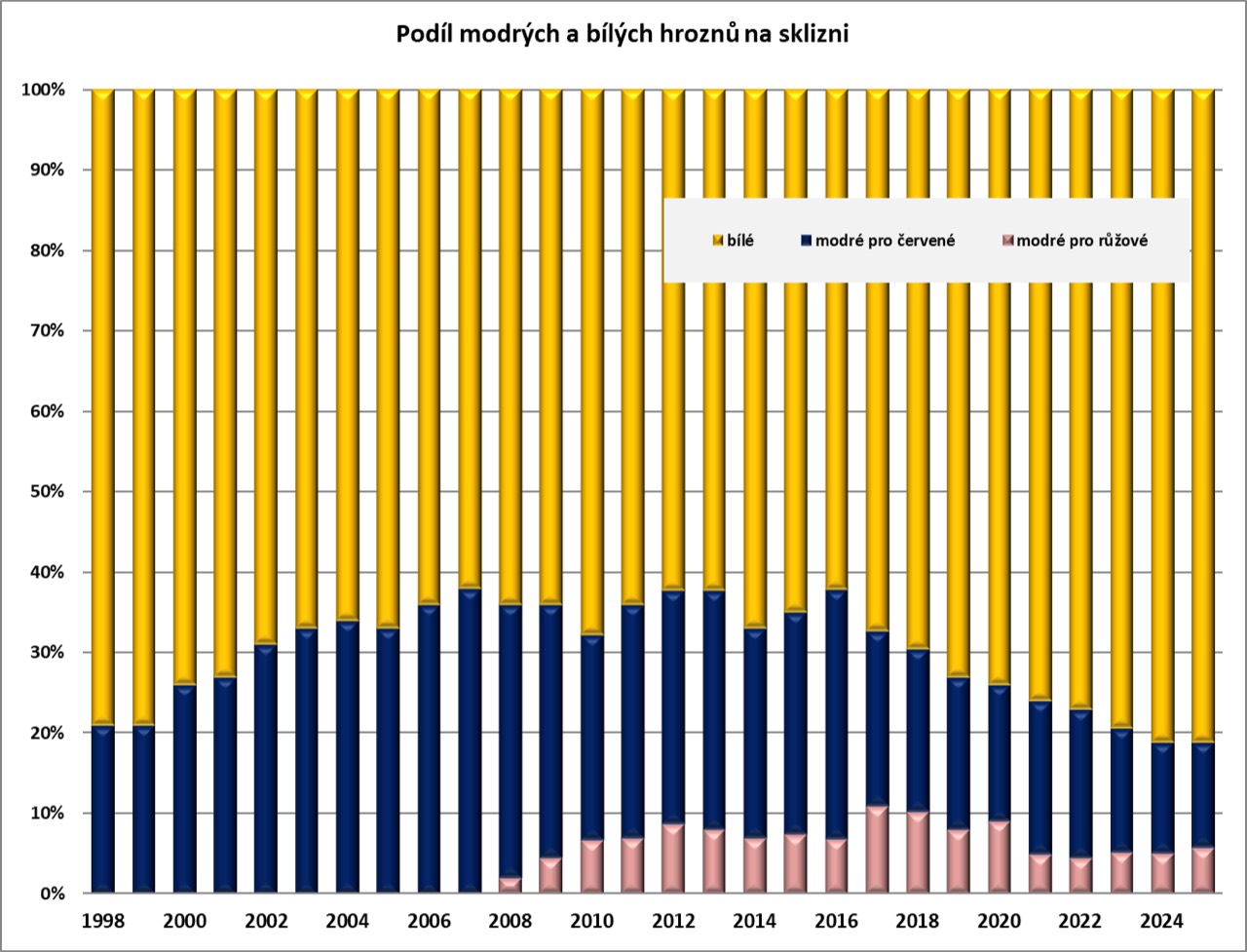
According to the winegrowers’ union’s chart, black grapes accounted for about a fifth of the entire harvest in 1998. In some years between 2007 and 2016, their share approached 40 per cent. Their share has been falling since then and is now back below a fifth. Moreover, roughly a third of black grapes end up in rosé rather than red wine.
The market is decisive. “There is a general trend towards switching to white wines, not only in Czechia but also in neighbouring countries,” says Půček. The effect on vineyard area is slower, because vineyards are planted for decades. According to the state register, vineyards growing black grapes cover about 4400 hectares, roughly a quarter of all vineyards. Vineyards growing white grapes cover more than 12 500 hectares.
05
To irrigate or not
Most winegrowers can do little against drought. The union advises keeping as much water in the soil as possible. Grass between the rows, mulch, gentle cultivation and summer work on the vines help ensure they do not carry more grapes than they can support. Over the longer term, the choice of varieties and the rootstocks onto which the vines are grafted also matters. Irrigation would help most, but not everyone has water. “This year has shown once again that vineyards without access to irrigation were more severely affected by drought,” says Půček.
Those who have water can see the difference. Wine producer Bohemia Sekt is trying out watering a trial vineyard only at key stages of growth. According to viticulture manager Petr Ptáček, it harvested 20 tonnes of grapes per hectare from the vineyard, more than double the previous average.
06
A hot summer elsewhere in Europe too
France had its hottest summer since records began this year, and its agriculture ministry expects 6 per cent less wine than last year. The harvest in Champagne is expected to be almost halved. In Spain, heat brought the harvest forward and made the grapes smaller. Cooperatives there still praise their quality and estimate that 34 million hectolitres of wine and grape must will be produced. Italy has not published a national estimate this year. The Franciacorta region shows how early the grapes ripened, with harvesting beginning in July for the first time on record.
07
Drought could leave its mark next year too
A vine that went thirsty in the summer will develop fewer fruitful buds, so it may bear fewer grapes next year. It will also be less well prepared for winter frosts. How much of the crop this will take in 2027 will only become clear at the next harvest.
Sources14 sources · every number and claim in the article comes from them
- Písemná odpověď redakci · Martin Půček, výkonný ředitel, Svaz vinařů České republiky, z.s. (Written response to the editorial team from Martin Půček, executive director of Svaz vinařů České republiky, z.s., the Czech winegrowers’ union; link to the respondent’s website) (in Czech)
- Písemná odpověď redakci · pan Michlovský (Written response to the editorial team from Mr Michlovský; link to the respondent’s website) (in Czech)
- Newstream / ČTK (Newstream is a Czech news website and ČTK is the Czech News Agency) (in Czech)
- Seznam Zprávy (Czech news website; Vinařská unie (Winegrowers’ Union)) (in Czech)
- Newstream / ČTK (Petr Ptáček, Bohemia Sekt; Newstream is a Czech news website and ČTK is the Czech News Agency) (in Czech)
- Agricultural Water Management 256 (2021), Lizama et al.
- ÚKZÚZ / MZe, Výběr statistik o vinicích k 31. 12. 2025 (Vineyard statistics as of 31 December 2025, from ÚKZÚZ, the Central Institute for Supervising and Testing in Agriculture, and MZe, the Ministry of Agriculture) (in Czech)
- Svaz vinařů ČRgraf (chart; visual observation) (in Czech)
- ESM / Reuters (8 September 2026)
- Hürriyet Daily News / AFP (8 September 2026)
- Agronews Castilla y León (1 October 2026)
- Vinetur (7 August 2026)
- Turismo Lanzarote
- Cornell CALS, Grapes 101: Water Stress (2016)
