
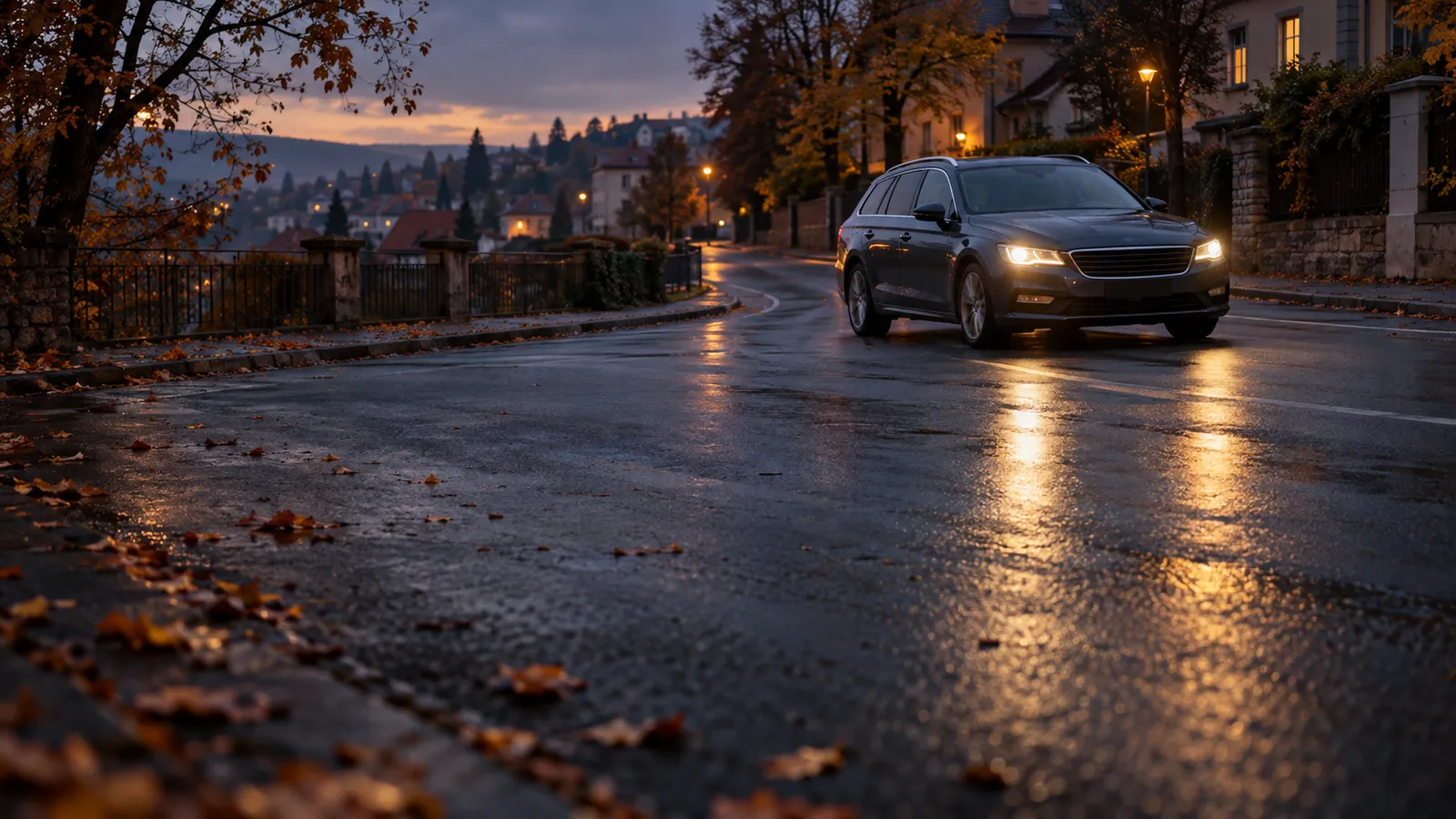
No extra daylight is gained, it simply moves from the afternoon to the morning. On Sunday you can sleep an hour longer, but from Monday there will be light earlier on the way to work and darkness earlier on the way home.
01Turning the clocks back
At three in the morning the clocks go back to two
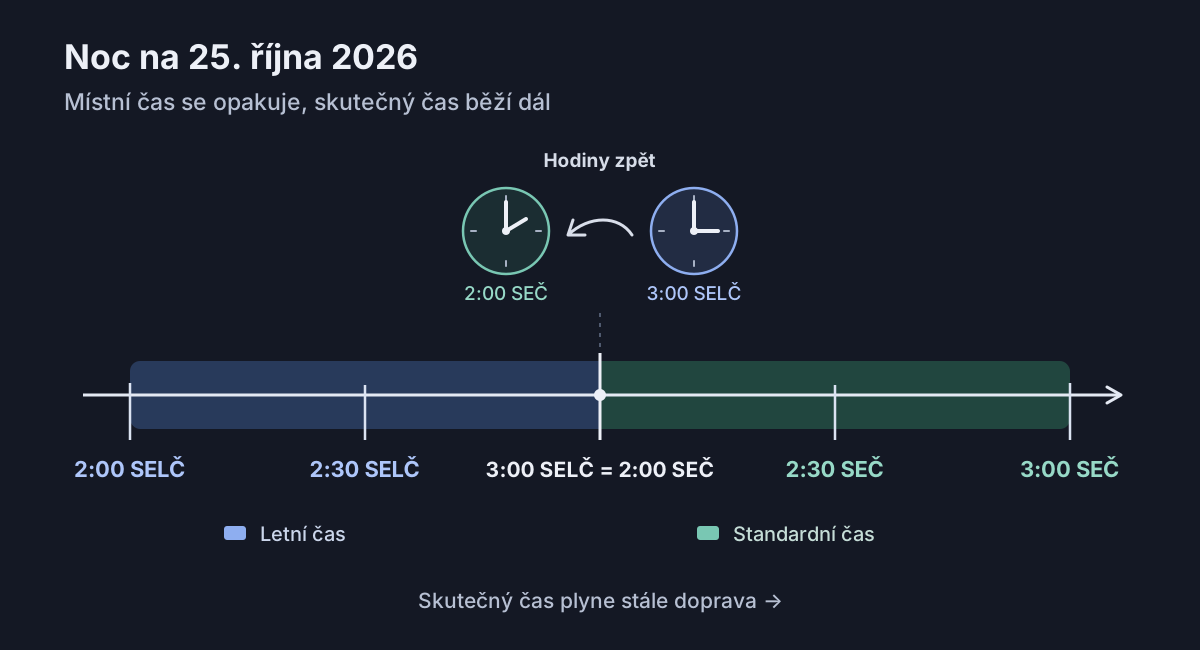
In the night from Saturday to Sunday, at 3:00 Central European Summer Time (CEST, in Czech SELČ) the clocks go back to 2:00 Central European Time (CET, in Czech SEČ). The hour between two and three o'clock therefore happens twice. It takes place at the same moment across the whole European Union, at 1:00 universal time, and standard time returns, which we commonly call winter time.
A phone or computer with automatic date, time and time zone settings will usually adjust itself. For analogue clocks, an alarm clock, an oven or the clock in your car, check the settings or the manual. If you have an important journey on Sunday, also check the time on the device that is meant to wake you.
02Lesser known
What is not commonly known about the clock change
In spring the hour goes missing instead. Before the move to summer time in 2025, České dráhy announced that the change would affect twelve of its night trains and that eleven of them would start with a delay of 60 minutes, which they would try to shorten, for example with shorter stops in stations. Morning connections were generally not supposed to wait for them, so that the delay would not carry over to daytime services.
During the spring clock change in 2025 the operator solved it differently for the night EC 461 Baltic express. It was due to leave the Polish city of Gdynia an hour earlier than usual and to run through Czech territory already on summer time, without a delay. For the rotations of carriages, locomotives and staff, České dráhy introduced a special measure so that the delay would not be passed on to trains in the daytime.
Summer time reached the Czech lands as early as the First World War, and it first applied from 30 April 1916. After the Second World War it applied in Czechoslovakia until 1949 and then went unused for thirty years. The clocks were moved forward in spring again only in 1979.
It may come as a surprise how little of the original energy argument is left today. According to studies that the European Commission referred to in 2018, energy savings from summer time are now marginal. A Commission report from 2007 already said that the real savings are hard to establish and are relatively small.
03Light during the day
In Prague the Sun will set at 16:52 on Sunday
Moving the hands changes only the reading on the clock, and the Sun does not move any differently because of it. In Prague the Sun rises on Saturday 24 October at 7:39 and on Sunday already at 6:40 by your watch. Alongside this jump the natural shortening of the day continues, so sunrise comes later day by day and sunset comes earlier.
| Date | Sunrise | Sunset |
|---|---|---|
| 22/10 | 7:35 | 17:57 |
| 23/10 | 7:37 | 17:55 |
| 24/10 | 7:39 | 17:54 |
| Clocks go back one hour (CEST → CET) | ||
| 25/10 | 6:40 | 16:52 |
| 26/10 | 6:42 | 16:50 |
| 27/10 | 6:43 | 16:48 |
| 28/10 | 6:45 | 16:46 |
In Brno the Sun sets on Saturday 24 October at 17:47 and on Sunday 25 October already at 16:45. In Ostrava it will be at 17:39 and at 16:37. Sunrise moves in Brno from 7:28 to 6:30 and in Ostrava from 7:23 to 6:25.
Sunset is, however, not the moment of complete darkness, and dawn begins before sunrise. How much light there actually is on your journey will also depend on cloud, fog and the surrounding terrain. Treat the times as a guide, not as a forecast of when you will be able to see.
When the Sun rises where you areLook up sunrise and sunset for your own location and plan your journey or walk.Find the Sun times04Reasons and rules
The Czech government does not decide on ending clock changes
Summer time was meant to shift the use of daylight to the hours when people are awake. The first European rules came in 1980 and gradually unified the national dates that had differed until then.
The directive in force today sets the start of summer time on the last Sunday in March and its end on the last Sunday in October. According to it, a common moment of change across the whole Union is important for the functioning of the internal market.
Czechia introduces the clock change through its own regulation, but it must keep to this common schedule. If the Czech government alone stopped changing the clocks, it would breach a European obligation. The alternation of time can be abolished only by a change in the European rules.
05The European debate
Abolishing the clock change in the EU has no date yet
On 12 September 2018 the European Commission proposed ending seasonal clock changes across the Union. The European Parliament adopted its position at first reading on 26 March 2019. That was not the end of the approval process, however. To this day the proposal is waiting for the position of the Council, that is, of the member states, and nobody has approved a date for the last turning of the clocks.

It also remains open which time would then apply all year round. The proposal leaves each state the choice of whether summer time or winter time will apply permanently. The end of the alternation would therefore not necessarily mean that winter time stays everywhere.
06The first week
To work in daylight, home after sunset
An extra hour of sleep does not mean you will wake up rested. Many people nevertheless cope with the autumn shift better than the spring one, because going to bed and getting up later tends to be easier than doing so earlier.
What to try in the first week after the change
- 01
Get up at the same time
Throughout the first week after the change, get up at the same time every day, even at the weekend. Sleep doctors advise this all year round.
- 02
Wind down the first evenings
In the first evenings after the change, limit bright light and allow yourself a calming routine. Switch electronics off at least half an hour before bed.
- 03
Watch caffeine and alcohol
Until you get used to the new time, avoid caffeine in the afternoon and evening and alcohol before bed.
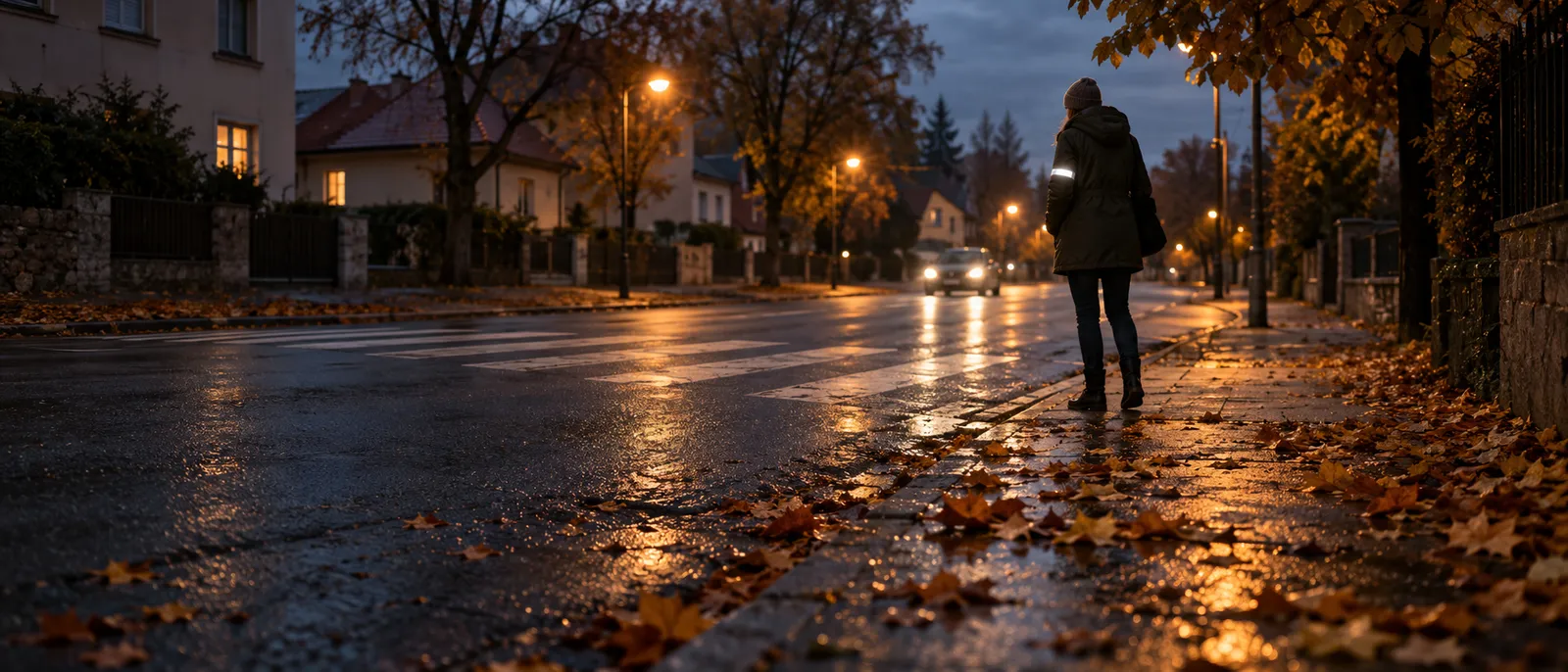
From Monday 26 October children will walk to school for 7:45 in daylight, as the Sun rises in Prague at 6:42. But from the after-school club at 17:00 they will already walk home after sunset (Prague 16:50).
Sources13 sources · specific figures come from the sources, the general explanation from expert knowledge
- Evropský parlament, Legislativní observatoř (European Parliament, Legislative Observatory) (in Czech)
- Výpočet Fakt počasí (Fakt počasí calculation) (in Czech)
- Evropská komise, Mobilita a doprava (European Commission, Mobility and Transport) (in Czech)
- ČT24, ČTK (ČT24 (Czech Television news channel), ČTK (Czech News Agency)) (in Czech)
- EuroZprávy.cz podle tiskové zprávy Českých drah (EuroZprávy.cz, based on a press release from Czech Railways (České dráhy)) (in Czech)
- EuroZprávy.cz (in Czech)
- Evropský parlament, Legislativní observatoř (European Parliament, Legislative Observatory) (in Czech)
- RFC EditorRFC 3339, oddíl 1 (RFC 3339, section 1) (in Czech)
- Evropský parlament, Ask EP (European Parliament, Ask EP) (in Czech)
- Evropský parlament, Ask EP (European Parliament, Ask EP) (in Czech)
- Evropský parlamentLegislativní observatoř (Legislative Observatory, European Parliament) (in Czech)
- Evropský parlament, EPRS (European Parliament, EPRS (European Parliamentary Research Service)) (in Czech)
- American Academy of Sleep Medicine (AASM)