
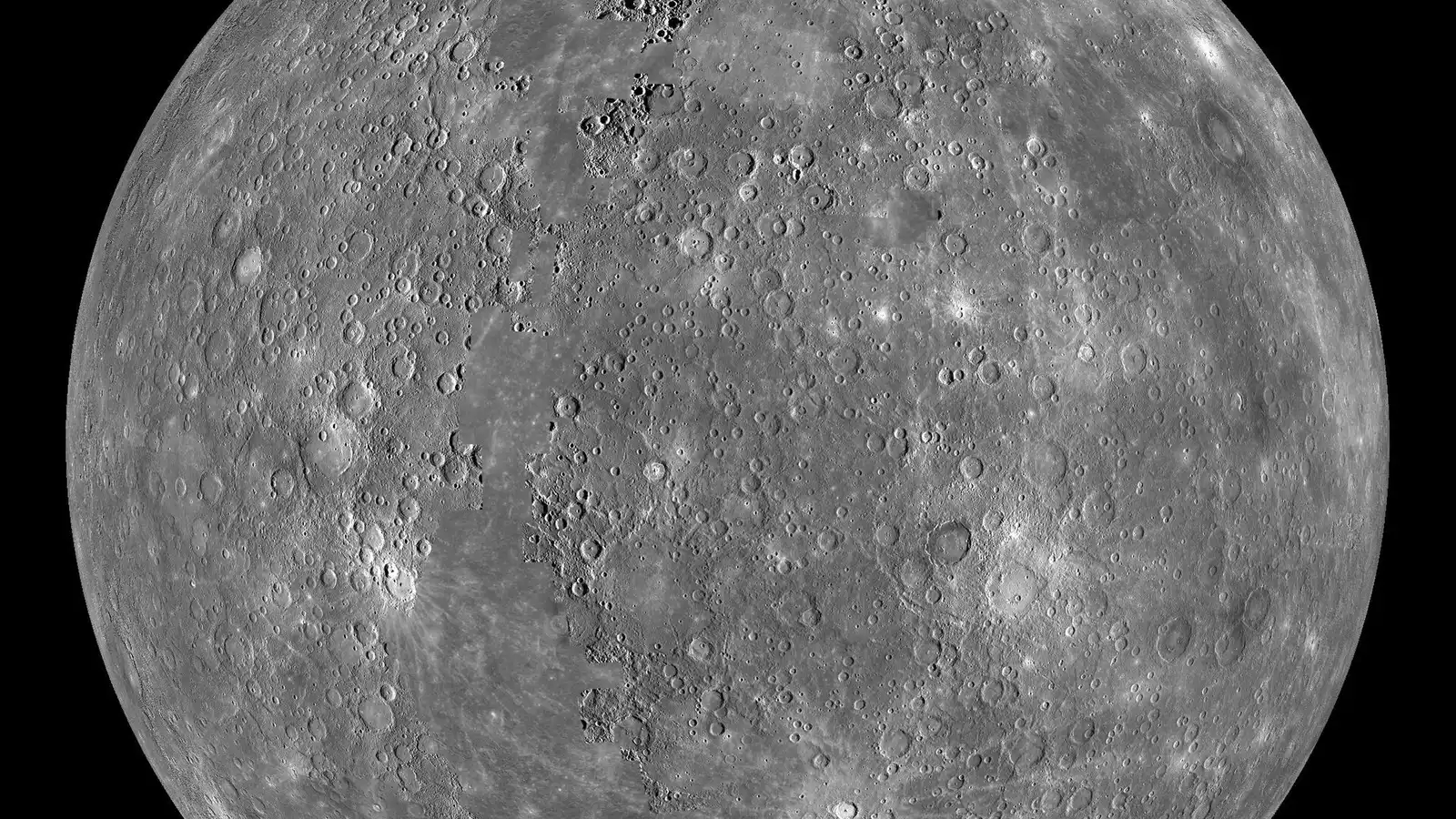

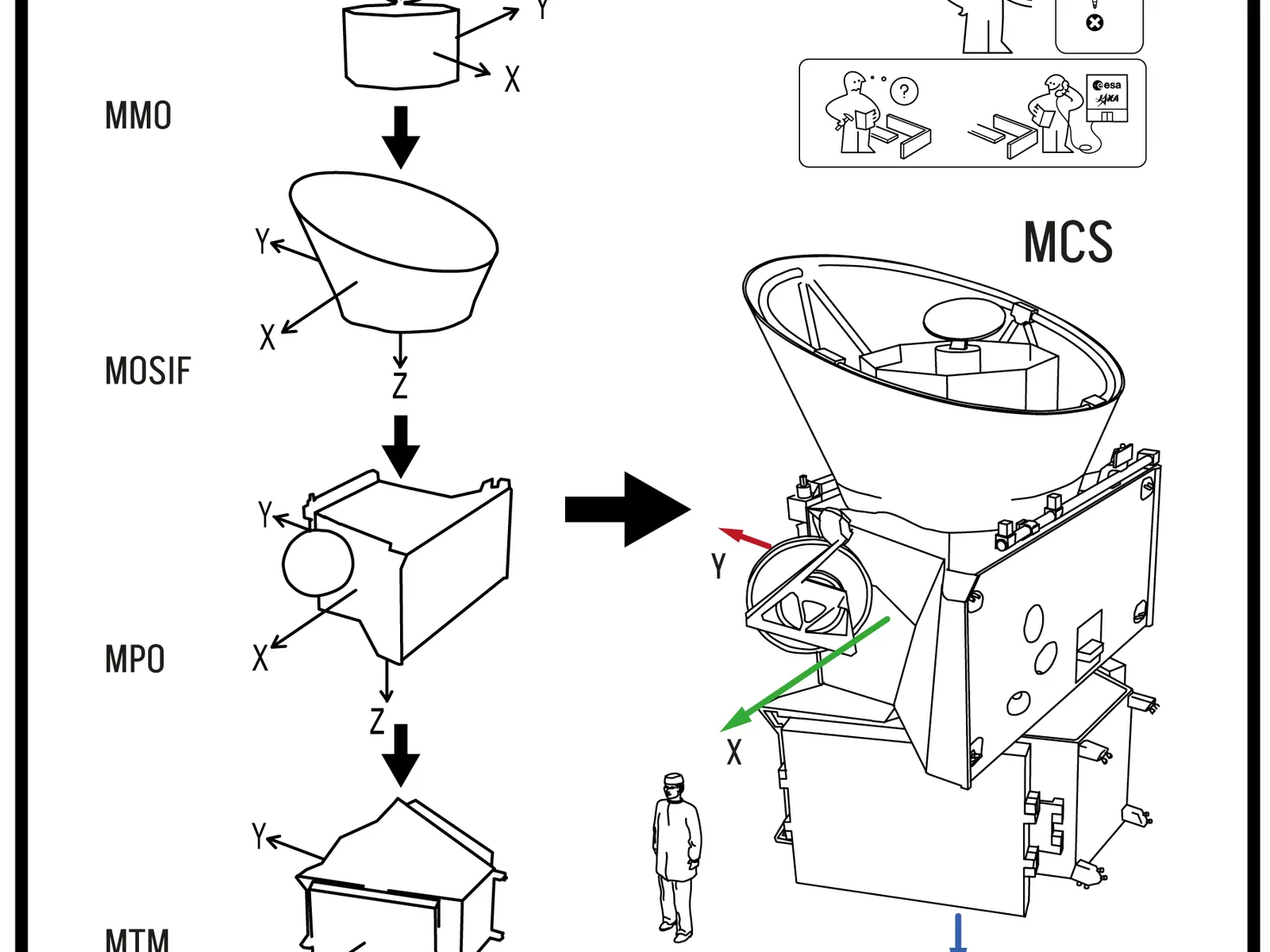
BepiColombo will not reach orbit with a single engine burn. The insertion on 21 November is one step in a six-month series of manoeuvres. The European probe MPO and the Japanese Mio, which for now fly joined together, will separate on 9–10 December, and the science phase of the mission is due to begin in April 2027.
01Dates
What happens on 21 November and what does not
The arrival phase began on 3 September 2026, when the MTM transfer module separated from the stack. The spacecraft was then still more than three million kilometres from Mercury. The module's ion propulsion was switched off as early as 15 June 2026, which ended its main job.
- When: 20/10/2018
What happens: Launch on an Ariane 5 rocket
- When: 15/6/2026
What happens: Ion propulsion switched off
- When: 3/9/2026
What happens: Separation of the MTM transfer module
- When: 21/11/2026
What happens: Insertion of the stack into orbit
- When: 9–10/12/2026
What happens: MPO and Mio separate from each other
- When: March 2027
What happens: MPO in its final science orbit
- When: April 2027
What happens: Start of the science phase
Cassini left for Saturn on 15 October 1997 and reached its system at the turn of June and July 2004, after less than seven years. BepiColombo has been flying since 2018 and will arrive at Mercury after more than eight years. The journey to the planet that is on average closest to Earth therefore takes longer than the journey to Saturn.

02Braking
Why the journey to Mercury is so hard
At its closest approach Venus comes nearer to Earth than Mercury does, but Mercury is the planet closest to Earth on average, because it orbits right next to the Sun. It is between 77 and 222 million kilometres from Earth.
The Sun pulls the probe towards it, and the closer it falls, the faster it goes. Falling towards the Sun, the probe would speed up so much that it would be faster than Mercury itself, which orbits at about 47 km/s. It would therefore shoot past the planet unless it had slowed down considerably beforehand. The slowing down has to be relative to the Sun, not relative to Earth.
It slowed down in two ways. Nine gravitational flybys, one at Earth, two at Venus and six at Mercury, each took away part of the probe's speed and bent its path. In between, the ion engine worked, turning xenon into plasma and giving a gentle but long-lasting thrust.

The probe was originally meant to enter orbit around Mercury in December 2025. After a fault in April 2024, however, the power output of the MTM module's solar panels dropped, and engineers found unexpected electric currents between the panels and the unit that distributes power around the spacecraft. The ion engines then gave less thrust than an arrival in December 2025 required, and the control team proposed a new trajectory with arrival in November 2026.
03Research
What the two probes will study
The two probes will divide the work. The European MPO carries 11 instruments and will orbit lower, in a polar orbit of 480 km × 1500 km with an orbital period of 2.3 hours. The Japanese Mio carries five instruments and will orbit higher, in a polar orbit of 590 km × 11 640 km lasting 9.3 hours.


A field shifted to the north
Mercury's field is 100 to 150 times weaker than Earth's and, according to the MESSENGER probe, markedly stronger in the northern hemisphere than in the southern. For a long time it was thought that the small planet had already cooled and could have no field. Measurements from Earth and from MESSENGER, however, showed that part of the iron core is still liquid and that the field arises in a similar way to Earth's. Why it is so weak and shifted by about 480 km to the north nobody has yet explained reliably, and that is exactly what both probes will measure.
Ice on a planet where it is hot
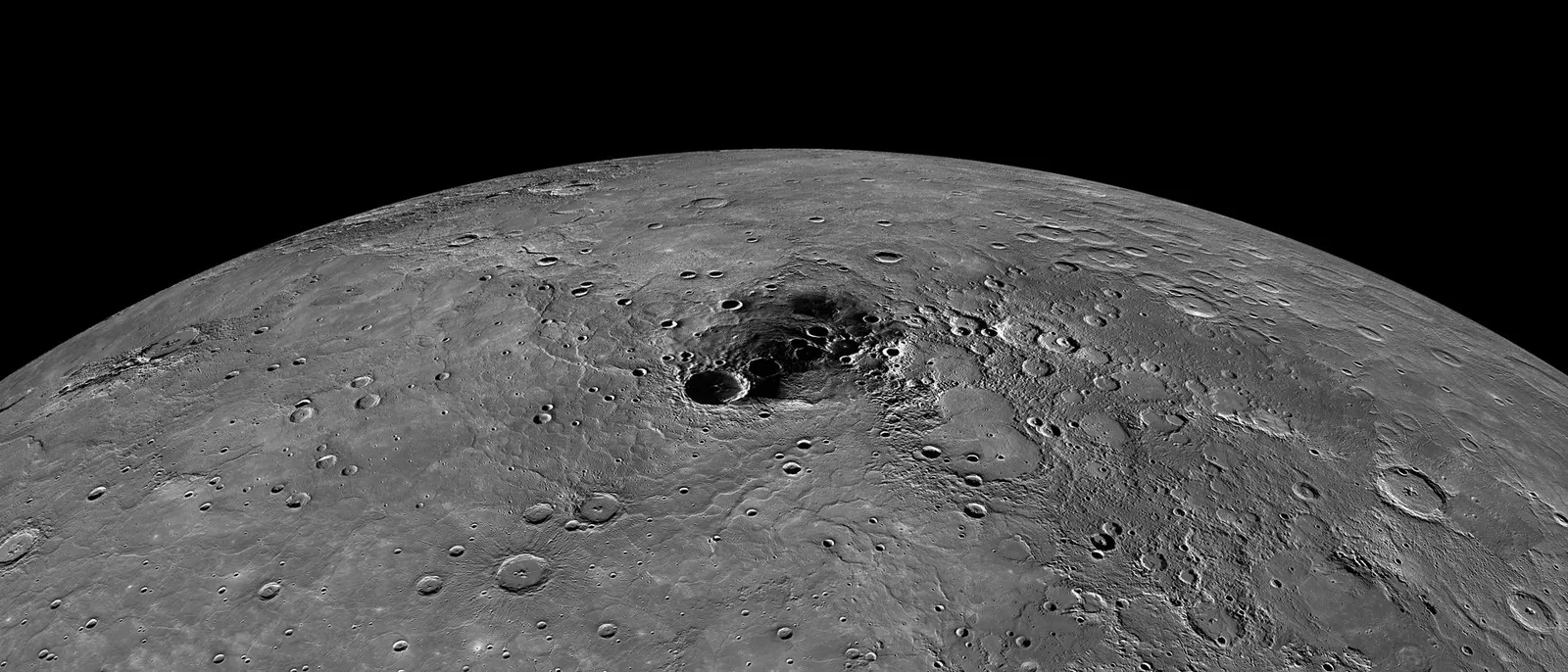
On the side facing the Sun, Mercury reaches hundreds of degrees Celsius, and yet it most likely has water ice. Earth-based radar and the MESSENGER probe showed that it lies on the floors of craters near the poles that sunlight never reaches. BepiColombo is to find out how much there is and how it got there.

Why Mercury is so dense
Mercury is much smaller than Earth, and yet it has almost the same mean density, 5429 kg/m³ compared with 5513 kg/m³. The iron core takes up about 85% of the planet's radius, against roughly half for Earth, and why it is so large we do not yet know. One hypothesis is a giant impact that stripped part of the mantle from the planet. The ISA and MORE instruments, together with other data, are meant to determine Mercury's internal structure and the physical state of its core.
| Quantity | Mercury | Earth |
|---|---|---|
| Solar day | 4223 h | 24 h |
| Orbital period | 88 days | 365 days |
| Rotation about the axis | 1408 h | 23.9 h |
| Radius | 2440 km | 6378 km |
| Mass | 0.33 × 10²⁴ kg | 5.97 × 10²⁴ kg |
| Density | 5429 kg/m³ | 5513 kg/m³ |
04Sky
When to expect news and where to look for Mercury
The SIMBIO-SYS camera on the MPO probe has already switched on its three optical channels and taken its first image in space. Further news will come from the steps in the timeline above, from insertion into orbit through the separation of the probes to the science phase from April 2027.
Mercury itself will be visible on the day of the probe's arrival in the morning before dawn in the east. In Prague it rises on 21 November at 5:29 am CET, so look for it in the early twilight above the eastern horizon.
Find out whether the morning will be clearA few days ahead, the local forecast will show what cloud cover to expect where you are on the morning of 21 November.Show the local forecast