


In numbers
about169.5cm
Ground uplift in Pozzuoli since November 2005 according to the RITE station in Rione Terra
4.7Md
Magnitude Md of the 31 July 2026 quake between Pozzuoli and Quarto
about700people
People out of their homes as of 4 August 2026
An earthquake of magnitude Md 4.7 struck on 31 July at 19:46 between Pozzuoli and Quarto, west of Naples. According to Andrea Billi of Italy's National Research Council (CNR), it is the strongest instrumentally recorded earthquake of the current crisis, and the Italian website Geopop even ranks it first since instrumental measurements began. The ground in the Campi Flegrei caldera (the Phlegraean Fields) meanwhile keeps rising, in Pozzuoli by about 1.7 metres since 2005.
01Explainer
Why the ground near Naples rises and sinks
Campi Flegrei is a caldera, a broad depression left by ancient volcanic eruptions, west of Naples. According to the INGV, Italy's National Institute of Geophysics and Volcanology, it formed through repeated collapse of a large area when the roof of a shallow magma chamber gave way. It has been a site of intense volcanic activity for millennia, and more than half a million people live there.
The slow rising or sinking of the ground that accompanies seismic activity is called bradyseism. Phases of slow subsidence alternate with faster uplift, which is usually accompanied by shallow, weak earthquakes. After roughly twenty years of subsidence, the ground began rising again in 2005 and is still rising.
The scale is shown by the RITE station in the Rione Terra area of Pozzuoli. According to the September monthly bulletin of the Naples observatory Osservatorio Vesuviano, issued on 7 October 2026 and carried by the website PozzuoliNews24, the ground here has risen by about 169.5 centimetres since November 2005. According to the INGV, the uplift is greatest around the port of Pozzuoli and weakens towards the edges of the caldera.
Scientists are still investigating the causes of the uplift. In 2023 Italy's National Institute of Geophysics and Volcanology (INGV) said it could be due to a strong release of gases and greater pressurisation of the deep hydrothermal system, that is, hot water and gases beneath the surface. Billi also names pressurisation of the hydrothermal system as a possible cause.

02Curiosities
The Roman market bored through by molluscs
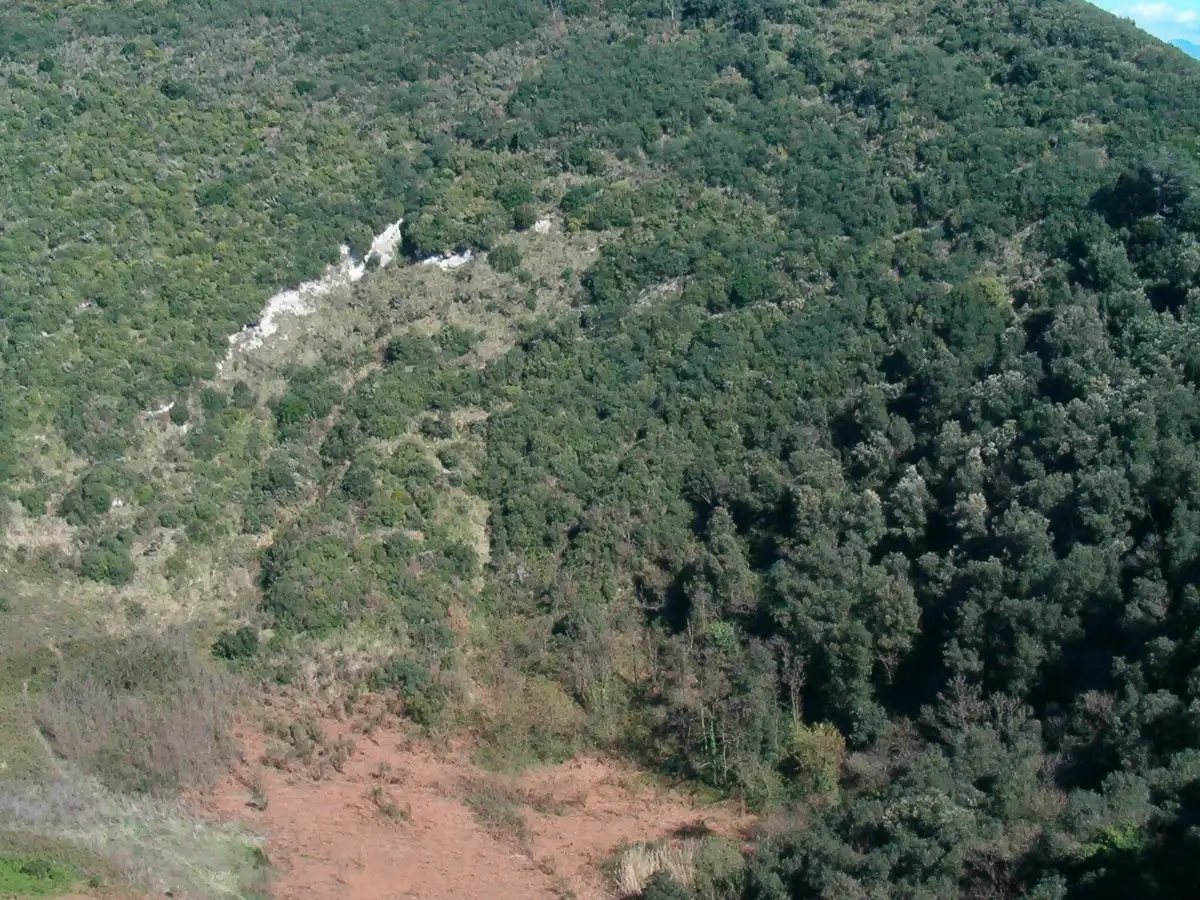
The Roman market in Pozzuoli, known as the Serapeum, was discovered in 1750 and dates from the first or second century AD. It was named after the Egyptian god Serapis, because it was long wrongly believed to be his temple. Three of its marble columns now bear holes drilled by marine molluscs that live in the zone between low and high tide, so the holes show where the sea level once was.
Subsidence submerged them around the turn of the fourth and fifth centuries. In the 13th century the columns lay more than 8 metres below the surface, then the ground began to rise, and in 1538 the Serapeum reached its highest position, about 6 metres above sea level.
By dating these holes, scientists reconstructed the vertical movement of the ground over roughly the last two thousand years. Today's uplift is therefore not a new phenomenon but a continuation of fluctuations that have gone on here for centuries.

03Comparison
Is the ground higher than in 1984?
According to the National Institute of Geophysics and Volcanology (INGV), the earlier episodes in which the ground rose accompanied by earthquakes were the crises of 1969 to 1972 and 1982 to 1984. According to both INGV and Billi, the ground in Pozzuoli rose by a total of at most about 3.5 metres during them. The first crisis accounted for about 170 centimetres (relative to 1968), the second for about 185.
The crisis of 1982 to 1984 was much harder on residents than this summer. Instruments recorded more than 16 thousand tremors during it, and the authorities ordered the evacuation of 20 000 people, many of whom never returned home.
| Period | Uplift | Strongest quake |
|---|---|---|
| Crises of 1969–1972 and 1982–1984 combined | about 3.5 m | Md 4.01 in the 1982–1984 crisis |
| Current episode, November 2005 to September 2026 | about 169.5 cm | Md 4.7 on 31 July 2026 |
The current uplift has slowed since the beginning of February 2026 to about 10 ± 3 millimetres a month, having previously been about 15 millimetres. The ground is therefore still rising, only more slowly.
According to Mauro Di Vito, director of the Osservatorio Vesuviano, the ground was already about 20 centimetres higher in October 2023 than at the peak of the 1984 crisis. By then, he said, it had risen by 115 centimetres since 2005 and was rising by about 15 millimetres a month. But between the crisis of 1982 to 1984 and the current episode the ground sank, so the two uplifts cannot simply be added together.
04July 2026
The 31 July quake and people out of their homes
The magnitude Md 4.7 has an uncertainty of 0.3, and the moment magnitude came out at 4.4 according to the weekly bulletin. The focus lay only about 3 kilometres below the surface, which is why, according to Billi, the quake was felt strongly.
For comparison, the strongest tremors of the crisis of 1982 to 1984, on 4 October 1983 and 14 March 1984, reached a magnitude of Md 4.01 according to Billi. For the tremor of 4 October 1983 the INGV gives a rounded magnitude of 4. The current crisis has already brought tremors of Md 4.2 on 27 September 2023, Md 4.4 on 20 May 2024 and Md 4.4 on 13 March 2025.

According to the news agency ANSA, the quake caused landslides, major property damage and injuries to 26 people, five of whom remained in hospital. By 4 August almost 400 houses had been declared uninhabitable and about 700 people had had to leave their homes.
The Italian government announced 100 million euros for emergency measures around Campi Flegrei. According to ANSA, Interior Minister Piantedosi said that one must expect the phenomenon to continue in the coming years.
05What we know
What is certain and what nobody knows yet
According to Billi, a single earthquake does not in itself mean that an eruption is imminent, and the official alert level at the beginning of August remained yellow. The yellow level, set by the Italian civil protection authority, is also given on the Osservatorio Vesuviano page. At the beginning of August INGV reported no changes that would point to a significant short-term development of volcanic activity, and the weekly bulletin of 12 to 18 October, according to Geopop, likewise does not point to a development in the near future.
| Status | What it means |
|---|---|
| Certain | The ground has been rising since 2005, more slowly since February 2026, by about 10 instead of 15 millimetres a month. |
| Uncertain | Whether magma is approaching the surface. In 2023 and again in March 2025 INGV found no sign in the data of magma rising to the surface, and the latest bulletins do not indicate a short-term change. |
| Nobody knows yet | How many more tremors will come, how long they will last, how strong they will be and whether the July record will be broken. According to Billi this cannot be predicted. |
In August 2023 INGV assessed the probability of an eruption as relatively low, because nothing pointed to magma rising towards the surface. At the same time it added that the volcano has its natural evolution and will sooner or later erupt again. According to INGV there is no direct relationship between the speed of uplift and the strength of tremors, and it is impossible to determine when earthquakes will come or how strong they will be.
In the week from 12 to 18 October volcanologists recorded 68 earthquakes with magnitudes from -0.5 to 2.5, that is, mostly weak ones. Developments are published continuously by the Osservatorio Vesuviano, the Naples observatory of INGV, in weekly and monthly bulletins on the website ov.ingv.it.
Sources14 sources · every number and claim in the article comes from them
- PozzuoliNews24 (republication of the INGV Osservatorio Vesuviano September bulletin, issued 7 October 2026) (republication of the September bulletin of the INGV Osservatorio Vesuviano, issued on 7 October 2026)
- MeteoWeb (Andrea Billi, CNR-Geo), 1 August 2026 (text of 1 August 2026)
- INGV Osservatorio Vesuviano
- Geopop (INGV OV bulletin), 5 August 2026 (INGV OV bulletin, text of 5 August 2026)
- Geopop (INGV OV bulletin of 12–18 October 2026), 20 October 2026 (INGV OV bulletin of 12 to 18 October 2026, text of 20 October 2026)
- INGVvulcani (INGV), 9 September 2023 (text of 9 September 2023)
- INGVvulcani (INGV)
- Geopop (INGV source), 14 March 2025 (source INGV, text of 14 March 2025)
- INGV Osservatorio Vesuviano
- Sky TG24
- MeteoWeb (based on INGV) (based on INGV)
- Il Tempo
- Il Mattino
- ANSA English, 5 August 2026 (text of 5 August 2026)