

In numbers
26satellites
Starlink V3 satellites carried by the fourteenth flight on 28 September 2026, the first real payload of Starship
up to15tankers
that many flying fuel tankers may, by one estimate, be needed by a lander for a single mission to the Moon
up to456launches a year
proposed by SpaceX from Starbase instead of today's 25, a plan now being assessed by the FAA
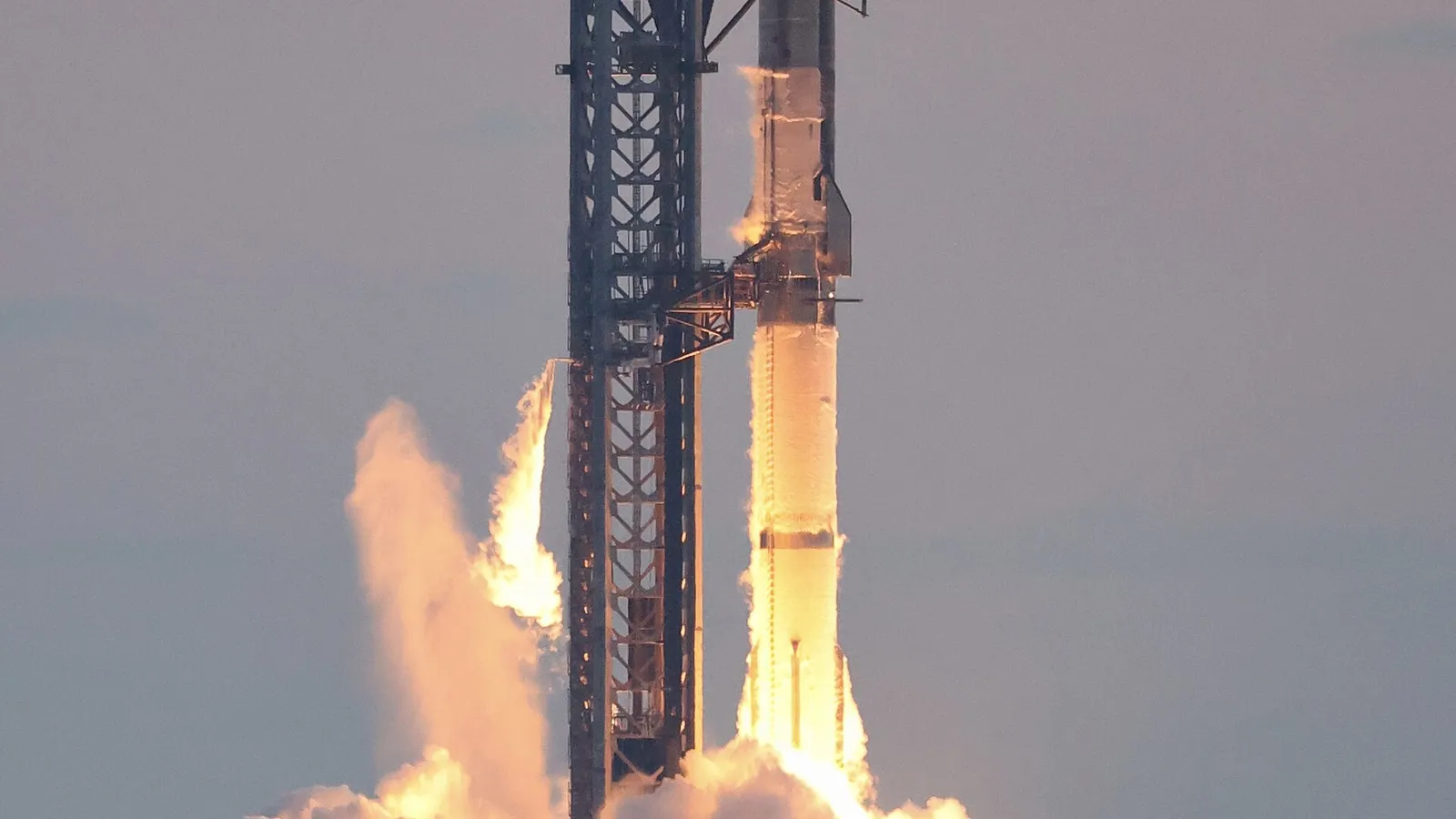
In 2016 Elon Musk showed an animation of a giant ship setting off for Mars. Ten years later a real rocket about 124 metres tall stands on the Texas coast, has fourteen test flights behind it, and its lower stage can be caught by a tower with steel arms. Only on the latest of them, on 28 September, did the ship reach orbit for the first time, where it will have to refuel if it is ever to return American astronauts to the Moon.
01Basics
What Starship is and where it stands after ten years
Starship is a two-stage rocket that SpaceX wants to use over and over, much like an aeroplane, meaning it would be refuelled after landing and sent on another flight. The company first presented it in 2016, still under a different name, and since then a grand vision has turned into a test programme with steel prototypes flying from the south of Texas.
By the end of September 2026 the whole vehicle has fourteen test flights behind it, and the first thirteen of them were suborbital. A suborbital flight is a hop along an arc in which the ship does not pick up enough speed to circle the Earth and falls back down before it has gone round the planet. The fourteenth flight, on 28 September, was only the third flight of the third generation, known as V3, which made its debut in May, and on it the ship reached orbit for the first time.
The fourteenth flight lifted off at 7:48 local time and carried 26 Starlink V3 satellites, the first real payload Starship has ever carried. During the climb, however, one of the ship's six engines shut down early, and it was not certain whether SpaceX would attempt to reach orbit at all. About 22 minutes after launch the team decided it was safe.
| What | Detail |
|---|---|
| Launch | Detail: 28 September 2026 at 7:48 local time from Starbase |
| Payload | Detail: 26 Starlink V3 satellites, three of them with cameras that filmed the ship |
| Speed | Detail: orbital, about 17,500 miles per hour, or roughly 28 thousand kilometres per hour |
| Original plan | Detail: an orbit at an altitude of about 275 kilometres, six orbits, a flight of roughly ten hours |
| What happened | Detail: flight cut short to three hours, splashdown in the Pacific Ocean 3 hours, 8 minutes and 32 seconds after launch |
| Super Heavy booster | Detail: 33 engines at launch, 31 relit after separation, simulated landing in the Gulf of Mexico about seven minutes after launch |
| End of the ship | Detail: exploded six seconds after hitting the water |
More important than the number of flights, though, is what has not yet happened. Starship has not yet demonstrated transferring propellant between two ships in space, which Astronomy magazine calls the hardest milestone still unmet, and the tower has not yet tried to catch the ship. The lunar version of the ship, on which the landing of American astronauts on the Moon depends, had also not yet flown according to a report from July 2026.
| What | Status |
|---|---|
| Test flights of the whole vehicle | Status: 14 by the end of September 2026, the fourteenth on 28 September |
| Newest generation | Status: V3, first flight in May 2026, the fourteenth flight was the third |
| Height of the vehicle | Status: about 124 metres |
| Engines powering the rocket at launch | Status: 33 methane-fuelled Raptors |
| Earth orbit | Status: first reached on 28 September 2026 on the fourteenth flight |
| Catching the ship with the tower | Status: not yet tried, the tower has so far caught only boosters |
| Propellant transfer between ships | Status: not yet demonstrated |
| Launches from Starbase in 2026 | Status: 3 by 14 October |
02Glossary
Ship, booster and chopsticks. Who is who in Starship
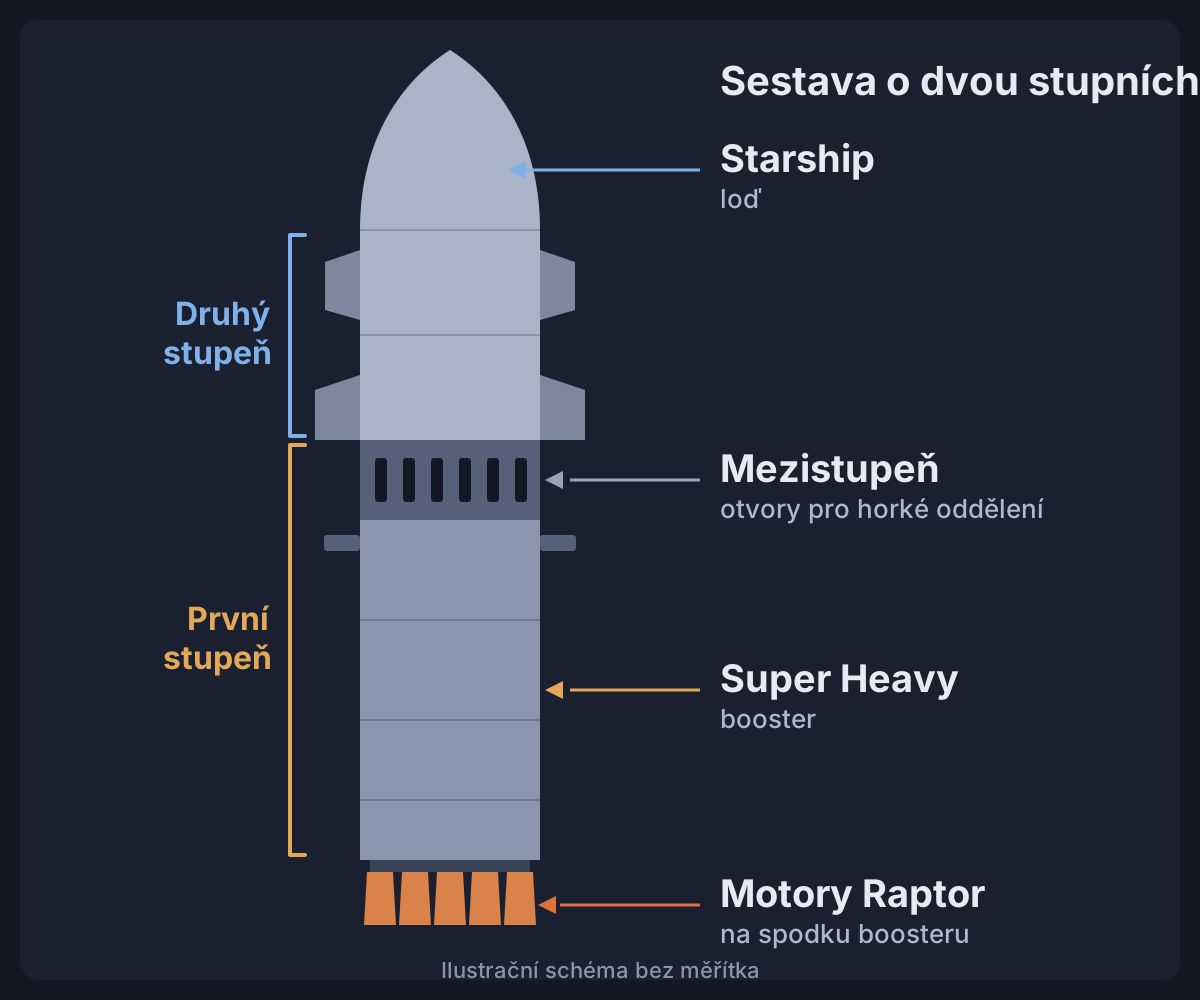
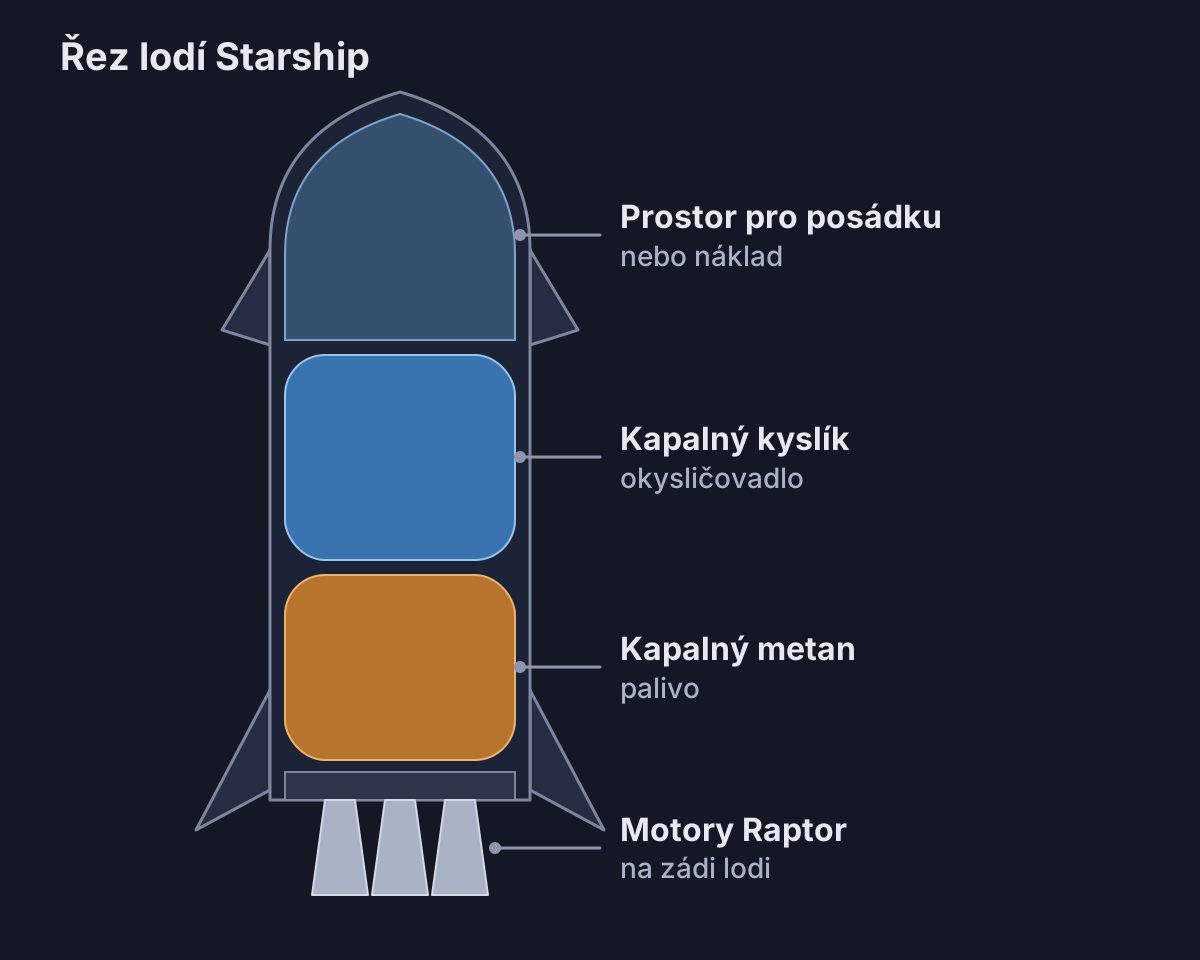
The name Starship is used in two ways, for the whole rocket and for its upper stage, the ship that carries crew or cargo. The lower stage is called Super Heavy, and in writing about the programme it is usually just called the booster. The rocket is powered by methane-fuelled Raptor engines, 33 on the booster and six on the ship, three of which are vacuum versions with a large nozzle for working in the near-vacuum of space.
Starbase is the SpaceX site by Boca Chica beach in the south of Texas, from which Starship launches. Its centrepiece is a launch tower with a pair of giant arms nicknamed the chopsticks, and the whole tower is called Mechazilla. The arms seat the rocket on the launch mount and can also catch a returning booster.
The glossary also often includes hot staging. The ship ignites its engines while it is still attached to the booster, so a ring with openings is placed between the two stages to let the flames escape sideways.
For the trip to the Moon the key abbreviation is HLS, Human Landing System, meaning the landing, or lunar, module. Under it NASA is running landers in its Artemis programme, and one of them is the lunar version of Starship, which is to land on the Moon and, under the contract, take off from it again. The propellant has to be transferred into it by tankers, which are further Starships flying only as fuel tankers.
03Curiosities
Remarkable facts from the launch mount to the return
On the launch mount and at liftoff
At liftoff the rocket is driven by 33 Raptor engines at the base of the Super Heavy booster. A single giant engine would not do, because the larger the combustion chamber, the more easily the flame in it starts to oscillate and uneven burning can tear the engine apart, and the pumps and walls would have to withstand ever greater pressure and heat. A large number of smaller engines can also tolerate the failure of some of them. On the fourteenth flight only 31 were relit for the return manoeuvre after stage separation, and during the broadcast SpaceX reminded viewers that a few engines may drop out along the way.
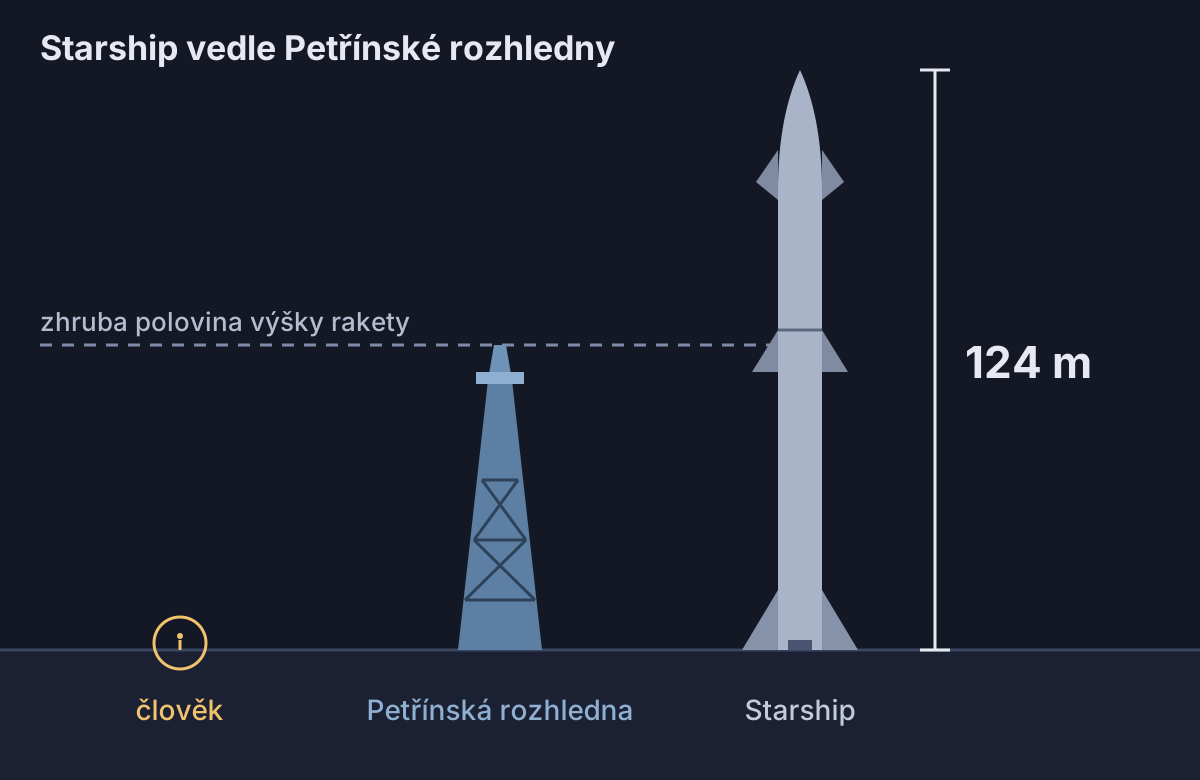
On the thirteenth flight the rocket left the launch mount with a thrust, that is the force pushing it upwards, of roughly 16 million pounds, which is about seven thousand tonnes. That is about what some sixty large Boeing 747 airliners would produce together at full take-off power. The whole vehicle is only about 124 metres tall, which makes it almost twice as high as the Petřínská rozhledna (Petřín Lookout Tower), a lattice lookout tower in Prague, and for such a size it is an astonishing amount of power.
Methane is not a choice made for convenience. On Mars it could be produced from carbon dioxide in the atmosphere and water from ice, so the ship could refuel for the return journey right on the spot. Methane also burns more cleanly than rocket kerosene and leaves less soot in engines that are meant to fly repeatedly.
In the air and on the return
The hot staging mentioned in the glossary has a practical reason. Because the ship lights its engines before it separates, there is no moment when the rocket would simply coast and lose speed. Propellant is saved and the upper stage can carry more.
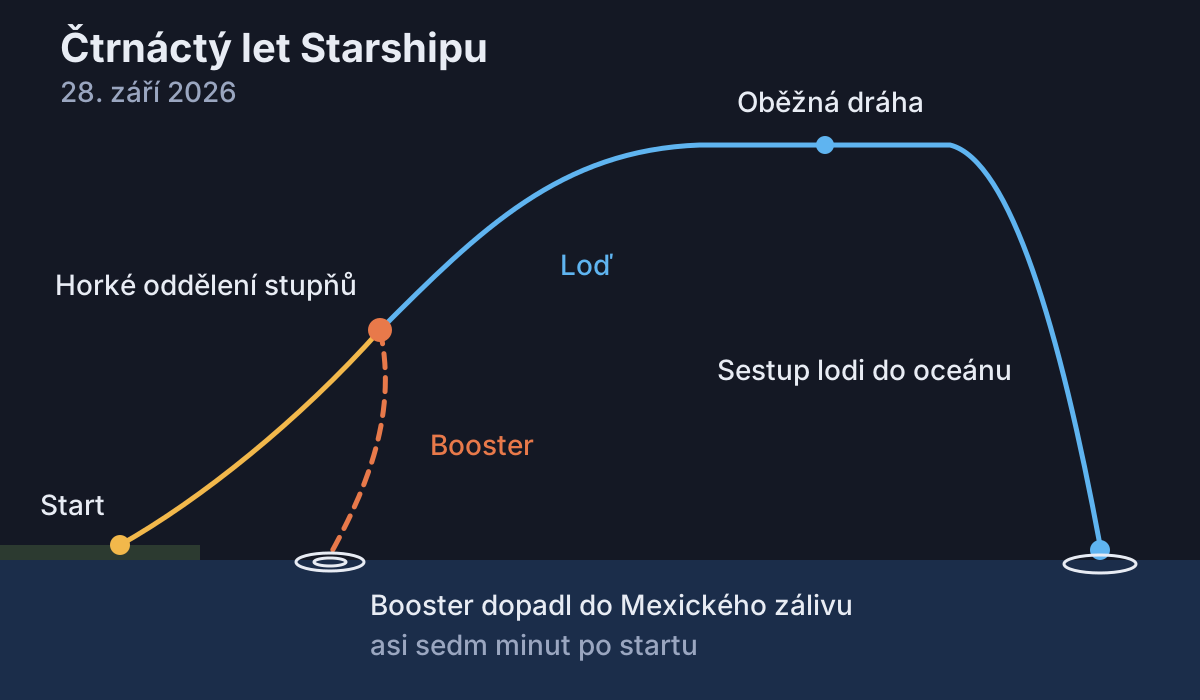
After separation the booster turns around, heads back towards the shore and, instead of landing on legs, settles into the arms of the tower, which catch it in mid-air. That removes heavy legs it would otherwise carry the whole way, and in theory the rocket can quickly be stood on the launch mount again. The tower managed it for the first time on 13 October 2024 on the fifth flight, and nobody in the world had caught a rocket like that before.
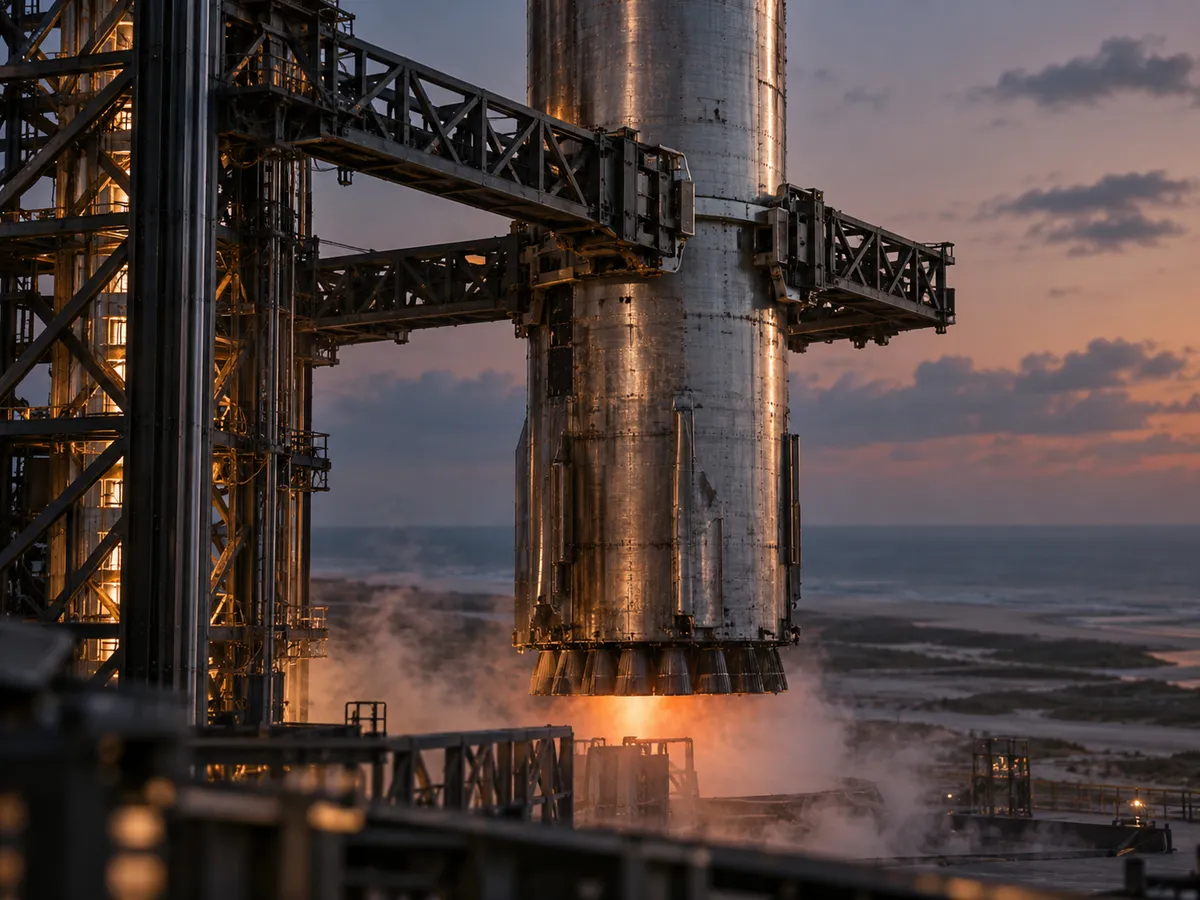
But it is not always caught. Before the fourteenth flight the tower had managed it on three flights, and the booster of the fourteenth flight only simulated a landing at sea in the Gulf of Mexico, where it came down about seven minutes after launch. No tower has yet tried to catch the ship.
The ship re-enters the atmosphere belly first, rather like a skydiver in free fall, braking with the whole area of its underside and steering with flaps. That underside is covered with thousands of hexagonal ceramic tiles, because hexagons fit together without long straight gaps through which hot gas could penetrate. Just above the surface the ship flips into a vertical position and slows with its engines.
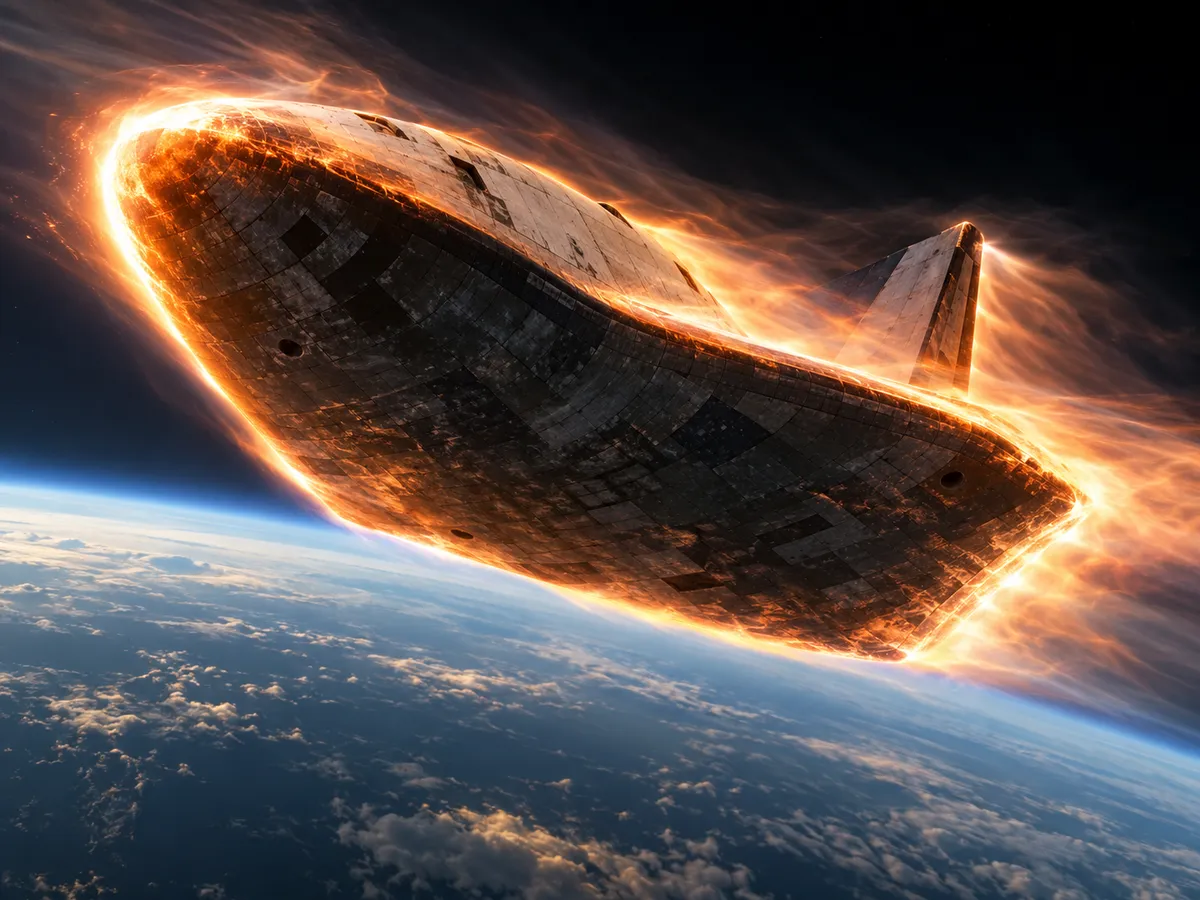
On the fourteenth flight the heat shield was tested under observation. Three of the 26 Starlink satellites had cameras that filmed the ship after deployment so that engineers could improve the shield. The ship then splashed down in the Pacific Ocean 3 hours, 8 minutes and 32 seconds after launch and exploded six seconds after touching the water, and the available sources do not give a cause.
Both the ship and the booster are made of stainless steel, although the original plans called for carbon composites as in modern aircraft. The company switched to steel at the turn of 2018 and 2019 because it is cheaper, it can be welded right on site, and it keeps its strength both in the cold of liquid propellant and in the heat of re-entry better than one would expect from such an ordinary material.
Neighbours on Boca Chica beach
According to Space.com, Starbase lies in a national wildlife refuge that is home to more than 2,500 species of plants and animals. As early as 2022 the US Fish and Wildlife Service concluded that further SpaceX activity at Boca Chica would affect animals protected under the American Endangered Species Act.
The best documented case is that of the piping plover, a small shorebird listed as federally threatened. Its estimated population at Boca Chica fell from 327 birds in 2018 to 214 in 2020. According to the service's draft opinion from 2022, the plan that SpaceX submitted to the FAA would have deprived the plover of roughly 180 of the 366 hectares of protected habitat that the authorities had designated for it around the site, which is almost half.
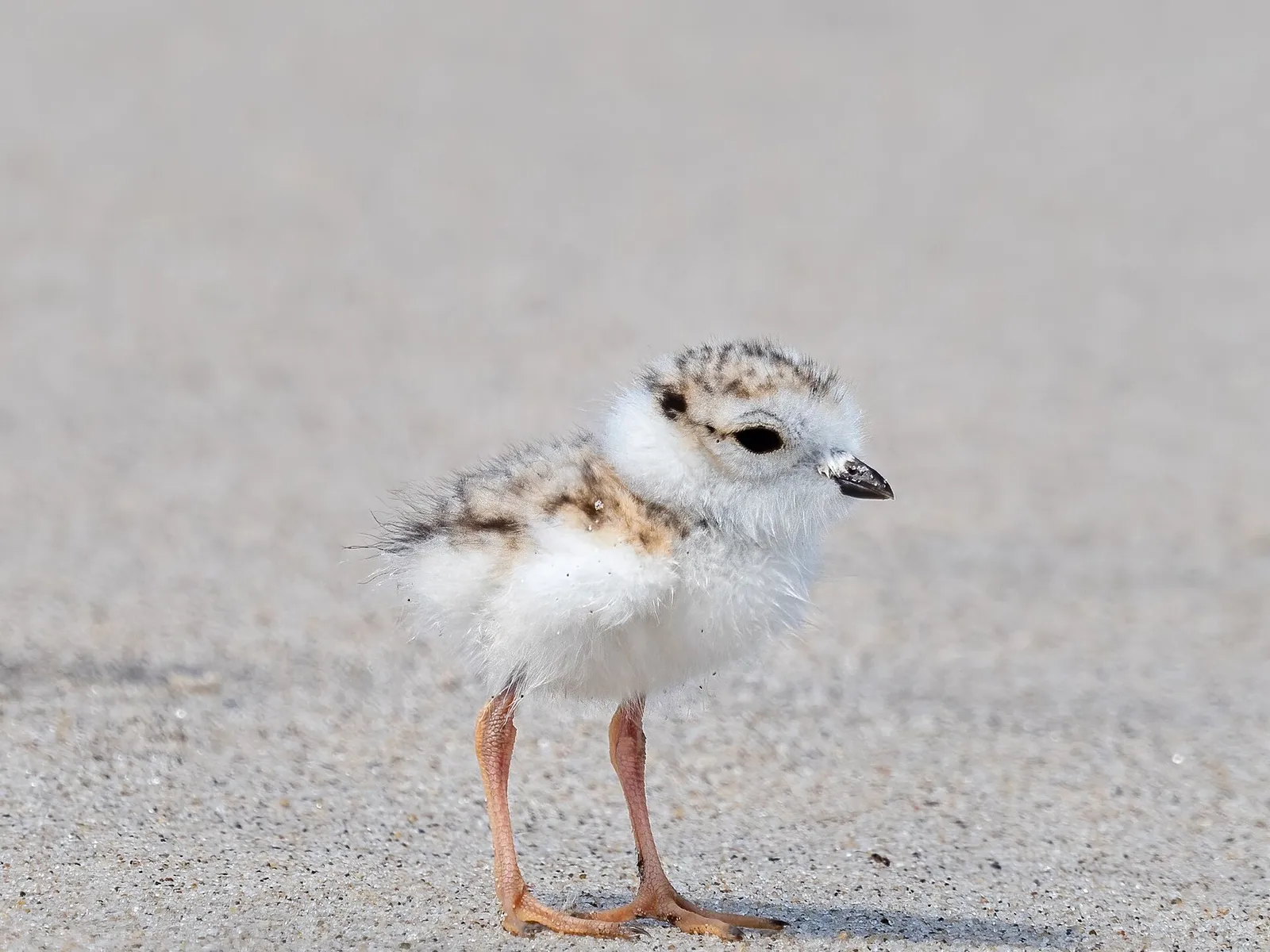

The beaches here are also nesting grounds for the Kemp's ridley sea turtle, the most endangered sea turtle in the world. The females lay their eggs directly in the sand, so every stretch of undisturbed beach matters to them.
The authorities therefore asked SpaceX for changes. In 2022 the FAA decided that SpaceX must amend its plan with more than 75 changes that would further limit the effects on the environment at Boca Chica. In its draft opinion the Fish and Wildlife Service wanted the company to monitor the affected animals carefully and to restrict construction and launches to certain seasons and to certain hours of the day or night.
Where the launch can be seen and heard
People go to watch the launches. At the first flight in April 2023 crowds of spectators stood on the beach at South Padre Island, while the media and the public watched the rocket from an amphitheatre about eight kilometres away. On the eve of the launch hundreds of fans came to Boca Chica beach to watch the rocket at sunset.
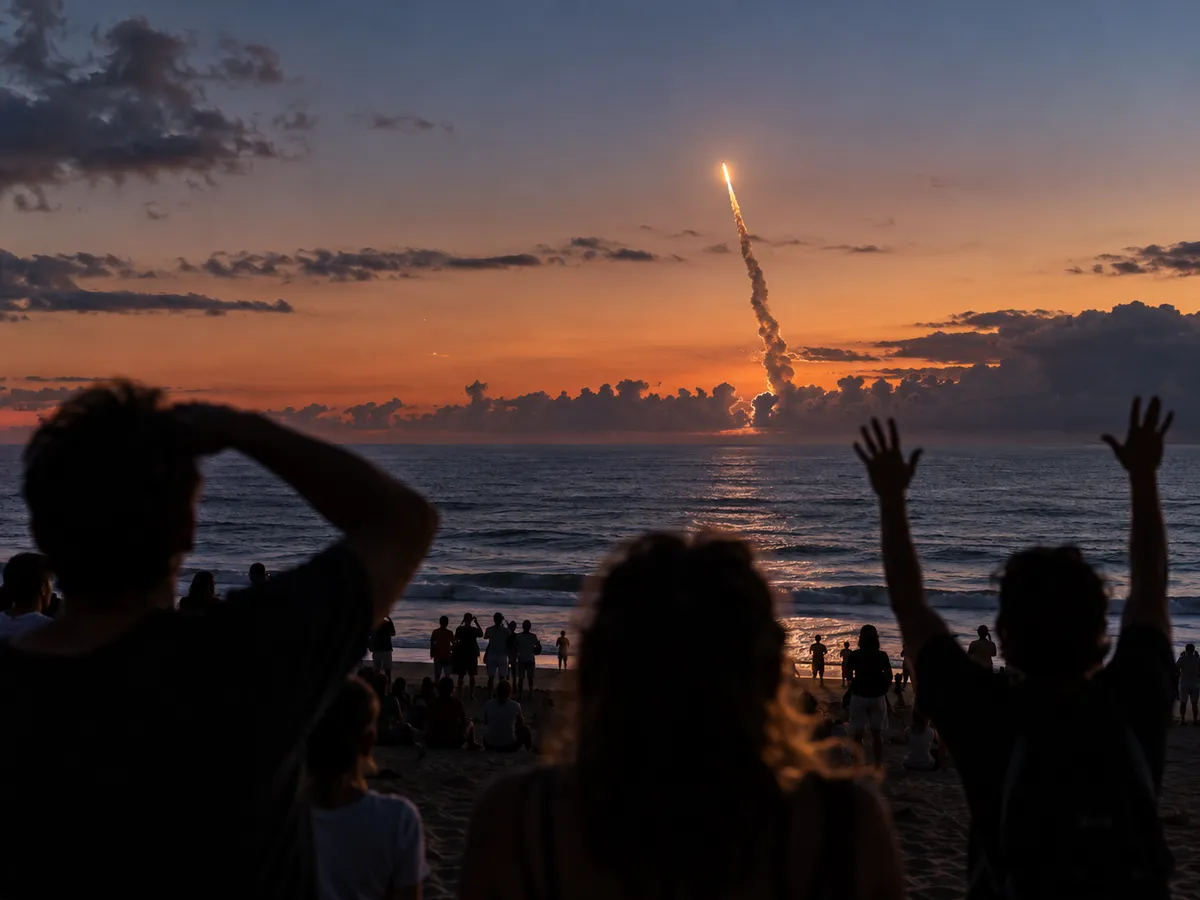
The local television station KRGV writes that anyone who comes to watch can enjoy the launches at South Padre Island. For the launch in May 2025 spectators came from as far away as Monterrey in Mexico, and the crowd kept their eyes on the rocket for several minutes after it disappeared from view.
No measurement says how far away the launch can be seen, but people watch both from the beach and from the amphitheatre eight kilometres away. It can be heard much farther. A reporter from Space.com described how the sound of the launch shook him to the bone.
Scientists from Brigham Young University in the United States measured the noise of the fifth flight at eight locations roughly 10 to 35 kilometres from the launch mount, including on a hotel roof and in nature reserves. It was loudest about 6.5 minutes after launch, when the booster returned to the tower and produced a sonic boom that, about ten kilometres away, was as loud as a gunshot at close range. According to the team, one Starship launch makes as much noise as at least ten launches of the smaller Falcon 9 rocket.
| Distance from the launch mount | The noise resembles |
|---|---|
| about 10 kilometres (just over 6 miles) | The noise resembles: a rock concert |
| about 20 kilometres (12.4 miles) | The noise resembles: a table saw or a snow blower |
| about 30 to 35 kilometres (18.6 to 21.7 miles) | The noise resembles: a vacuum cleaner |
The noise is felt most by residents of South Padre Island and Port Isabel, about ten kilometres from Starbase. A study by the firm Terracon measured a peak sound pressure of 144 decibels at homes in Port Isabel, and the town manager said that some residents had reported minor damage to houses after launches.
The wildest was the first launch on 20 April 2023, which ended in the rocket exploding after four minutes of flight. Even at liftoff the 33 engines dug a crater in the concrete beneath the launch mount, and debris big enough to crush a car flew in all directions. In Port Isabel people then reported broken windows, and cars and houses were covered in dust, which according to the town was just stirred-up sand with no health risk.
The rocket's neighbourhood has another human side. SpaceX bought dozens of homes in the area so that their residents would move away, and because of tests other people also had to be evacuated. A group of residents and organisations from the Rio Grande Valley also published a joint statement against SpaceX activity in the area even before the first launch.
According to the Brigham Young University team, no regulations covered rocket noise in November 2024. The noise and the visual effects will now be examined by the FAA as it assesses the new SpaceX application, which we cover in the last section.
04Moon and Mars
Does Elon Musk hold the trump cards for the Moon and Mars?
NASA chose Starship as the first crewed landing module for its Artemis programme, which is meant to return people to the Moon and build a base near its south pole. The lunar version of the ship is to carry astronauts from lunar orbit to the surface. Since December 2023 the contract also requires the ship to take off from the lunar surface and demonstrate that it can relight a Raptor engine.
The catch is the propellant. The lunar Starship uses up most of its propellant on the way to Earth orbit, so other Starships flying only as fuel tankers have to top it up there. SpaceX is reluctant to say how many will be needed and itself gives roughly ten launches, while the website Spaceflight Now reckons on as many as roughly fifteen tankers.
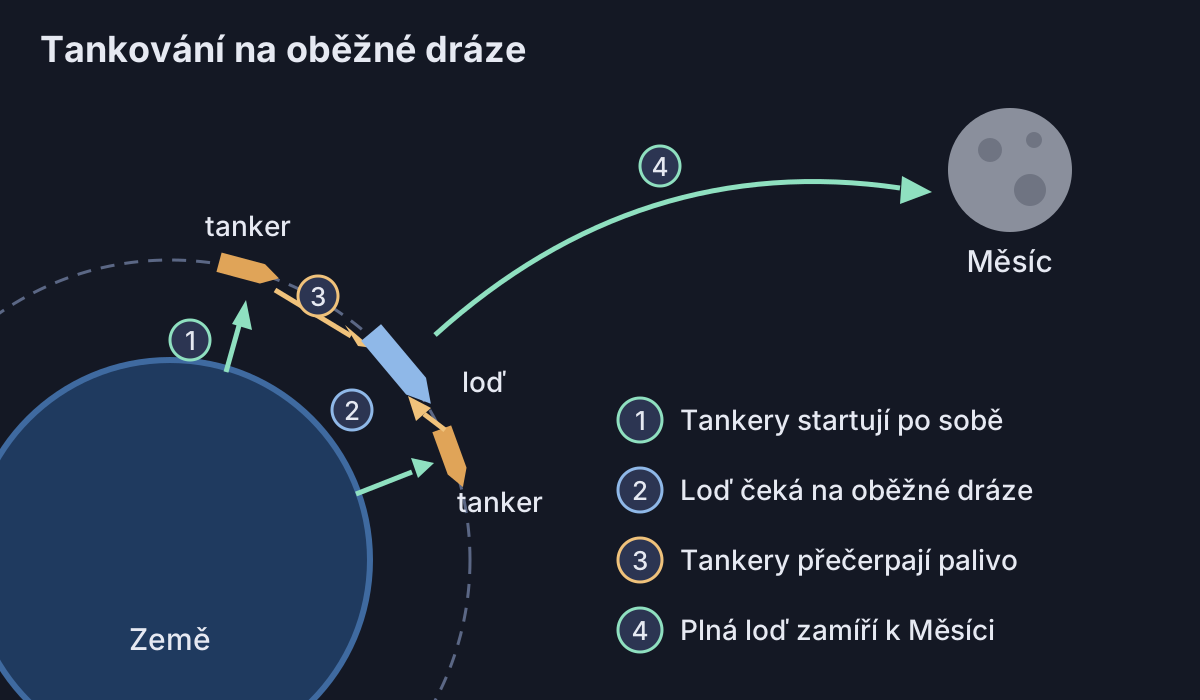
The fourteenth flight showed that Starship can reach orbit, but SpaceX has not yet demonstrated transferring propellant between two ships in space. The US Government Accountability Office, GAO, the audit body of the American Congress, named SpaceX's development of technologies for handling cryogenic, that is deeply chilled, propellant as one of the main risks of the programme.
According to the same office, SpaceX is more than a year behind its original schedule on key milestones. A delay to Starship is therefore also a delay to the return of people to the Moon. In March 2026 the NASA Inspector General wrote that the SpaceX lander would not be ready for a landing in June 2027, and that the agency is assessing proposals from SpaceX and Blue Origin on how to speed up development so that the landing could happen in 2028.
The mission plan has meanwhile shifted. Under the SpaceX plan the ship is to fly only to low Earth orbit in 2027 on the Artemis III mission, where NASA wants to test docking the Orion capsule with both Starship and the Blue Origin lander, and it is to land astronauts near the Moon's south pole only a year later on the Artemis IV mission. But NASA has also selected the Blue Origin lander, and which of the two will fly on Artemis IV is not yet clear.
| Item | Value |
|---|---|
| Set aside for HLS lander development since 2019 | Value: 6.9 billion dollars |
| Estimated spending to fiscal year 2030 | Value: 18.3 billion dollars |
| Increase in the SpaceX contract | Value: 6 per cent, and less than 1 per cent for Blue Origin |
| Launches per Moon mission | Value: estimates from about 10 to about 15 |
| Landing in June 2027 | Value: the SpaceX lander will not be ready for it, according to the NASA inspector |
| New landing target | Value: the year 2028, feasibility still uncertain |
So Musk does hold trump cards, but only some of them. The SpaceX ship can already reach orbit, but it cannot yet refuel in space, and NASA also has a second lander from Blue Origin in development. According to the inspector, the SpaceX contract has grown by only six per cent, so the agency is not yet paying much more, but it is losing time.
Starship was created mainly with Mars in mind, which is why it flies on methane and is meant to be reused. The ship reached Earth orbit only on 28 September 2026, and missions to both the Moon and Mars will, according to Space.com, require several tanker launches, so Mars remains more a direction of development than a date in the calendar.
05Musk
Elon Musk's influence and whether it is changing
Elon Musk founded SpaceX, runs it, and Starship has been his project since the first animation in 2016. The programme follows his style of building quickly, testing, and when something breaks, learning from it and fixing it, which is why the prototypes fly far more often than is usual for large rockets.
Musk is also famous for deadlines that are not met, and fans have a nickname for it, Elon time. Already at the first launch in April 2023 Space.com wrote that Starship will come, only perhaps not on Musk's ambitious schedule. Musk, for that matter, had not even promised a successful first flight.
| What | Announced | How it turned out |
|---|---|---|
| Starship at the Moon | Announced: According to Space.com, Musk claimed it would probably fly to the Moon before 2024 | How it turned out: the ship reached Earth orbit only on 28 September 2026, and the lunar version had not flown as of July 2026 |
| Landing of astronauts from Starship | Announced: In April 2023 NASA was counting on 2025 | How it turned out: the lander will not be ready for June 2027, the new target is 2028 |
On top of that, the audit body of Congress writes that SpaceX is more than a year behind its original schedule on key lander milestones. How much Starship matters to the company itself was admitted by SpaceX in documents ahead of its stock market listing, according to which a failure or delay of Starship would limit its growth plans.
The relationship with the FAA, the aviation authority, is key for the programme, because without its licence the rocket cannot launch from Boca Chica. The documented steps taken by the authorities towards SpaceX are summarised in the table below. Whether Musk's approach or his relationship with the authorities is demonstrably changing does not yet follow from them.
- Year: 2022What happened: The FAA required more than 75 changes to the SpaceX plan to limit effects on the environment
- Year: 2022What happened: In a draft opinion the Fish and Wildlife Service asked for monitoring of animals and time limits on construction and launches
- Year: 2023What happened: NASA added a take-off from the lunar surface and an engine relight to the lander contract
- Year: 2026What happened: The FAA began assessing a plan for up to 456 launches a year from Starbase
06News
456 launches a year. What the new application from Starbase means
SpaceX wants to launch from Starbase far more often. On 14 October 2026 the FAA announced that it will assess a plan to raise the number of launches from the Boca Chica site from 25 a year to as many as 456 and the landing limit from 50 a year to 912. This year SpaceX has launched from there three times, and a higher limit would not force it to use all the launches.
| Status | Launches a year | Landings a year | Note |
|---|---|---|---|
| Current limit | Launches a year: 25 | Landings a year: 50 | Note: current permit |
| SpaceX proposal, first phase | Launches a year: up to 100 | Landings a year: up to 200 | Note: at any time |
| SpaceX proposal, second phase | Launches a year: up to 456 | Landings a year: up to 912 | Note: Monday to Friday, at any time of day |
| Actual in 2026 | Launches a year: 3 | Landings a year: not stated | Note: by 14 October |
The authority will prepare a programmatic environmental impact assessment, meaning an analysis of the effects of the entire future operation rather than of a single launch, and has opened a public comment period. Among other things it will examine air, fish, wildlife, plants, the coast, hazardous materials, noise, visual effects and water resources. The draft assessment will be published for comment only later.
The highest limit would apply in the second phase of the plan and only from Monday to Friday, so at full use it would mean, on average, almost two launches every working day. The authority's assessment assumes that half of the launches and landings would take place at night, between the 22nd and the 7th hour of the day. One resident of nearby South Padre Island told the local television station that he fears more frequent launches will mean more closures of Boca Chica beach.
SpaceX is also preparing the first Starship launch from Florida, from pad 39A at the Kennedy Space Center, and 10 December is mentioned as a possible date. We have no officially confirmed source for that date, however, so treat it only as an unofficial target.
After ten years, then, Starship is both a flying rocket and an unfinished promise. It launches, it returns, the tower can catch its booster, and on 28 September the ship reached orbit for the first time. But it has not yet demonstrated transferring propellant in space, and SpaceX is more than a year behind on the key lander milestones, so how quickly it catches up will decide when people land on the Moon again and when they fly to Mars.
Take a look at today's skyFind out what conditions for observing the sky today's sky above you offers.Open the skySources14 sources · specific figures come from the sources, the general explanation from expert knowledge
- Space.com
- Smithsonian Magazine
- Spaceflight Now (quoting the GAO, text of 25 July 2026)
- KRGV (text of 14 October 2026)
- Astronomy
- FAA, Federal Register
- NPR (WUNC)
- Space.com
- SpacePolicyOnline.com (text of 27 March 2025)
- Space.com
- Popular Science (text of 14 June 2022)
- CNBC (text of 3 May 2022)
- KRGV
- NASA OIG (report IG-26-004 of 10 March 2026)